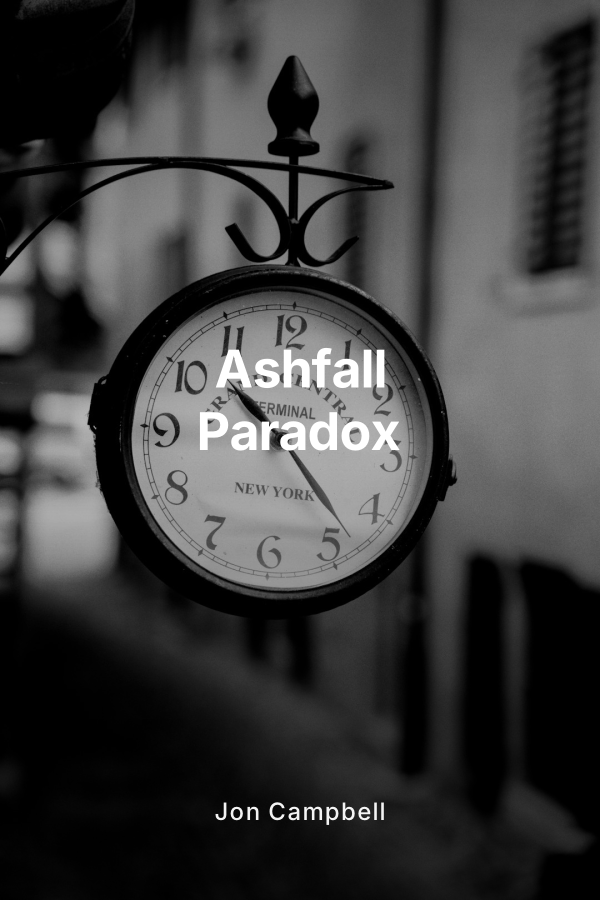
In the late 2020s, physicist David Rockwell has one obsession: a black box of anomalous sensor data silently recorded above the Nevada desert before a classified aerospace test disintegrated in a brief artificial aurora and a falling fireball. The official record describes a routine failure in solar-approach testing. The raw telemetry tells a different story, one that should be physically impossible in standard cosmology: gravitational phase noise, nonlocal correlations stretching backward along the test vehicle’s trajectory, and a coherent, human voice encoded in thermal background hiss.
The voice repeats a short, desperate warning in fractured English that appears to be speaking across spacetime to David himself.
From his post in 2030, working on advanced solar insertion and heliophysics analytics, David reconstructs the failure frame by frame. He discovers that the doomed testcraft briefly occupied a region of distorted metric shear, as if local spacetime had been pulled thin and then snapped back. Deep pattern analysis reveals signatures that cannot be reconciled with known general relativity. More troubling still, hidden in the interference, his algorithms keep converging on a proper name and a date: Virginia City, 1870.
Paranoid, brilliant, and quietly grieving a stalled marriage and a disintegrating relationship with his reckless younger brother Lorne, David begins to suspect that the incident was not an accident in experimental propulsion, but a side effect of a deeper and older intervention. As he digs, he encounters the only other person who believes the anomaly is real: an obscure warning scientist whose theoretical work on closed timelike geometries and cosmological boundary conditions was buried by defense contractors years ago.
Together they explore a radical model of the universe in which time travel is not a traversal through a fixed history but a constrained rewrite of a causally entangled frontier. In this framework, “past” and “future” are emergent bookkeeping devices of an underlying global solution. Local edits are possible, but every intervention sends compensating ripples across the entire manifold. The cosmos always reoptimizes for self-consistency. Human agency does not vanish, but it is channeled into narrow corridors where choice and inevitability collide.
Then the anomaly returns.
A second classified test, incorporating quiet corrections based on David’s recommendations, enters solar-approach phase and once again triggers impossible data: transient cosmic background shifts, local vacuum fluctuations, and, emerging from noise like a distant radio sermon, the cadence of a nineteenth century preacher.
Without warning, the vehicle is torn out of conventional spacetime. For an instant, David shares its reference frame. The lab around him disintegrates in a wash of white geometry, and gravity collapses into a kaleidoscope of skewed axes. When the world reforms, he is face down in alkaline dust under a vast Nevada sky that should not be this clean, this quiet, or this devoid of contrails and orbital glints.
It is 1870 in the Great Basin. The only fireball over the desert is the lingering trail of the experiment that ripped him out of his life.
The book follows David as he staggers into the raw, metallic frenzy of Virginia City during the silver boom. He is a stranger with an impossible accent, inexplicable knowledge of celestial mechanics, and a head full of equations several generations ahead of Maxwell. His wrist implants and augmented interfaces are dead in this low-tech past. His only remaining asset is his memory and a mind disciplined in systems thinking.
He quickly discovers that his arrival is not a random misplacement but the center of a closed causal loop. The town is already haunted by a figure whose name appears in David’s corrupted telemetry: Theo, a local physician and reluctant preacher wrestling with the collision between frontier superstition and emerging scientific modernity. Theo runs a small medical practice and occasionally occupies the pulpit of a weathered church. He talks of providence in the language of probability and causality, infuriating traditionalists while quietly attracting miners and outcasts who sense that something in the world has shifted.
Theo has been seeing things. In his dreams and in brief waking flashes, he perceives diagrams of orbital mechanics, nervous system schematics rendered in metallic clarity, and strange towers scraping a sky slashed by artificial satellites. He believes these visions are spiritual. David recognizes them as distorted reflections of his own century.
Their meeting is the novel’s first hinge. David realizes that Theo is the true origin of the anomaly in his 2030 data. Theo, in turn, begins to suspect that David is the living answer to an unanswered prayer. Between them stands a hostile community that reads any deviation from its fragile consensus as a threat. Miners whisper about unnatural lights above the desert. A sheriff worried about outbreaks of violence listens too closely. A local magnate smells opportunity in any new technology that might squeeze a little more ore from exhausted veins.
As David struggles to survive in the nineteenth century, he must also solve a planetary-level problem. In his own timeline, the orbit of Earth is subtly unstable, perturbed by a chain of marginal industrial decisions and cumulative climate engineering that never quite respected planetary feedbacks. Heliophysical models in 2030 hinted at a catastrophic event generations later: a resonance cascade that would push Earth into a chaotic dance with the Sun, ending in surface sterilization. The solar-approach experiments were part of an aggressive program to understand and, if necessary, blunt those forces.
The Virginia City anomaly reveals that someone, sometime, already tried to edit history to avert that distant calamity. The attempt refracted through spacetime, capturing David as unintended fallout. Now trapped in 1870, he faces a brutal calculus. If he does nothing, the future he left will unfold unaltered, including the seeds of planetary instability. If he acts too aggressively, he risks breaking the fragile constraints of the temporal manifold and inviting paradoxes that the cosmos will resolve with ruthless efficiency.
The heart of the book is the evolving collaboration between David and Theo. Theo’s theology has always flirted with a vision of God as the boundary condition of the universe: not an intervening agent within time, but the governing equation that holds the cosmic solution together. Through David’s explanations of relativity and quantum field theory, Theo finds language to refine that intuition. Providence becomes, in their shared vocabulary, an emergent feature of a globally self-consistent spacetime, one in which human choice is genuine but never unconstrained.
Their conversations are threaded through immediate physical stakes. A sermon against mob justice collides with a lynch-hungry crowd. A mining accident exposes systemic negligence, forcing David to reveal just enough advanced medical knowledge to save lives without appearing supernatural. Each success binds him deeper into the town’s story, weaving his presence into the fabric of history he is not supposed to disturb.
As pressure builds, an anonymous antagonist emerges. Someone in Virginia City has intercepted fragments of David’s improvised devices and sketches, reverse engineering them into crude prototypes. The resulting hybrid machines are glorified toys by 2030 standards, but in 1870 they represent a technological singularity in miniature. Telegraph lines carry more than Morse code. Steam engines begin to flirt with thermodynamic edge cases. Rumors circulate of a secret workshop where impossible experiments spark in the dark.
This local adversary is not a villain in the traditional sense but a foil whose ambition and rationalism mirror David’s own. He believes that technology is neutral and that any leap forward, no matter how abrupt, is inherently good. David, haunted by the planetary consequences of his own century’s arrogance, knows better. Their conflict illustrates a core theme: the ethical dimension of knowledge deployment across time.
The overarching speculative engine of the narrative is the temporal physics model that binds 1870 and 2030 into a single problem. The book explores ideas such as:
• Global self-consistency constraints as a kind of mathematical providence, shaping which timelines can exist.
• Causality as an emergent pattern from a deeper atemporal structure, with human experiences of “before” and “after” embedded within a four dimensional manifold.
• Information as the true conserved quantity across rewritten histories, with the universe favoring timelines that minimize paradox by preserving informational integrity even as events shift.
• The possibility that prayer, intuition, and prophetic dreams are misinterpreted human interfaces with that global structure, weak redundant signals emitted by a cosmos perpetually solving for self-consistency.
Throughout, David is forced into choices that test his beliefs. He does not share Theo’s faith, yet he cannot deny that the past appears to have been arranged to force an encounter between his scientific skepticism and Theo’s fierce, rational spirituality. When he discovers evidence that Theo’s family line may be the hidden origin of a twenty first century research foundation, quietly funding the very program that will eventually fling David into the past, the loop sharpens to a point. Their actions in 1870 will retroactively seed the institutions that send David back to 1870.
The book’s climax unfolds across two planes. In Virginia City, tensions erupt into open violence as the secret technological tinkering backfires, triggering a localized disaster that threatens to tear the town apart. A jury rigged generator built from David’s discarded designs goes unstable, creating a small scale metric anomaly identical in signature to the 2030 test failure. Gravity flickers. Time fractures. For a few terrifying minutes, the town becomes a laboratory in uncontrolled temporal physics.
Simultaneously, in the far future of the reconfigured timeline, an alternate version of David’s 2030 universe struggles to interpret a series of “ghost” measurements from the 1870 event. In sparse interludes, we glimpse analysts and scientists trying to reconstruct what happened from fragmentary data. These scenes, however, are rendered obliquely, filtered through David’s own evolving understanding. The book never fully steps outside his perspective, preserving the uncertainty of whether those future scientists are his original colleagues or altered descendants of a history he has already changed.
As the Virginia City anomaly spirals, David faces his final decision. He can attempt to ride the instability back to 2030, abandoning Theo and the town but perhaps returning with knowledge to engineer a more controlled intervention. Or he can help Theo stabilize the local event, binding the causal loop closed and accepting permanent exile in a past that will no longer be the same past he studied.
Theo argues, in language that fuses liturgy and physics, that the universe itself is inviting a particular choice. Not a coerced decision, but a path of least contradiction in which David’s sacrifice becomes the pivot on which a gentler future can turn. If David stays, they can encode subtle yet durable changes into the fabric of society and science. They can inspire institutions that will, generations later, approach planetary engineering with humility rather than hubris. They can leave behind not a leap to star drives, but an early, quiet insistence on systems thinking, ethical constraints, and reverence for the planetary system as an integrated, fragile engine.
The resolution is deliberately understated. The immediate crisis is contained, but at cost. The makeshift generator is destroyed. The antagonist survives, chastened and forever changed by a glimpse of powers he can never fully control. David remains in 1870, accepting a new identity at Theo’s side. Together they begin work on projects that seem small to the world around them: a clinic that emphasizes preventative care and data keeping, a school that teaches miners’ children to think in terms of feedback loops and long term consequences, a humble institute whose pamphlets whisper about stewardship of Earth as a shared vessel in a delicate orbit.
In the concluding pages, the narrative jumps forward. David, decades older, steps out of a refurbished church that now also houses a modest research library. Above him, in a subtly altered sky, orbital infrastructure gleams more cleanly than he remembers. The cross atop the building has been carefully reworked into an abstract intersection of axes, equally suggestive of coordinate systems and sacramental symbols. Across town, a medical institute bears a familiar family name, its logo echoing a phrase Theo once used. The world is recognizably his, yet softened at the edges, as if someone had gently perturbed key variables long ago.
We are left with the suggestion, not the assertion, that the catastrophic orbital resonance of David’s original timeline has been averted or delayed. The planet appears more carefully gardene. Hints of alternative technologies, more in harmony with long term stability, peek through the background. Yet no narrative voice confirms this. The universe remains opaque, its equations partially glimpsed but never fully solved.
Ashfall Paradox is ultimately a story about responsibility in a universe that may already be written and yet still demands choices. It fuses speculative temporal physics with a nuanced exploration of faith without resorting to caricature. David’s journey from detached analyst to embedded moral agent, and Theo’s evolution from local oddity to quiet architect of a new intellectual tradition, unfold against a rigorously imagined backdrop of nineteenth century frontier life and twenty first century heliophysical science.
Structured in five chapters that expand from intimate scenes to planetary stakes, the book will alternate between the immediacy of gunpowder and sermons and the abstraction of tensor calculus and cosmological integrals. Each chapter adds a new layer: the mystery of the black box and the fireball, the shock of displacement into 1870, the alliance and conflict between science and faith in a raw mining town, the ethical crisis of unintended technological acceleration, and the final acceptance of a role in a self consistent yet still profoundly open cosmos.
In this fusion of technical futurism and historical grit, Ashfall Paradox challenges readers to reconsider what it means to change the world when the universe itself might be resisting contradiction, yet quietly encouraging transformation along paths that honor both physical law and human conscience.