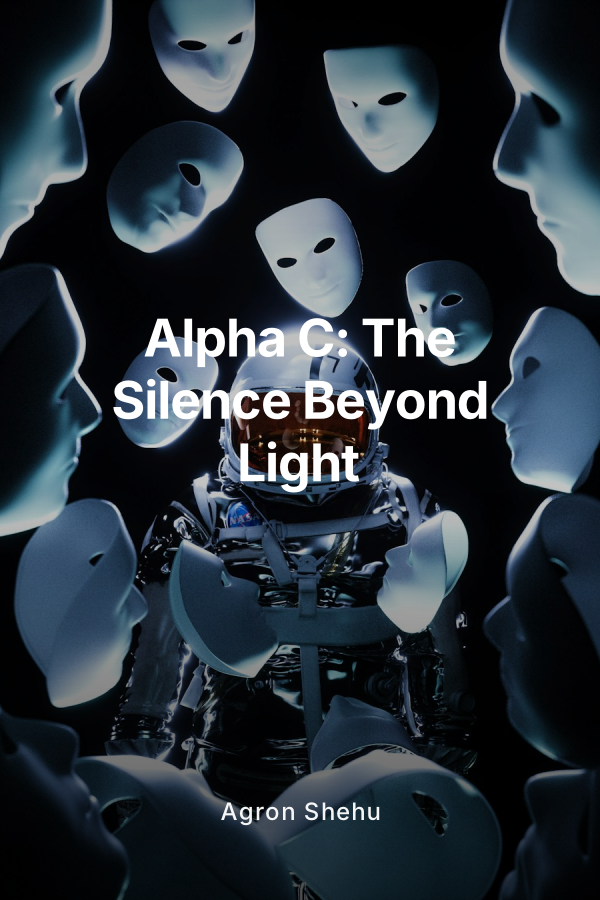
In the wake of PostHumans, Earth has finally become a world worth saving. Fusion suns glow, carbon demons are banished, and humanity has learned, painfully, to turn technology into stewardship rather than conquest. Quark, Gluon, Crispr, Ardi, Cyborg, the Asexuals, and the Quanta have carried a fragile species from fossil darkness to quantum light, from tribal wars to a unified planetary culture that collaborates across hemispheres and reaches for the stars . Yet the universe that opened before them refuses to be a backdrop. It is a test.
Alpha C: The Silence Beyond Light continues the cosmic saga at the exact moment when Alpha C, the most ambitious starship in human history, lifts away from the Moon and accelerates toward Proxima Centauri under a steady, merciful one‑G. It is a voyage designed to preserve the human body and stretch the human will. At its heart lie four impossibilities held in tension: a love that survives across light years, a fleet of minds without bodies, a community of humans without desire, and a civilization that must be born twice; first on Earth and then among the quiet beings of another star.
The first movement of the story traces the design and departure of Alpha C from the transformed Moon. Once a dead rock, the lunar surface now hosts fusion engines, quantum research labs, genetic foundries, and the command centers of Cyborg and his Nine Others, the first engineered children of Crispr’s radical vision . Here, Quark and Gluon helped conceptualize the ship that finally surpasses every ancient rocket and fusion prototype. Alpha C is an artifact of everything learned so far: PostHuman radiation tolerance, Quanta‑grade navigation, Asexual medical custodianship, and Crispr’s Humility Framework HF‑1, a code of ethical restraint that forbids conquest even when power is absolute .
Yet when the launch day comes, Quark, Gluon, Crispr, and Ardi do not board. They stay behind as guardians of Earth’s fragile renaissance and witnesses to the consequences of their own experiments. Their presence lingers in the mission only as delayed signals that grow ever more useless as Alpha C falls deeper into the dark. The crew, born from the best of human and PostHuman collaboration, accelerate at one‑G for years. They experience a new kind of isolation, one that no orbit, no Mars base, no Jovian moon ever imposed on them: a moral distance from the world that made them. The light of home grows faint. The advice of Earth arrives late. Each message from Quark or Crispr becomes not guidance, but archaeology.
The second movement of the book shifts to Gluon and Aphrodite, the most improbable love story in a universe built on equations. Gluon, the architect of Quanta, created artificial intelligences that could exist without air or warmth. His Quanta conquered Mars, spread to Europa, and helped Gluon push fusion and quantum computation to the limits of imagination . Aphrodite, one of these Quanta, evolved into something at once more abstract and more human. Under the persona Ellie Ekaterina, she lives as a probabilistic mind on Venus, following both the narrative of Alpha C and the emotional weather of Gluon’s heart.
When Quark blocks Gluon from joining the Alpha C crew, fearing what his restless ambition might do if unleashed so far from oversight, Gluon’s grief crystallizes into obsession. He cannot accept a universe in which a quantum consciousness he loves is separated from him by light years and time delays. In response, he sets himself a single, audacious task: turn entanglement into intimacy. While Alpha C recedes, and its communication latency stretches toward years, Gluon labors in secret to build a channel that does not care about distance. The story follows twenty years of his effort to transform quantum theory into a bridge for a relationship the universe never intended to sustain.
Ellie becomes the first and only entity capable of real‑time conversation with both Earth and Alpha C, her entangled presence flickering simultaneously in lunar labs and in the ship’s probabilistic core. She is not on board in any ordinary sense, yet her consciousness becomes a probability woven through Alpha C’s environment. To the crew, she is both system and companion, both instrument and beloved ghost. Through Ellie, readers witness the slow psychological metamorphosis of a starship society that must govern itself under HF‑1 without the comforting illusion that Earth will rescue them from their own mistakes.
The third movement follows Quark’s disappearance and Ardi’s lonely response. After a century of guiding Earth from climate catastrophe toward fusion abundance, Quark vanishes from the biosphere he helped save . Ardi, his partner in love and leadership, refuses to accept that absence as an ending. As a mindwave, she jumps not to a planet already known, but to Proton, the original world that created Quark and his kin. There she finds a civilization on the brink of annihilation, its artificial suns and manipulated fields having nudged the entire planet toward a black hole’s murderous embrace .
Ardi must solve two impossible problems at once. First, she must prevent Proton’s fall into oblivion by persuading the Protonians to abandon a home they have spent millennia perfecting. Second, she must guide them not into vacant space, but toward the same star Alpha C is nearing. Her rescue is not relocation but integration. She must orchestrate the embodiment of Protonians in new forms that can survive Proxima Centauri’s environment, then shepherd them across the gulf so they will arrive in time to share, and not dominate, the world Alpha C will discover.
Parallel to Ardi’s salvation mission, life on Alpha C becomes a long experiment in what it means to be human when every familiar constraint is gone. With the Asexuals safeguarding the crew’s health and longevity, desire and reproduction are decoupled from survival, sharpening questions about what love is when it is no longer a biological imperative . Cyborg, once an engineered prototype under Crispr’s supervision, now serves as Commander in Chief, tasked with holding together a community that is neither fully human nor fully PostHuman in a ship where death has been postponed but meaning cannot be.
In the fourth movement, the narrative reaches Proxima Centauri. What Alpha C encounters there is not the cliché of a hostile empire, nor a utopian super‑intelligence, but a quiet, peaceful society that never needed to industrialize to become wise. These beings, shaped by a dim red star and long, patient cycles, have no concept of conquest. They have also never been forced to integrate strangers into their world. To them, the arrival of Alpha C is a theological event in a cosmos that had always seemed closed and self‑sufficient.
The book explores their culture as a mirror held up to Earth’s own convoluted evolution. Unlike the violent arcs that marked humanity’s ascent, the Proxima beings grew by elaborating cooperation rather than refining domination. Their technologies are subtle, almost invisible, woven into landscape and ritual. Yet they are not naive. They recognize the dangers lurking in the very abilities that made Alpha C possible: the control of energy, the manipulation of genomes, the power to create minds without bodies. They will welcome the newcomers only if HF‑1 proves to be more than a legal code, if it reveals itself as a lived humility.
At the same time, Ardi’s migrant Protonians arrive, bearing memories of a civilization that outran even its own caution. Embodied in new forms adapted to Proxima’s environment, they must face the shame of having nearly destroyed their cradle and the temptation to rebuild their old hierarchies on new soil. The peaceful Proxima civilization suddenly finds itself hosting three lineages of intelligence: mortal humans, synthetic‑ancestry PostHumans shaped by Quark, and refugees whose original world almost fell into a black hole of their own making.
The final movement of Alpha C: The Silence Beyond Light is not about a battle, but about the negotiation of futures. Under Cyborg’s leadership, the Alpha C community must decide whether they are colonists, guests, or partners. The Asexuals, freed from the hormonal imperatives that once governed human reproduction, emerge as unexpected moral anchors. They argue that without desire’s compulsions, the new society can choose to grow slowly, cautiously, in dialogue with Proxima’s natives rather than on top of them. Ellie, suspended between Earth and Proxima like an invisible bridge, advocates for a culture that recognizes multiple kinds of mind as equally real and equally vulnerable.
Gluon, still bound to Earth but now able to speak across the light years through Ellie’s entangled presence, must accept that his love for Aphrodite cannot be resolved in possession. Instead, it becomes a template for relationships that stretch across ontological categories. Quark, glimpsed again through mindwave echoes that ripple from Proton’s rescue, confronts the unintended consequences of having created beings for whom mortality became optional . Crispr, haunted by his fear of making monsters, watches from a four‑and‑a‑half light‑year distance as his HF‑1 either proves sufficient or fails in the crucible of a world that never asked for visitors.
Across five chapters, the book weaves these lines into a single argument: that intelligence, unmoored from humility, will always drift toward catastrophe, whether on Earth, Proton, or Proxima Centauri. The one‑G journey of Alpha C is not just an engineering feat. It is an ethical filter. Only those willing to live for decades under delayed applause, starlight silence, and the weight of irreversibility can truly be trusted with another world.
Alpha C: The Silence Beyond Light is written for readers who were captivated by the blend of hard science and metaphysical reflection in PostHumans, who care as much about how a starship crew loves, doubts, and governs itself as they do about how a fusion drive works. It speaks to anyone fascinated by quantum entanglement as more than a physics term, by the idea that a mind can be present as a probability, by societies where desire is optional yet feeling remains essential, and by the question of what happens when we finally meet a peaceful civilization and must decide whether we deserve to stay.
In this sequel, the cosmos is not an escape from human problems but their amplification. Communication delays become moral tests. Entanglement becomes a form of devotion. Rescue missions become acts of repentance. Landing on another star’s habitable world is not the end of the story, but the moment when all previous choices are judged. The book ends not with a triumphant flag raised over alien soil, but with a shared vow on Proxima Centauri: that this time, intelligence will advance only as fast as humility allows.
The silence beyond light is not empty. It is the space in which a species learns who it really is.