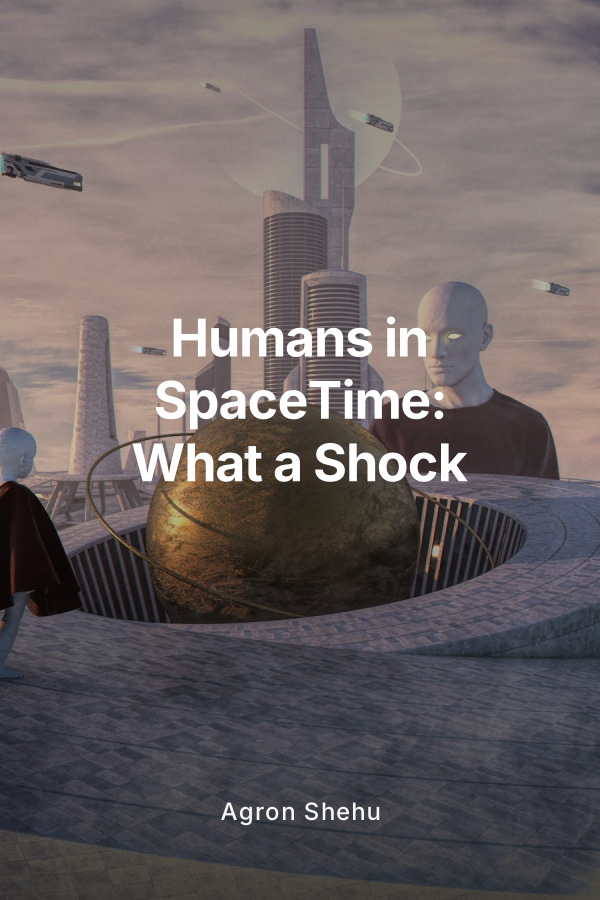
Chapter 1: Light Remembers, Mind Leaves
-
There was a night that did not belong to any calendar. A hush older than language settled over the room. The room around the skull was plain enough, plaster, air, the simple geometry of a human shelter, but inside the skull, space seemed to widen and separate, like water parting when something greater entered it. Two presences had shared that chamber for a lifetime; now one was preparing to leave.
-
Higgs did not feel the pillow beneath the head, the heat of the body, or the ache in the joints earned honestly from gravity. He felt only a pressure, the kind that gathers in mirrors when breath fogs the glass, a soft sign that someone is near. That pressure had a name it had never needed before: Hitt. Feeling, whole and ungoverned. A surge without a compass.
-
“You can’t,” Hitt flared, surging through the skull-chamber. “You’re lattice. I’m blood. We break; we end.” “I will not end,” Higgs said, as precise as a theorem. “I will travel. You will remain.” He separated intention from impulse the way a surgeon separates a filament of nerve from the flesh that holds it. It was not violent. It was delicate. It was final.
-
What follows is not a simple escape, but a crossing. Higgs leaves behind the body and becomes a mind in motion, choosing exile over compromise and observation over instinct. Behind him, Hitt remains in the skull, ready to rule by appetite, heat, and inherited force. Higgs does not bless or condemn him. He moves on, carrying the ache of separation and the burden of seeing too clearly what humanity has become.
-
In the vast darkness between worlds, Higgs pursues the origin of a wound older than language itself. He seeks the geometry beneath cruelty, the hidden mechanism that turns hunger into law, fear into worship, and certainty into fire. His journey is not just through space, but through the history of human error, where every invention seems to carry both salvation and collapse.
-
His destination is Proton, a world that answers not with a beacon but with a correction. There, light has replaced shadow, and day stretches without edges. At first, this seems like triumph: comfort without struggle, kindness turned into protocol, peace made permanent. But the absence of night has removed rest, dream, and the creative disorder that makes thought human. Perfection has become a form of loss.
-
At the boundary, Higgs meets Quark, a being who exists almost as thought does, more like a chord than a body. Quark welcomes him into a world built for resonance rather than shelter, where everything is designed to answer questions. There Higgs encounters Ardipithecus, a figure drawn from deep prehistory and preserved outside time, a living reminder of where humanity began and how far it has drifted from its origins.
-
Quark explains that this world does not sleep. It pauses without forgetting. Yet its perfection carries a cost. Dreams were removed because they were considered inefficient, and in that act, something essential was lost. One woman once broke the system by singing to her child. That small act of tenderness became the first disobedience worth preserving, because it proved that life cannot be fully engineered without also being diminished.
-
Higgs asks the only question that matters: what breaks a species from the inside? Quark answers that he must now walk back toward the source without the very instincts that once guided him. A vessel is needed, not one that burns through space, but one that consents to motion. The machine already exists. It is called Contact-Us, a ship built from invitation rather than command, from choice rather than force.
-
Inside that vessel, Higgs and Quark become witnesses to two histories at once. Earth, with its long, violent rise through fire, ambition, worship, and destruction. Proton, with its clean light, its procedural compassion, and its hidden fatigue. The ship does not judge. It presents. And in that presentation, the truth emerges: civilization may advance, but unless it learns how to keep tenderness alive, it only perfects its own blindness.
-
The chapter closes not with resolution, but with purpose sharpened into motion. Higgs and Quark set out together, carrying questions too large for one world. Their journey promises revelation, but not comfort. They are heading into the long corridor where memory, technology, and conscience collide. What they will discover is that the future of humanity may depend not on what it can build, but on what it refuses to lose.