In a shipping warehouse in central California, Leo is thinking about overtime pay and the ache in his shoulders when the world as he knows it vanishes. One moment, steel racking towers over him and forklifts complain in reverse somewhere behind his back. The next, the building, the city, and every artifact of human progress dissolve into blinding absence.
The pallet of toaster ovens still presses against his gloved hands. His hard hat sits on his head, his worn boots still pinch his toes, and his phone and multitool ride heavily in his pockets. Around him in the raw late afternoon light, dazed coworkers stand in loose clusters on a landscape of scrub and pale hills where concrete and asphalt once sprawled. Every road, line, wire, and machine has disappeared. The only things left in the world that human hands have made are those they were wearing or clinging to when everything else fell away.
Leo has always believed that the only person he can truly rely on is himself. The cold distance of his childhood taught him that reliance on others was a luxury, and that safety meant staying inward, keeping his own counsel. So when panic breaks across the scattered survivors, his first instinct is not to organize or comfort. It is to count what he owns, measure what he can protect, and slip sideways out of the confusion before anyone has the chance to see his small advantage and ask him to share it.
This novel follows what happens when a modern world built over centuries collapses in a single, inexplicable instant. The disappearance is total and unforgiving. No cities on the horizon, no distant aircraft carving their careful paths across the sky, no hum of power lines in the wind. Even the satellites that once circled above have ceased to exist. Human beings stand in clothing suddenly precious, shoes now irreplaceable, jewelry turned to wealth and liability at once. Their phones light up with dead networks, screens that are only mirrors of a world that can no longer hold what they were designed to reach.
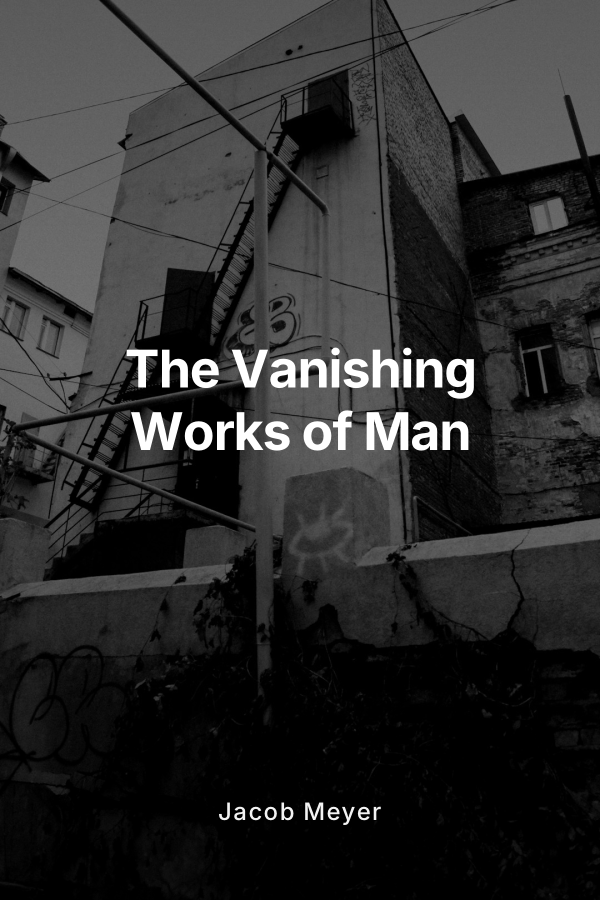
The Vanishing Works of Man is a story of the slow rearrangement that follows, of what grows in the clearing left behind when every machine and structure disappears. It is a narrative rooted in the texture of survival. Fire without lighters or stoves. Water without pipes or taps. Shelter without lumber or nails. It is about the terrifying brilliance of bare necessity and the fragile, shifting rules that form when nothing but flesh, will, and memory remain.
Alone at first, Leo peels away from his coworkers and drifts toward the scrubby hills. He does not trust the panicked crowds. He can feel the hunger that will come when the sun dips and the first night arrives over a world stripped of its comforts. His pockets hold a multitool whose cheap metal has suddenly become priceless, a phone that is little more than a flashlight and a dead camera, a hard hat that feels absurd and necessary both. He is prepared, in his limited way, more so than the barefoot office worker clutching her designer shoes or the warehouse temp in thin canvas sneakers. That small edge feeds his instinct to keep moving, alone.
Yet the new world resists solitude. In the quiet of the unfamiliar hills, Leo crosses paths with Maya, a recent college graduate and weekend hiker who had been on a nearby trail when the event struck. She carries nothing but the clothes on her back, a pair of sturdy boots, and a daypack that has vanished from her shoulders as completely as the town has from the horizon. Maya is not a hardened survivalist, but she knows the lay of the land, reads the sky, and can find her direction in the slow fall of shadows. She is, above all, stubbornly kind in a way that unsettles Leo, because kindness now looks to him like an open wound.
The partnership that forms between them is reluctant, then necessary. Leo wants distance and control. Maya wants to help the people they stumble upon in the first bewildered hours, the ones clutching the last of their man made possessions like talismans. Between them lies a growing tension over what survival will require in this emptied world. Do they owe anything to the strangers who cry out for water that no longer runs, for tools that no longer exist, for a past that cannot be recovered? Or is the only rational path to build a small, secret life far from the chaos, to trust no one and reveal nothing?
Their early challenges are painfully concrete. The earth has not disappeared. Grass still grows. Trees still cast their shade. The river still carves its cold channel through the hills, glittering beneath the sun. Yet all the means of mastering, bending, and transporting that water are gone. To drink safely, they must improvise. To stay warm and dry, they must learn to shape shelter from branches and stone, to line sleeping spaces against moisture, to understand the shape of wind and slope.
Most of the knowledge the old world contained vanished with the books that were not in anyone’s hands. Yet some fragments survive. When Leo and Maya meet Elias, a former librarian who was walking home with an armful of volumes when the air around him detonated into absence, they encounter not a man of practical skill but of memory and ink. His fingers know the texture of pages. His mind holds the structure of indexes, the familiarity of spines. In his surviving books live line drawings of edible plants, instructions for caring for animals, diagrams of simple tools that no one can build anymore because there are no nails, no cordage, no metal beyond what they wear and carry.
Elias offers them knowledge in trade for protection. He is gentle, a little clumsy, and wholly unsuited to sleeping on hard ground, yet his presence expands the horizon of possibility. Through him they learn to look at the scrub and scattered trees not as a hostile emptiness, but as a library of sorts waiting to be read with new eyes. Bark that can be stripped and braided into cord. Branches shaped into frames. Mud that can be dried into crude vessels. His guidance is imperfect and often betrayed by the difference between theory and reality, but it gives their struggle shape, something like a plan.
From these beginnings, a small, hidden community starts to coalesce. The three of them push deeper into the hills, avoiding the gathering knots of desperate people who have begun to clash over water and whatever edible plants can be found. They move until they find a rocky outcropping that overlooks a bend in the river. The climb to reach it is steep and treacherous, a natural defense. From that height, they can see anyone approaching along the bank long before they draw near. The rocks provide overhangs against the weather, crevices where supplies can be stashed, and vantage points for watchful eyes.
Here, Leo and Maya begin to imagine more than a single night survived. With Elias’s help, they talk in low voices about roles, tasks, and rules. There is no formal charter, only a sense of what must be done if their fragile shelter is to become a home. Someone must always be watching. No one may hoard without sharing. Food and water are divided as fairly as the day allows. They will accept only those whom they believe will not jeopardize their safety, and even then, with caution. Above all, their location must remain secret from anyone who might see their modest security as a prize to be taken.
It is this rule that bends and nearly breaks when they stumble upon a small family in the drainage of a dry creek, half hidden by thistle and fear. A mother, a father, and a child. Footsore, thirsty, and wearing clothes already fraying at the seams. Maya cannot walk away. Leo wants to, feels the argument rising in his throat, sharp with images of dwindling food and encroaching danger. The woman’s compassion clashes with his pragmatism in a way that exposes every fracture between them. In the end, he relents. They lead the family back to the rocky refuge, knowing they are bringing risk through their own door.
That risk takes form in the figure of a drifter who has followed the family’s trail at a distance, drawn not by care but by the scent of opportunity. His arrival shatters the illusion that they can remain invisible simply by wanting it. In the shadowed tangle below their outcrop, a kidnapping attempt on the child splits open the group’s understanding of what it means to be safe. In the brutal seconds that follow, Leo discovers that he is capable of taking a life to protect people who were, only days ago, strangers to him. The act surprises him more deeply than it horrifies him. Rage and fear knot together and leave him staring at his own hands as if they belong to someone else.
In the aftermath, his instinct is to redouble their isolation. He argues that the family should never have been taken in, that every new mouth and every story from the outside world are threads that might lead predators straight to their door. Yet survival is now a collective project. Maya and Elias push back, quietly, persistently. Over time, the tiny group settles into a rhythm of shared work. Some gather food and experiment with crude trapping. Others refine shelters, reinforce paths, and search for edible plants with Elias’s books open between their knees. Small crafted goods appear through trial and error rope woven from plant fibers, rough containers hardened in charcoal tinged fire, lengths of sharpened wood ground smooth against stone.
As seasons turn, the harsh immediacy of day to day survival loosens enough to reveal a horizon beyond bare endurance. They begin to think in terms of stockpiles and seasons, of small herds that might one day be coaxed into domestication, of the possibility of planting seeds if any can be found. Meat from their hunting and trapping, knowledge distilled from Elias’s books, and simple crafted objects become their first currencies. These goods allow them not only to live, but to consider the dangerous possibility of exchange.
The wider world, such as it is, has not been idle. In the lowlands, where the hill shadows give way to broader plains, other survivors have banded together into more visible, ambitious communities. One such settlement grows around the remnants of an old river crossing, marked now only by beaten paths and a natural ford. It is held together by the force of a charismatic leader whose warmth makes him immediately likable. He speaks of shared strength, of rebuilding something better out of the ashes of the old world, of unity in the face of the unknown that took everything else away.
When a band of travelers from this larger settlement hears rumors of a hidden group trading meat and knowledge at neutral ground near the river, curiosity and opportunity converge. Leo and his companions are drawn into a cautious dance of trade. They bring their smoked meat, their woven cord, their carefully gathered information about foraging and water sources. In return, they receive news of other bands, of conflicts and territories, and of the slowly forming web of new human ties lacing the empty landscape.
Leo insists on strict boundaries. Meetings take place at neutral sites far from the rocky outcrop. Their true numbers remain obscured. They reveal nothing about their defensible position in the hills. He fears that any weakness or abundance they show will mark them as a target. The charismatic leader of the larger settlement meets him with outstretched hands and easy laughter. He offers generous trades, speaks in inclusive terms about everyone in this new world belonging to one community, gently probes for details about their camp. His gaze lingers, curious rather than crude, on Maya and on Elias, the man of books, as potential assets.
The offer that follows is as flattering as it is unsettling. The larger settlement proposes that Leo’s group merge with them, combining resources, skills, and people. In return, they promise greater safety, more hands to share the work, a stronger defense against bandits and desperate, roaming clusters of the displaced. To some in Leo’s camp, especially the family he risked so much to protect, the idea of thick walls of human bodies and regular meals is tempting. To Leo, it feels like a slow surrender of the very independence that has allowed them to survive this far.
Their negotiations become the crucible in which Leo’s reluctant leadership is fully forged. He finds himself sitting across from a man whose charm wraps around conversations like smoke, whose vision for the future is expansive and absorbing. Leo must decide how much to trust, how much to yield, and what lines he refuses to cross. In these exchanges, he is surprised to see his own people watching him when tempers rise or subtle pressures surface. Their eyes find his face in moments of uncertainty, not because he asked for their faith, but because he earned it in all the small decisions that carried them to this point.
The partial agreement they finally reach is carefully hedged. They will trade on agreed days at known neutral sites. They will offer mutual defense if faced with a common enemy. They will not, for now, merge their camps or surrender their right to move freely. Leo leaves the meeting with the weight of compromise heavy in his chest. The charismatic leader’s smiles and gifts have given nothing away, yet Leo can feel that the man wants more than meat and knowledge. He wants people, territory, influence.
In the quiet that follows their return to the hills, Leo stands once more on the lip of the rocky outcrop and looks down at the river. Below, the water moves with patient indifference, carving its way through stone as it always has. Behind him, voices mingle in tired conversation. The shelters they have built, the rules they have shaped, the rituals of watch, work, and shared meals have woven into something like community. These people, once strangers bound only by catastrophe, have become the closest thing to family he has ever known.
The Vanishing Works of Man charts Leo’s journey from isolated warehouse worker to the hesitant center of a fragile, determined group trying to reimagine life without the invisible scaffolding of human invention. It is a story of ingenuity made visceral through necessity and of the ways people learn, reluctantly and painfully, to trust one another when trust itself feels like a dangerous resource.
At its heart, the book asks how much of the old world’s habits of power, fear, and attachment will seep into what comes next. Can a small, hidden camp remain independent in a landscape where larger forces are already coalescing and reaching for more? Can compassion survive in the same space as the brutality that survival sometimes demands? And what does it cost a guarded man to admit that his survival is no longer his alone, but bound up in the lives of those he once swore he would never need?
By the end of this first arc, readers are left on the edge of a precarious balance. The community in the hills has endured hunger, fear, and bloodshed. They have turned a rocky outcropping into a living place and learned to coax food and security from a world stripped of tools. They have made their first uneasy contact with the broader patchwork of human society reassembling itself. The agreement they have reached is fragile, their independence still intact but no longer unchallenged. Leo stands in the uncomfortable space between isolation and entanglement, knowing that every choice he makes will define not only his own fate, but the shape of the little world he has helped to build out of nothing.