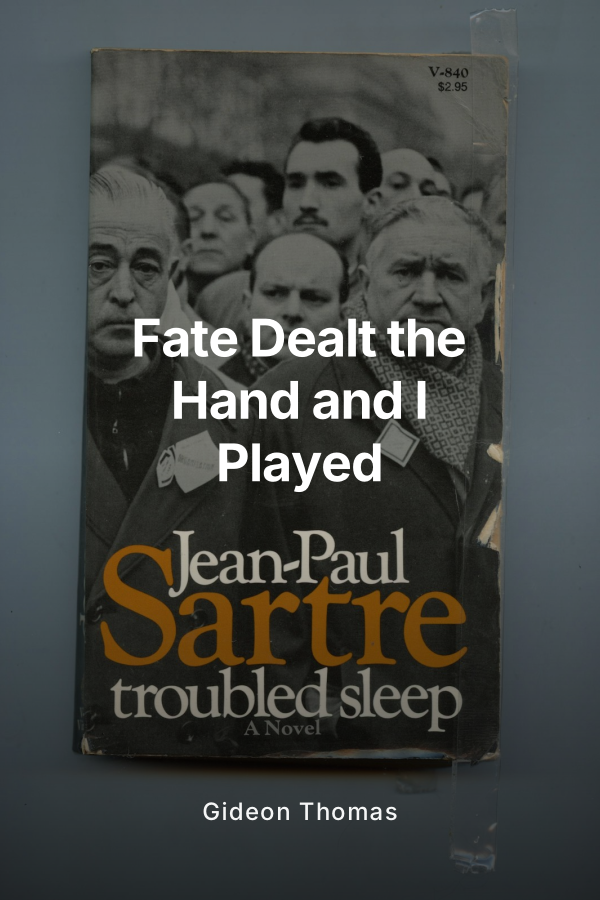
Fate Dealt the Hand and I Played is a clear eyed, quietly powerful memoir that traces the life of a man who had to become his own example. Born on the small Caribbean island of St Vincent and the Grenadines, Gideon grows up in a crowded suburb outside Kingstown, in a house where love is practical, his mother is strict, and his father is distant and sometimes violent. When his father leaves and his mother dies young, childhood ends abruptly. There is no mentor waiting in the wings, no guiding hand. Faced with grief, poverty, and the pull of bad choices, he makes a private decision that will define his life: if he is to become a man of substance, he will have to forge himself.
This is not a story of dramatic declarations. It is a record of what it takes to stand up without support and keep standing. The book follows Gideon from the dusty yards and strict routines of Montrose in St Vincent to the cold streets and cramped terraces of 1960s England, where a fifteen year old boy arrives to meet a father who offers obligation instead of welcome. In that silence, Gideon accepts that no one is coming to rescue him. School and the library become his refuge, and the moral teachings he discovers there help him to shape an inner compass built on restraint, fairness, and quiet strength, even while he is invisible in the world around him.
Across roughly twenty five chapters, the memoir unfolds in four broad movements that mirror a lifetime: Island Foundations, England and the Making of a Man, Love and Fracture, and Illness, Gratitude, and Legacy. Each movement deepens the central question at the heart of the book: how does a man with no model for manhood decide who he will be, and how does he hold that line when life keeps testing it.
Island Foundations explores Gideon’s early years in St Vincent, where the noise of lorries on the main road and the closeness of neighbours form the backdrop to a household held together by his mother’s order and resolve. He witnesses his father strike his mother at the dinner table and feels shame he cannot name. Soon after, his father is gone. A part time job at fourteen and one desperate, foolish theft bring him before a magistrate who warns that a year more in age would have meant prison. This brush with the law brands honesty into him. From that point, he chooses to live cleanly, to earn what he has, and to measure himself by his own actions rather than anyone else’s opinions.
England and the Making of a Man follows Gideon’s emigration to London in 1966. The reunion with his father at Heathrow is transactional rather than tender, and the journey to a small, untidy house confirms what he already suspects: the relationship he imagined across the ocean does not exist. In cold classrooms and quiet libraries, he discovers two crucial truths. First, that solitude can be a source of strength rather than a sentence. Second, that the ideas of dignity, justice, and nonviolence found in the writings of moral leaders can offer a framework for his own code. These influences, which the finished book can attribute properly, help him shape a way of living that refuses bitterness without denying reality.
As he moves into work and adult life, Gideon learns the value of patience, discipline, and self control in factories and offices where he starts again from the bottom and proves himself through quiet consistency. The memoir does not dwell on racism, but it does not ignore it either. It acknowledges the extra weight carried by a black immigrant man in Britain, while keeping the focus on Gideon’s response: to stand straight, to meet expectations, and to refuse to let resentment define him.
Love and Fracture traces his two marriages, fatherhood, and the deepest wounds of his family story. In his first and second marriages, Gideon experiences closeness, joy, betrayal, and loss. The collapse of each marriage brings financial strain, courtrooms, loneliness, and the ache of time away from his children. The seizure of custody after thirteen years of trying to hold a family together feels less like justice and more like punishment for enduring. Yet he refuses to poison Nicola and James against their mother or to let anger speak for him. Survival becomes a matter of discipline: he absorbs the blows and keeps going.
The death of his son James is a sorrow that never fades, an empty chair at every celebration and a silence that shapes his days. Around that grief sits a wider pattern of family fracture. Gideon’s attempts to reconnect with siblings across oceans are met with indifference or actions that deepen old hurts. Their inherited faith, in his eyes, rarely matches their conduct. In pages that are candid but not bitter, he reflects on what it means when religion is used as a shield rather than a bridge, and how he chooses instead to live his values in quiet, practical ways.
Alongside these losses, the memoir charts the growth of a different kind of family. Meeting Gina opens a chapter of steadier love, mutual respect, and partnership. Through years of hard work, shared responsibilities, and simple routines, they build a home where laughter and order coexist. With his children, Nicola and Ben, Gideon adopts the same principle that guided his early years: love is shown more in presence than in speeches. He may not say the words often, but he shows up, provides, listens, and holds standards he hopes will anchor them. Watching them grow into adults, and then parents themselves, becomes one of his deepest quiet joys.
Illness, Gratitude, and Legacy forms the final movement of the book and one of its most distinctive features. In later life, after retirement and years of deliberate care for his health, Gideon is diagnosed with prostate cancer. He chooses surgery, accepts the long term consequences, and then lives almost a decade with clear test results before facing a recurrence and another round of treatment. Just as he believes the hardest chapter may be behind him, a holiday in Tenerife turns into a life threatening bout of sepsis. He deteriorates rapidly, is put into an induced coma, and hovers at the edge of death while his family waits and prays at his bedside.
This chapter of the book is not told by Gideon alone. It becomes a chorus. Gina’s calm, unwavering account of ambulance calls, hospital corridors, and difficult decisions reveals the daily courage of a spouse who refuses to give up. Nicola writes from the perspective of a daughter carrying old memories and fresh fear, threading childhood scenes into present shock. Ben offers both reflection and the raw bullet point notes he kept while his father dreamed and muttered in delirium about empires, court battles, and new beginnings.
By placing these voices alongside his own recollections of illness and recovery, the memoir shows that resilience is never entirely solitary. Gideon’s determination is real, but so is the devotion, patience, and practical love of those who stand beside him when he cannot stand at all. When he returns home, he finds himself changed. Life feels sharper, more precious. Gratitude becomes something he practices in simple ways: in shared meals, grandchildren’s laughter, and the ordinary gift of waking up beside Gina.
The closing chapters look outward again. Having survived cancer and sepsis, Gideon and Gina lean into travel, taking cruises and long driving holidays, visiting the Caribbean, Europe, North America, and the distant landscapes of New Zealand. Movement becomes a way of honouring the time he has been given, proof that joy can follow hardship. Interwoven with these journeys is a quiet thread of spiritual reflection and a sense of personal prophecy, as Gideon considers what his life may still be for and what message he wants to leave behind.
The book ends where it began: with family. In letters to Nicola and Ben and in reflections on grandchildren Olly, Sophie, Maia, and Jasmine, Gideon speaks plainly of pride, regret, and enduring love. He acknowledges that he did not often say the words, but hopes that a lifetime of showing up has already answered the question of whether they were loved. He accepts that some wounds from his own childhood and extended family may never fully heal, yet he refuses to pass that harm forward. What he offers instead is a legacy of steadiness, honesty, and care.
Fate Dealt the Hand and I Played is written for his children and grandchildren, but it speaks to a far wider circle: to anyone who has grown up without guidance, to those who have survived domestic conflict, betrayal, illness, or the quiet ache of being overlooked. It offers no easy slogans. Its power lies in the accumulation of choices made in private: the decision not to repeat harm, not to steal again, not to abandon responsibilities, not to surrender to bitterness, and not to give in when a body fails.
For readers carrying their own unspoken burdens, this memoir offers a companion rather than a lecture. It shows that a life that begins in hardship can still grow into one marked by integrity, tenderness, and purpose. It invites the reader to believe that even when the hand dealt is hard, what matters most is how it is played.