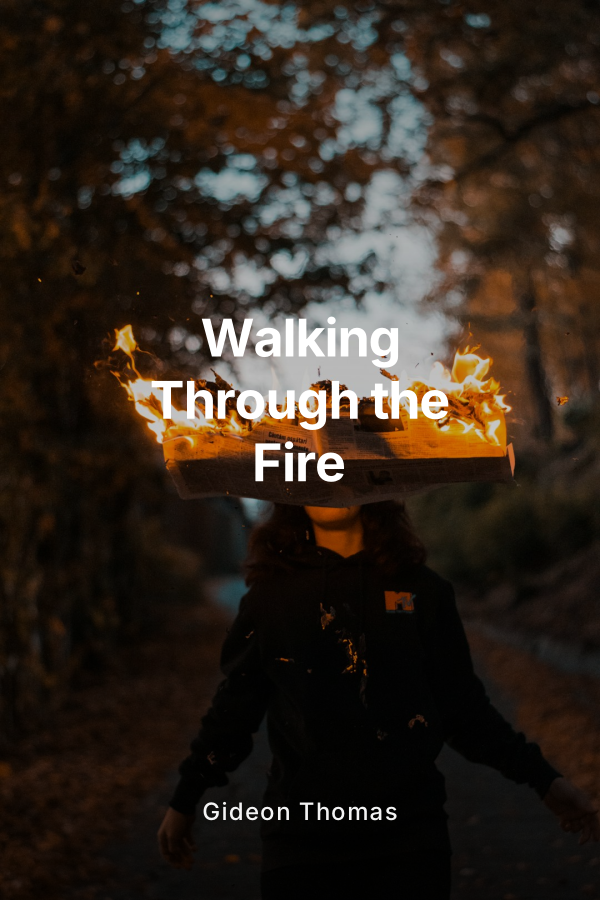
This book is a raw, reflective life story of a boy who began with almost nothing and no one to guide him, yet refused to surrender his dreams. It traces his journey from a tough, uncertain childhood in St. Vincent through emigration, hard work, heartbreak, and serious illness, toward a life built by his own hands and held together by love.
In the early chapters, the reader is taken into a world where safety and certainty are in short supply. There is no mentor, no ready‑made plan for the future, only a deep, stubborn conviction that life can be different. The narrative explores how, in the absence of guidance, a young boy slowly teaches himself how to become a man. Every move is a risk, every decision a leap into the dark. Through long hours, lonely moments, and private promises, he learns discipline, self‑reliance, and the quiet determination that will become the backbone of his life. The story illuminates the grit it takes to keep going when no one is watching and no one is cheering, and how character is forged in the silence between failures and small, unseen victories.
As the boy becomes a young man, he begins building the life he once only imagined. New countries, new jobs, and new responsibilities appear, each demanding more strength and courage. The book charts the hard climb from uncertainty to a degree of stability, and then toward success, but always with an honest look at the price paid along the way. The narrative does not romanticise struggle. It shows how resilience is not a slogan but a series of choices made at 5 a.m., at midnight, and in those long days when it would be easier to simply give up.
Into this hard‑won stability crash two disastrous marriages. These relationships do not just fail; they threaten to break the man himself. The book does not dwell on blame or bitterness. Instead, it examines what it means to hold on to your sense of self when your private world collapses, and how easily a life can slide off the rails even after years of effort. The emotional cost, the financial strain, and the shattering of trust are laid bare. Yet, through it all, the central figure refuses to be defined by disappointment. Each collapse becomes another test of the resilience he began forming as a boy with no guide. Rather than destroy him, these experiences strip his life down to its essentials and quietly prepare him for something unexpected.
That “something” is Gina. When she arrives, it is not in a blaze of drama but as a profound turning point. Fate seems to intervene, but the book makes clear that it is also his own growth that allows him to recognise and receive this new kind of love. Gina is not a saviour in a fairy tale. She is a partner, an anchor, and a witness to both his past scars and his continuing struggles. Their relationship becomes the steady centre of the second half of the book. Through scenes of everyday life, shared laughter, and private battles, the reader sees how love can be both tender and fiercely practical. Gina’s presence reframes his understanding of what partnership can be. She offers not only affection but also a kind of unwavering loyalty that he has never truly known before.
Threaded through this personal journey are his children, Nicola and Ben. The book recounts their place in his story without pretending that fatherhood has been simple or straightforward. He does not present himself as a man of flowery declarations. Instead, he opens up about being a father who shows love through deeds more than words. The reader is invited into holiday trips, weekends together, and small rituals that may have seemed ordinary at the time but, in hindsight, carry deep emotional weight. The two days every two weeks, the shared laughter on trips, the effort to create happiness during limited time together all become his unspoken way of saying “I love you.”
In his unified reply to Nicola and Ben, he finally gives voice to what has mostly lived in action and silence. He explains that every holiday booked, every drive, every meal shared, and every sacrifice made behind the scenes was an expression of love. He hopes they can now see the man behind the father the boy who had to raise himself, the young man who learned to stand alone, and the adult who tried, despite his own wounds and limitations, to give them something better than he had. This reflection is not a plea for sympathy. It is an offering of truth, a way of drawing a clearer line between his past struggles and the imperfect, determined love he has tried to give.
The book also confronts a series of major health crises that nearly end his life. Prostate cancer, sepsis, terrifying episodes in foreign hospitals these are not just medical events but existential turning points. In these chapters the narrative slows down and draws the reader into the vulnerability of a strong man brought low, into the strange mixture of fear, confusion, and fierce will to survive. Each crisis becomes a battlefield where his lifelong resilience is tested more brutally than ever before.
Here, Gina’s importance comes into devastatingly clear focus. Through detailed, grounded scenes the reader sees her at his bedside, arguing for his care, making critical decisions when he cannot, and holding his hand through nights when survival is anything but guaranteed. The book returns again and again to the conviction that he would not have made it through these ordeals without her. Her vigilance, her strength, and her refusal to give up on him become as vital as any medicine. Their love story, which began as a quiet rescue from emotional ruin, evolves into a partnership that literally keeps him alive.
The later chapters weave together all these threads: the boy with no guidance, the self‑made man, the wounded husband, the devoted but often inexpressive father, the gravely ill patient, and the survivor who walks out of hospital with a new understanding of what his life has meant. The reader sees how his early strength, courage, and resilience were not abstract virtues but survival tools that he reshaped, again and again, each time life tried to break him. These qualities help him face not only external hardship but also his own regrets and shortcomings.
By the end of the book, the central figure does not claim perfection or offer neat moral lessons. Instead, he presents his life as it is: complex, flawed, hard‑won, and deeply human. He honours his journey from a child left largely to his own devices to a man who built something solid out of almost nothing. He pays tribute to Gina as the love that steadied and sustained him, to Nicola and Ben as precious parts of a wider story, and to the inner fire that refused to be extinguished even when everything was at risk.
Walking Through the Fire is a memoir of survival and self‑creation, but it is also a love story and a quiet apology, a testament to the power of perseverance and a recognition of the people who stand beside us when our own strength is no longer enough. It speaks to anyone who has ever felt alone at the start of their life, anyone who has weathered failed relationships, serious illness, or the fear of not being enough for their children. Above all, it shows how a man with no map can still find his way, how fate and choice can work together, and how, after so many trials, it is possible to look back and say: I walked through the fire, and I am still here.