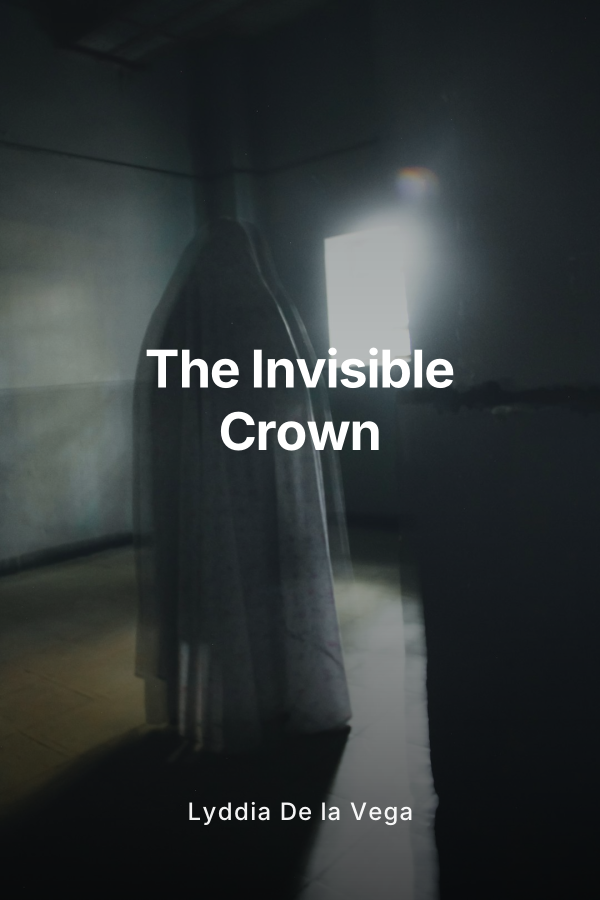
The Invisible Crown is a dark, sensual paranormal romance about a woman who has always been “too much,” and the invisible demon king who has spent a thousand years fading from existence. When she becomes the only mortal alive who can perceive him, their collision sets off a chain of events that will shatter her old life, ignite a forbidden bond, and crown her as Queen of the Underworld.
At three in the morning, heartbroken artist Elara Voss tries to paint her ex out of her system and instead finds herself staring straight into something impossible: a darkness in the corner of her apartment that feels like it is watching her back. The thing in the shadows speaks, in a voice rough with age and loneliness, and tells her no one has truly seen him in a thousand years.
He is Luci, Demon King of the Obsidian Reach. Once feared, worshipped, and undeniably real, he has been slowly fading until even his own realm barely remembers his face. Until Elara. She does not just sense him, she dreams his world and paints it in obsessive, haunting detail. She has the Sight, an untrained, forbidden gift that lets her turn canvas into doorways and shadows into living things.
Their connection begins in whispered conversations, invisible hands, and forbidden touches in the dark. Elara feels him before she ever sees him: cool fingers lacing with hers at the easel, a solid body at her back in bed when nightmares drag her under, a low voice in the shower telling her exactly how he is touching her even when her eyes show her nothing but steam and tile. Luci fights his own desire as fiercely as he fights his growing fear, because every moment he lets himself want her is another moment he risks pulling her into the war that has been hunting him for centuries.
Elara’s ex, Jasper, cannot accept being shut out. Convinced by his own guilt that she needs saving, he runs straight to a secret order of demon hunters known as the Order of the Iron Thorn. Their leader, Father John Mercer, sees in Elara what no one else has found in generations: a mortal anchor to a fading Demon King. Where Jasper thinks of rescue, John thinks of harvest. Luci’s blood promises power and longevity beyond anything the Order has ever held, and Elara is his perfect conduit.
As Elara’s Sight sharpens and her intimacy with Luci deepens, the veil between realms thins. She learns that the landscapes she paints are not just visions but maps to the Obsidian Reach itself. She can open doors. She can also, with training, tear living things apart with nothing but perception and will. Ironos, Luci’s brutal yet loyal general, begins training her as a weapon in her own right. At the same time, Luci becomes the only place she feels truly safe: the invisible presence in her studio, the hands that wash paint from her skin in a hot bath, the cool mouth at her throat when she is desperate to feel wanted by someone who actually sees her.
But the Underworld notices what the mortal world has already started to disturb. A rival demon, Morvenna, appears in Elara’s apartment in a flare of red fire and polished cruelty, warning that if she can sense Luci through Elara, others can too. The Obsidian Reach is no longer just fading history. It has a living, breathing queen in the making.
When Father John manipulates Jasper into stealing Elara’s largest painting, the doorway to Luci’s realm rips out of her small human life and into the hands of the one man ready to weaponize it. Luci’s answer is as simple as it is terrifying: he brings Elara through the very door she painted, into the Obsidian Reach itself.
There, for the first time, she sees him.
Not as a shadow, not as a voice in the dark, but fully: tall, elegant, inhumanly beautiful, eyes like obsidian lit from within. In his realm he is no longer half-faded; he is solid, undeniable, and more powerful than any dream had hinted. That first real sight explodes into touch and then into heat. In a pool of black glass and water that reflects nothing but them, Elara studies every line, scar, and flaw on his body with an artist’s hunger and a woman’s need, and the restraint that held him back in the mortal world finally snaps.
What began as unseen comfort in her bed becomes full, explicit worship in his. As demons bow and armies train, their nights turn into a slow surrender: shared baths in shadow-lit pools, healing sessions where his cool magic soothes the burns on her neck left by holy symbols, and arguments that end pressed against obsidian walls with promises to never again let anyone make her feel small.
Yet the Obsidian Reach is not a playground; it is a kingdom preparing for war. Father John studies the stolen painting, unlocks its secrets with his own blood, and uses Elara’s unwilling connection to Luci to open the way. The Order invades the throne room with silver blades, holy water, and a binding collar meant to twist the very bond that saved Luci back into a weapon against him.
Cornered between the man who wanted to “fix” her and the demon who has staked his eternity on her, Elara is forced to decide who she is going to be: the woman who shrank herself for a mortal man, or the queen who kills to protect the one creature who has never once asked her to be less.
The decision is sealed the night she agrees to the old binding.
Blood to blood. Soul to soul. Forever.
The soul-bond between Elara and Luci is not just a romantic metaphor. It is literal, ancient magic that ties their lives, their power, and their futures. Their binding night is a blend of ritual and raw need: cut palms pressed together until power detonates through both of them, centuries of his isolation flooding into her, all her years of being “too much” or “too weird” pouring into him. Then it becomes purely physical, a claiming and a surrender that leaves both of them marked in ways no crown ever could.
When the Order finally steps through the painting into the Obsidian Reach, Elara is no bystander. Wearing armor forged for her and armed with her sharpened Sight, she stands beside Luci as the invading soldiers are swallowed by a demon army that has been waiting centuries for an honest fight. Father John, clutching the binding collar, goes straight for Elara, intent on plugging himself into her soul-bond and bleeding Luci dry.
The collar burns like sanctified fire when it snaps around her throat. Through the warped bond, Elara feels Luci’s strength draining into John’s scarred hands, feels her king begin to dim in his own realm. With the entire hall watching, she makes the only choice that honors the woman she has become.
She kills the priest herself.
It is not neat, and it is not easy. Jasper watches, stunned, as the woman he once called “too intense” drives a blade into a holy man’s throat to save the demon he believes is corrupting her. When the battle ends, Elara stands bloodied but unbroken. Luci holds her in front of his entire court and names her what he has always felt her to be: his equal, his queen.
The remainder of the book turns from survival to sovereignty and from desperate attraction to a fully realized partnership.
Elara must learn to rule a realm forged from shadows and glass. She faces down the Shadow Court’s icy queen, Seraphine, who once loved Luci and now arrives to see if Elara is a passing infatuation or a true sovereign. Elara matches her, gaze for gaze, and wins not through inherited status but through courage, honesty, and a power Seraphine cannot duplicate: the ability to see through any mask, any armor, any lie.
Between meetings with factions who would happily test a mortal-born queen and training sessions that teach her to rip apart attackers with nothing but a look, Elara carves out something fiercely her own: a vast studio where she can paint doorways and futures, nightmares and home. Luci, who has spent millennia as a weapon and a symbol, now sits in a sunless room just to watch the woman he loves cover white canvas with impossible worlds.
Their romance never steps aside for the plot; it deepens alongside it. There are shared baths where she traces the history written into the scars on his body, quiet nights where his hands massage the ache from her fingers after hours of painting, and mornings where she wakes in a bed large enough for a king and realizes she is done apologizing for taking up space. The sex is explicit and emotional, threaded with worship, possessiveness, and the ever-present awareness that neither of them is alone anymore.
In the climactic coronation, Elara accepts the visible crown to match the invisible one she has already shouldered. In front of every court that matters, Luci declares her his equal in all things. The crown she wears unlocks the full scope of her Sight: she feels every realm, every path, every possible future. With that overwhelming power, she chooses something profoundly simple.
She chooses them.
No new conquests. No crusade against the mortal world. Just the promise to protect the Obsidian Reach, to protect Luci, and to protect anyone under their rule who has ever been told they are too strange or too intense for the worlds they inhabit.
The book closes not with a battlefield vow, but with the domestic warmth they both once believed they would never deserve. Months later, Elara sits on a rooftop of black glass, painting pink flowers against the starless sky. Her belly is rounding beneath her gown, carrying a child who will bridge mortal and demon blood. Luci joins her, wraps a cloak around her shoulders, and kneels to speak to the life they have created.
He confesses his terror: that he will fail them, that his darkness will stain their child, that the realms will try to turn their baby into a weapon or a symbol. She counters each fear with steady certainty. Their child will never be invisible. Never be made to feel “too much” for existing. Not with a mother who once painted her way into a kingdom and a father who has sworn to destroy anything that tries to make them small.
On that black-glass rooftop, with paint on her fingers and his hands resting reverently over their child, they talk about names and futures and what stories they will tell. No armies, no priests, no courts. Just an artist, a demon king, and the baby who proves that their love is not only powerful enough to survive darkness, but to build something tender within it.
The Invisible Crown is a standalone dark paranormal romance that leans hard into emotionally intense, explicitly steamy connection. It offers:
- A heroine who transforms heartbreak and “too much” into literal power.
- A demon king who goes from invisible myth to fiercely devoted, deeply vulnerable partner.
- A bond that is permanent, sacred, and unabashedly possessive without cruelty.
- Enemies-to-lovers tension with the universe itself, as realms, priests, and rival courts test their right to be together.
- An ending that is not just happily ever after, but intimately, domestically blissful: eternity painted in pink flowers on black glass, and a king whispering promises to his unborn child.