Summary
At the edge of a small lakeside town, an aging dock stretches into dark, patient water. Its planks are scarred with initials, dates, and half‑forgotten symbols, each mark a quiet testimony to the people who once stood there and loved in their own imperfect ways. Across decades, four different lives brush against the same weathered boards, each story guided by a different love language and a different way of carving meaning into wood, memory, and time.
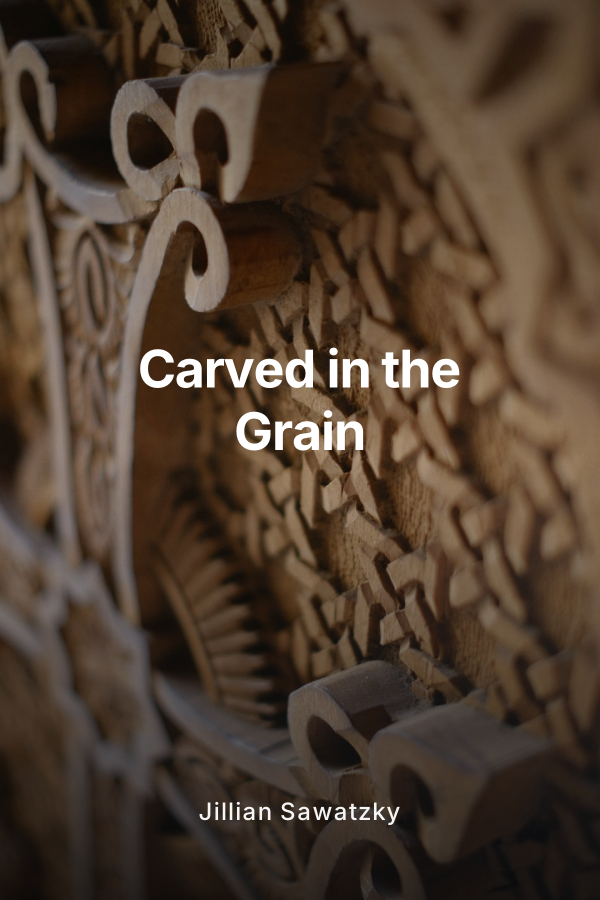
Carved in the Grain weaves four interconnected yet independent stories that all return to the same dock and its growing constellation of carvings. Every tale reveals a new layer of the place and a new facet of love, from the rush of first romance to the quiet courage of healing, the complicated tenderness of family, and the wide, generous reach of community care.
Story One follows a summer that feels like it could last forever. A boy visiting town for a few sunlit months and a local girl who knows every nail and knot in the old boards meet by accident when he slips off the dock into the lake and she hauls him out, reversing the usual fairytale script. What begins as a clumsy, laughing rescue turns into a season of shared quality time. They claim the dock as their own secret world, returning for sunrise swims, late‑night picnics, canoe trips into the mist, and long conversations that stretch until the stars blur.
The story stays almost entirely anchored to this one setting while their feelings grow in fits and starts. Misread silences and brief misunderstandings make the sweetness feel earned, not easy. As his departure date creeps closer, the dock becomes both sanctuary and countdown clock. In the final scene, they carve their initials into a hidden strip of wood and promise, with the fearless hope of youth, to meet again at this exact spot. The ending leaves their future unspoken, inviting readers to carry the question of whether they ever return.
Story Two shifts to familial love and the love language of gift giving, seen through the eyes of a granddaughter who has grown tired of the very tradition that once thrilled her. Every Friday night, her grandparents insist on walking the same boardwalk that leads to the dock, snapping photos, buying small silly souvenirs, and pointing out ordinary details she has seen a thousand times. Now a teenager who feels “too cool for this,” she tries to skip out, hides behind sarcasm, and vents in her group chat while her grandmother secretly compiles a gallery of their shared moments.
When one grandparent’s slow but serious illness changes the family’s rhythm, the walks become harder. A wheelchair appears. Hospital visits replace ice cream stands. And the granddaughter starts to see how each little gift her grandparents gave her, from cheap trinkets to carefully printed photos, was really an attempt to wrap time and memory in something she could hold.
A flashback to a childhood evening at the dock cracks her defenses. She remembers how small her hand was when she first helped carve their names into the wood, how proud they all were of the crooked letters, how the dock felt like it belonged to them forever. That single carving becomes a hinge between past and present. The story does not offer a neat cure or miracle recovery. The illness remains, and the future stays uncertain. Yet the granddaughter changes in quiet, concrete ways. She chooses to show up, to be present, to wheel her grandparent all the way back to that same dock. They take a new photo together, older, more fragile, but more honest, and she begins to understand that time itself is the rarest gift.
Story Three turns inward toward self love and the power of words of affirmation. Told in first person, it follows a young woman in her early twenties who navigates life with both anxiety and blindness. The dock is at once a comfort and a threat in her imagination, a place where the water whispers a little too closely to thoughts she tries not to let form fully. She walks there with her dog, whose steady presence adds both humor and grounding charm to her inner monologue. Rather than sinking the narrative into unrelenting heaviness, her voice blends sharp wit, self awareness, and a stubborn refusal to be reduced to her disability or mental health struggles.
On a day when her thoughts feel particularly jagged, she sits at the edge of the dock and runs her fingers over the wood, tracing grooves in the grain. Under her hands she finds a patch of carvings, layered and rough with time. One set of words stops her. Someone, long before she arrived, used a simple knife to carve a message that feels like it was written directly to her. Those words of affirmation do not magically solve her problems, yet they interrupt a spiral that had been tightening for weeks.
As she returns day after day, she makes a ritual of coming to that exact spot. The dock becomes a classroom where she slowly relearns how to talk to herself, borrowing strength from the stranger who once stood where she now sits. Through humor and honesty, she challenges unkind narratives she has swallowed about blindness, weakness, and worth. Eventually, she adds her own carving alongside the old one, choosing words she wishes someone else in her position could discover one day. In the end, she does not emerge with a perfect life, but with a growing, practical love for herself anchored in chosen truths rather than drifting fears.
Story Four expands the lens to universal love and acts of service, focusing on a community effort to restore the now decaying dock. Years of weather, careless litter, and neglect have left it splintered and unsafe. The town is divided between those who see only an old structure that should be replaced and those who recognize it as a living archive of shared history. At the center of the effort stands a local Indigenous elder who regards the water and shore as relatives, not resources. Without turning the story into a heavy lesson, a single teaching guides the narrative: people are responsible for leaving this place better than they found it, for the sake of those who will stand here long after they are gone.
Through meetings, workdays, and quiet one on one conversations, the elder helps the mixed community imagine the dock in terms of relationship instead of convenience. Children join clean up crews, older residents defend the carvings as important memories rather than vandalism, and even skeptical voices begin to soften as they witness what shared care can create. Work gloves replace handshakes, and shared labor becomes its own language of love.
As planks are repaired and the structure is strengthened, the long history carved into its surface is carefully preserved. People notice, perhaps for the first time, the tangled initials, dates, and simple messages that span decades. Some of the marks belong to people they once knew. Others come from strangers whose stories remain untold but still matter. The restoration culminates not in a grand ceremony but in a simple gathering at sunset, where neighbors stand together on the renewed dock in an easy, companionable silence. The elder offers a short blessing that links past, present, and future, and the youngest children present gently press new, respectful marks into the wood, symbols rather than names, carrying the teaching forward.
Across all four stories, the dock and its carvings serve as the quiet spine of the book. Romantic love, familial love, self love, and universal love each have their own story, voice, and emotional arc, yet the setting binds them into a single narrative landscape. Readers watch the town and its people shift over roughly half a century while the water and wood remain steady witnesses.
Carved in the Grain invites readers, especially young adults and those who love character driven fiction, to reconsider what it means to leave a mark. It suggests that every act of presence, every shared moment, every kind word, and every choice to care for a place or person adds another line to a larger story. In the end, the dock stands not only as a physical structure saved from decay, but as a symbol of how love in all its varied forms can be both fragile and enduring, personal and communal, fleeting and yet somehow carved into the world to outlast us.