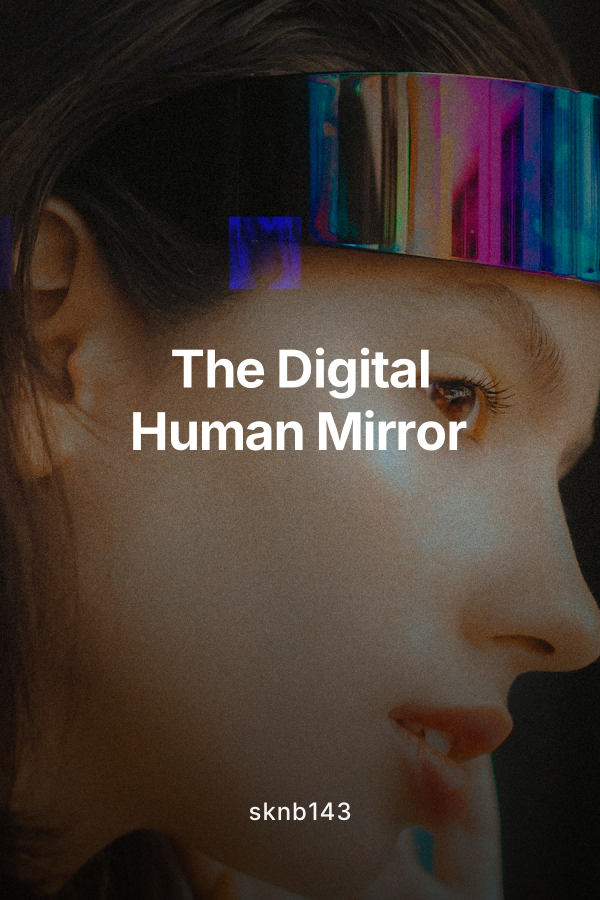
This book investigates how data and artificial intelligence do not merely compute our actions but progressively construct a reflective surface in which contemporary humans learn to see themselves. Building on the central metaphor of the “Digital Human” as a luminous, data-driven avatar that reflects patterns of identity, emotion, and behavior, the work argues that data now functions simultaneously as infrastructure, medium of self-knowledge, and site of moral struggle. At stake is whether this mirror will amplify human dignity, agency, and wisdom, or instead distort and fragment our collective life.
The core thesis unfolds through two tightly interwoven threads. The first is conceptual: the book develops a rigorous account of the continuum from data to information, knowledge, and wisdom, and shows how this continuum is increasingly instantiated in AI systems that model and influence human conduct. The second is ethical and educational: it contends that students and professionals must be equipped not only to design and deploy such systems, but to interrogate them as socio-technical mirrors that encode values, power relations, and visions of the human future.
Chapter 1 constructs a formal framework for understanding digital traces as the raw material of intelligence. It characterizes data as structured inscriptions of human and environmental events, which only become information when organized for interpretation, and knowledge when woven into validated models and practices. The chapter culminates in a conception of wisdom as context-sensitive judgment about how data and models ought to be used in light of human flourishing. Visual diagrams present the data–information–knowledge–wisdom (DIKW) continuum as a layered architecture that underlies both human cognition and machine learning, clarifying points at which bias, error, and value-laden choices enter the pipeline.
Chapter 2 introduces the Digital Human mirror as a central analytical construct. Here the book examines how cumulative digital footprints form dynamic, datafied portraits that illuminate intimate aspects of selfhood: emotional rhythms, habits of attention, relational networks, and trajectories of aspiration. Through this lens, AI systems that track messages, movements, physiological signals, and online interactions are interpreted as engines that continuously update an internal model of each person. Yet the mirror is never neutral. It embodies design decisions about what counts as relevant, normal, risky, or profitable. Conceptual schemata depict the flow from lived experience to data capture, to algorithmic modeling, to the reflective image returned to the user or institution, and finally to behavioral feedback into the world.
Chapter 3 turns to the ethical landscape of this reflective infrastructure. It analyzes how predictive algorithms in domains such as credit scoring, policing, employment, and healthcare can transform partial and biased histories into seemingly objective classifications that reshape life chances. Narrative case studies of individuals and communities affected by misclassification, opacity, and surveillance illuminate the human stakes of abstract design choices. The chapter argues for a robust ethics of data stewardship that integrates principles of transparency, accountability, justice, and respect for autonomy into each layer of the DIKW continuum, from collection practices to model governance. A governance diagram maps these principles onto concrete processes of auditing, explanation, contestation, and redress.
Chapter 4 develops the idea of augmentation rather than replacement as the proper orientation for AI in relation to human potential. Focusing on systems that extend perception and cognition, such as clinical decision support, augmented reality interfaces, and educational recommender systems, the chapter shows how the Digital Human mirror can become a site of empowerment when designed to support reflection, learning, and skillful action. It contrasts architectures that treat users as manipulable targets with those that treat them as partners capable of inquiry, critique, and growth. A set of conceptual frameworks illustrates how feedback loops can be tuned to cultivate critical awareness rather than passive dependence, and how symbiotic human–AI systems might redistribute rather than concentrate epistemic power.
Chapter 5 addresses education and professional formation in the data age. It argues that data literacy and AI literacy must be reconceived as forms of ethical agency rather than purely technical competence. For students and practitioners across disciplines, this means learning to read datasets as condensed social histories, to decode algorithmic outcomes as artifacts of contested design, and to situate technical work within broader narratives of justice and responsibility. The chapter outlines pedagogical strategies that blend conceptual rigor with inquiry-based projects, encouraging learners to move from naïve trust or cynicism toward informed stewardship of the Digital Human mirror. Diagrams and reflective exercises invite readers to map their own digital identities, interrogate the systems they inhabit or build, and envision alternative designs.
Taken as a whole, the book offers a systematic, technically informed, and philosophically grounded account of what it means to live, learn, and act in a world where the self is incessantly refracted through layers of data and intelligent computation. It neither celebrates nor condemns AI in simplistic terms. Instead, it frames the Digital Human as an unfinished ethical project: a mirror that can clarify or distort, illuminate or obscure, depending on the conceptual frameworks, institutional arrangements, and educational practices that shape it. By integrating analytical models, narrative vignettes, and visual diagrams, the book aims to provide students and professionals with a vocabulary and toolkit for transforming data-driven mirrors into instruments of shared understanding, responsible innovation, and humane intelligence.