Summary:
Connor first meets Mason at twelve in the borderlands of a half-built city, where cracked asphalt bleeds into wild scrub and a rough dirt bike track forms their shared sanctuary. From the moment Mason grins at him from the seat of a too-big bike, something inside Connor tilts. What starts as a fierce boyhood friendship grows into an unspoken devotion built on shared helmets, scraped knees, and late-night messages. For years, Connor keeps his love unnamed, tucked away beneath jokes and easy loyalty.
Their lives fracture at sixteen when Mason takes the jump he has feared for months. For one suspended instant he hangs in the air like an angel. Then metal and bone meet hard earth. The hospital becomes another reality: plastic chairs, fluorescent ceilings, the steady breath of machines. While Mason lies unconscious, Connor breaks open. He confesses all of it into the quiet of the hospital room: the love, the fear, the guilt. He pours his heart into a silence he believes is absolute.
Mason hears everything.
He wakes. He heals. They survive. On the surface, life moves forward: school, rides at the track, familiar routines. Connor never repeats that confession while Mason is awake, and Mason never admits he heard. The truth between them buries itself deep and keeps breathing there.
Two years later, on the night of Mason’s eighteenth birthday, they return to the track with cheap alcohol and the reckless certainty of boys who think time is infinite. In the dark, drunk and shaking with a courage that is part liquid and part longing, they finally cross the line Connor has spent years circling. The moment erupts into one long, breathless tangle: mouths and hands, shirts stripped away, bodies pressed together, grinding and grabbing until they shatter in each other’s arms. There are slurred “I love you”s, names gasped against skin, a desperate, wordless need that feels like everything they have ever failed to say.
In the morning, Connor wakes wrapped around Mason, sunlight on his face, the taste of last night still on his lips. Terrified of what it might mean, he tells himself it was just a dream, a drunken mistake Mason surely never intended. He brings water, painkillers, food. He brushes hair out of Mason’s eyes. Mason groans about a strange dream and a sore neck. The clues are there, soft and easy to miss. Connor steps over them on purpose and carries on as if nothing happened.
The years that follow trace a long, quiet ache. From late teens through their twenties and thirties, Connor and Mason build lives that run side by side instead of together. They graduate. They land full-time jobs. They take road trips that feel almost like honeymoons, only without the name. They date other people, stand at each other’s weddings, and exchange looks that say far more than their vows ever could. Again and again they stand on the edge of choosing each other, and again and again they pull back.
Mason keeps riding, forever chasing speed and open sky. Connor builds something that resembles a future with a woman who is kind, real, and almost right. She is not Mason. The guilt of loving one person while building a life with another settles into him like sediment. He tells himself this is adulthood: compromises, half-measures, lives that look good enough from a distance.
Throughout these years Mason writes, filling a battered notebook he tucks into his riding gear. On its pages he returns obsessively to that hospital room, to Connor’s cracked-voice confession, and to the night at eighteen when he almost had everything he had ever wanted. He writes about his dreams in unsparing detail: a life shared with Connor, mornings waking up in the same bed, trips that never have to end, the ordinary domestic peace of being allowed to love each other in the open. He writes about how fear, timing, and habit kept him silent. He writes about that birthday night under the stars, about Connor’s hands on his skin, about how close they came to finally claiming their own slice of heaven.
At forty-eight, on a drive back to the old track that made them, fate calls in its debt. Connor rides passenger while Mason takes the wheel, older now but still orbiting each other with the same familiar ache. When another car jerks into their path, Mason’s reaction is instantaneous. He turns the vehicle just enough to save Connor. The impact takes him instead.
The aftermath is brutal. Connor crawls from crushed metal to find Mason torn open on the road. There are no last speeches, no tender scripted goodbyes. Only Connor’s voice, wrecked and useless, saying Mason’s name over and over. Mason dies in his arms on asphalt that feels too close to the old packed dirt to be coincidence.
In the hollow quiet that follows the funeral, Connor is left with the wreckage of two lives: Mason’s absence, and the pieces of himself he scattered across decades of almost-choices. In Mason’s room, where his smell still lingers in fabric and leather, Connor begins to sort through the relics. He finds the notebook. Inside its worn covers, he finally meets the version of Mason he has been imagining for most of his life.
The notebook is a map of a love that never learned to speak out loud. Entry after entry reveals how Mason heard that hospital confession, how he held it like a fragile, burning thing. It details the eighteenth birthday night clearly enough that there can be no more denial. Mason writes about hands and mouths and the way Connor’s name broke in his throat. He writes that in those hours he came closer than ever to the life he had always dreamed of: a life with Connor, claimed instead of avoided.
Reading, Connor is split open a second time. The night he labeled a drunken mistake becomes, in an instant, the blazing center of what their story could have been. Every moment he dismissed, every loaded glance he learned to overlook, blooms with new meaning. Mason had loved him. Not in vague, wishful ways, but in sharp, specific, fiercely chosen ones.
The narrative carries the reader through Connor’s recollections: the dusty summers of boyhood, the hospital corridors, the golden afternoons at the track, the weddings where they watched each other promise half-truths to other people, the quiet adult routines that felt like a marriage in everything but name. All of it unfolds through Connor’s intimate first-person gaze, rich with detail and stripped of easy answers. The tone is tender, raw, and unflinching. Love is never in question. Courage is.
Only in the very last lines does the full frame of the story snap into place. Connor sits alone at the abandoned track, the notebook beside him, the afternoon light slanting across the scarred earth where everything began. He talks into the wind as if Mason is sitting there too, boots in the dirt, helmet at his side, laughing like he always did. He apologises for every time fear won. He thanks Mason for loving him in the ways he could. He whispers a wish out into the empty sky: that if there is a next life, they might find each other early, and this time choose the truth they both already know.
Then the perspective shifts in the smallest, most devastating way. All along, Connor has been holding on to the past so tightly that it has swallowed his present whole. The story the reader has walked through with him is not a neutral, neatly ordered account of two lives; it is the looped devotion of a man caught in memory, replaying every glint of sunlight from before the crash, clinging to the one slice of heaven he ever claimed. The world around him has moved forward. Connor has not.
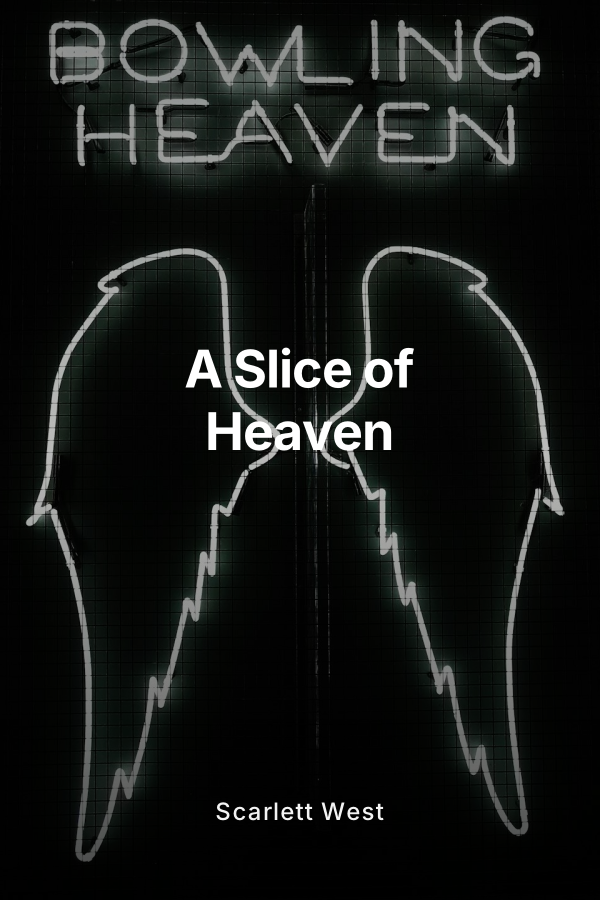
A Slice of Heaven is a bittersweet, adult, queer love story about friendship, desire, missed chances, and the brutal tenderness of fate. It does not offer grand redemption or a neatly healed heart. Instead it holds up a mirror to what happens when love is real, mutual, and enduring, yet never fully spoken in time. It is a book for readers who know the gravity of the words “what if,” who have loved someone they were never quite brave enough to choose, and who still, quietly, hope that somewhere beyond this life, there might be another chance to get it right.