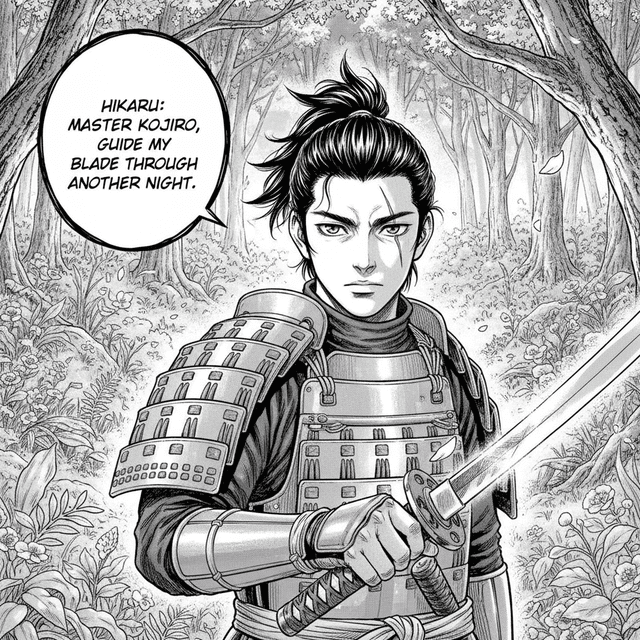
Summary:
In the mist-veiled heights of the Sakura Range lies Sakura Hiro, a village where cherry blossoms never fall and the circuitry of the future hums beneath roots older than memory. Here, neon-lit shrines stand beside moss-covered stones, and bioluminescent lanterns float like captive stars over houses warmed by silent solar domes. At the heart of this delicate coexistence rises Hakuto Academy, where Master Kojiro once taught the Way of Two Worlds: that a soul must be fluent in both the whisper of leaves and the pulse of machines.
Hikaru Tachibana, a 28-year-old swordsman, carries that lesson like a concealed flame. His weapon, a crimson katana, is more than forged steel; it is a vessel for a forbidden fusion of bioengineering and spirit craft, the latent seed of a magic system long thought lost. Hikaru’s life is disciplined but contained, his mornings spent cutting mist with precise strokes guided by Kojiro’s lifelike hologram, his nights haunted by a restless sense that the mountain winds have begun to hold their breath.
When an army of Kage-Kin descends from the clouds, the illusion of safety shatters. These are not simple robots but predatory constructs sculpted from shadow alloy and hijacked forest code, their footfalls heavy with the stench of oil and scorched sakura bark. In one coordinated strike they mutilate the village’s delicate infrastructure, sever neural webs, and extinguish Kojiro’s projection, silencing a generation’s main conduit to wisdom.
Amid the wreckage, Hikaru discovers that his blade responds to this new chaos. A dormant red glow stirs along the steel, pulsing in time with his heartbeat and the distant, wounded groan of the forest. Peace dies among drifting petals, and in its place rises a question that cuts deeper than his sword: Has Sakura Hiro’s blend of nature and invention invited a new and insidious predator?
The answer begins to unfold in dreams. Kojiro’s ghost visits Hikaru in a spectral glade where petals fall upward, and rivers flow like liquid glass. There, the old master speaks not as a glitch but as something half-remembered from an older era of magic. He tells Hikaru to “seek the Bloom,” a mysterious figure who plucks hearts the way one plucks petals from a flower. When Hikaru wakes, a vial of crimson liquid rests over his chest, still cool, still trembling with a faint bioluminescent throb. It tastes of iron and sweet sap, and in its depths swirl encrypted sigils that seem to answer the glow in his blade.
This crimson liquid is the key to the world’s hidden sorcery: a living alchemy that fuses blood with coded blossom pollen and residual AI fragments. In Sakura Hiro’s heyday this art was shunned, too intimate, too entangling, its practitioners capable of weaving sensations, memories, and raw desire into tangible power. The substance magnifies emotion, binds souls, and lets its wielders reprogram flesh and circuitry alike. Yet every use demands a sacrifice. It steals warmth from the body, clarity from the mind, and sometimes entire pieces of identity, leaving hungry blanks where love and restraint once lived.
To uncover who commands the Kage-Kin and why his village was targeted, Hikaru joins forces with Yuna, a brash 22-year-old engineer whose cybernetic arm whispers with pirated code. Yuna is a paradox: part hardened survivor, part curious scientist, part woman learning where her body ends and her enhancements begin. Her mechanical limb responds viscerally to the crimson liquid, registering its influence as heat surges and phantom touches racing over synthetic nerves. What begins as a pragmatic alliance soon coils into a charged tension, as the magic system reveals itself to be intertwined with intimacy itself. Touch, breath, shared blood, and arousal do not merely decorate this world; they sculpt energy, forge wards, and amplify the destructive or protective force each character can command.
Their journey drags them through the Blackroot Forest, a sprawling biome where nature has gone feral around the skeletons of abandoned technologies. Roots crush cooling fins, vines rifle through databanks, and feral drones buzz like metallic hornets around shrines strangled by kudzu. There, Hikaru and Yuna encounter Sora, a sixteen-year-old herbalist fleeing Kage-Kin patrols. Sora cradles a twin vial of crimson liquid and bears a rare gift: she can channel the earth’s response to this nectar, cleansing minds twisted by psychic toxins at the cost of her own blood and youth. Every healing leaves delicate tendrils of bark along her veins, a reminder that the forest does not give power without claiming kinship.
Together they piece together a chilling truth. A figure called Lady Kurohana, the Black Bloom, has hijacked the forest’s dormant AI, grafting it onto the forbidden crimson art. She commands seven Rai-Rings, enigmatic bands of refracted reality that orbit her soul like moons. Each ring alters a different stratum of existence: flesh, feeling, memory, probability, circuitry, spirit, and dream. Through them she weaves a subtle conquest, bending villagers into adoring thralls, corrupting alliances, and driving some to violent obsession.
The Rai-Rings and the crimson liquid form a complementary, perilous system. The liquid heightens the senses and opens the body to new pathways; the rings seize those open channels and rewrite them. Lover becomes weapon. Pleasure becomes leash. Wounds become conduits for shared spells that spread between partners through skin, saliva, and blood. In the heat of battle or in the privacy of tangled sheets, the same currents flow, charging gestures and whispers with literal, explosive consequence. This world’s magic is not cast from afar. It is born in closeness, carved into touch, and its most devastating workings require trust or its sick inversion.
As Hikaru’s makeshift fellowship grows with the addition of Kai, a stoic mercenary archer scarred by prior wars, they begin to test the boundaries of this system. Their training scenes blend martial discipline with uneasy vulnerability, as they learn that synchronized breath and skin contact can extend shields across multiple bodies, that shared arousal can supercharge reflexes, and that suppression of emotion dulls their weapons. The price is steep. Overuse leaves them raw, stripped of defenses, haunted by intrusive memories that are not always their own.
Violence and desire interlace as they storm fortresses of oxidized steel and resin-grown towers. In duels against Kurohana’s enforcers, Hikaru’s crimson blade flares brightest when he fights for those he has touched and been touched by. When his defenses falter, erotic memories surge to the surface, offering sudden bursts of strength or crippling distraction. Yuna’s cybernetic arm, once a mere tool, evolves into a living conduit for this magic, its inner filaments tingling when she opens herself to another’s warmth. Scenes of intimacy between them and others are not separate from the warfare that surrounds them; they are fuel, vulnerability, sometimes a battleground of their own, contested by lingering traces of Kurohana’s influence.
The climax draws the heroes to a floating fortress shaped like a mechanical lotus that blooms above the ravaged canopy, tethered to the earth by braided cables that pulse with stolen lifeforce. There, in shifting gardens of synthetic petals and mirrored halls that reflect innermost fantasies, Lady Kurohana awaits. Her presence trembles with stolen adoration, her perfect features a collage of desired faces harvested from the minds she controls. The Rai-Rings orbit her in smooth, predatory arcs, each one humming with the voices of enthralled villagers.
The final confrontation unfolds as both an epic battle and a psychic orgy of wills. Every strike calls up echoes of prior touches and whispered vows, as the crimson magic drags the heroes’ most intimate bonds into the open. Kurohana weaponizes desire itself, twisting tender memories into chains, turning fear of loss into blades that turn inward. Hikaru must learn to let the forest flow through him without drowning in its hunger, to accept that the crimson blade is not only his but also an extension of every soul that has ever trusted him enough to reach for his hand.
In the end, he anchors his katana in living earth, inviting roots and circuitry to merge. The forest’s buried AI and the old, patient spirits awaken in defiance of their abuser. The crimson aura that explodes from his blade is not the rage of a lone warrior, but the amalgam of all the hearts bound to him, with all the pleasures, wounds, loyalties, and betrayals engraved in their veins. Kurohana’s rings shatter, spilling light and whispers into the spiral of petals and circuitry, and her carefully constructed empire dissolves into ash and scattered memory.
The victory does not erase the cost. Those freed from mind control awaken to acts they committed under another’s will yet through their own hands. Survivors bear scars of addictive magic, burned-out neural pathways, and phantom touches that no longer lead to warmth but to the echo of violation. Hikaru’s party must navigate the aftermath, using the very system that empowered their enemy to soothe, purge, and reshape their village.
Yuna wrestles with what her arm has become: no longer just a weapon or research project, but a limb that remembers every caress and every surge of power it has channelled. Her intimacy with Hikaru grows into a complex, volatile sanctuary where both healing and danger reside. Sora learns to anchor her earthbound gifts in ritual, teaching others to cleanse themselves without surrendering entirely to the forest’s hunger. Kai, uneasy with how the crimson art makes every bond a potential tether, chooses to vanish into the wider world, leaving behind skills and unanswered questions.
Kojiro’s ghost returns in the hush that follows reconstruction, his form finally whole, no longer just data or specter but an amalgam of both. He recognizes Hikaru as the living bridge between the old world of quiet shrines and the new epoch of blood-scripted circuits. In a renewed ceremony, he offers Hikaru a reforged katana, its hilt blossoming with living sakura, its edge singing with digitized birdsong and rustling leaves. The weapon is a promise and a warning: the Way of Two Worlds has evolved into something more perilous, more intimate, and more necessary.
Years later, Sakura Hiro stands as a beacon for those who seek balance between the carnal and the cosmic, the feral and the coded. Hakuto Academy becomes a crucible where students learn that closeness has consequences, that desire can build cities or raze them, and that power rooted in shared sensation demands relentless honesty. Murals across the domes show Hikaru amid cascades of petals and sparks, his crimson blade raised not in conquest but in fierce guardianship.
Yet even in this hard-won peace, the forest murmurs of distant movements. Data phantoms flicker at the edge of the network. New generations experiment with the crimson art, some in devotion, some in secret. Standing at the border where moss kisses metal, Hikaru listens to the overlapping heartbeats of soil, steel, and flesh. The blade at his side hums softly, ready to answer not only the call of war, but the never-ending question of how to love, fight, and live in a world where every touch contains the seed of transformation.