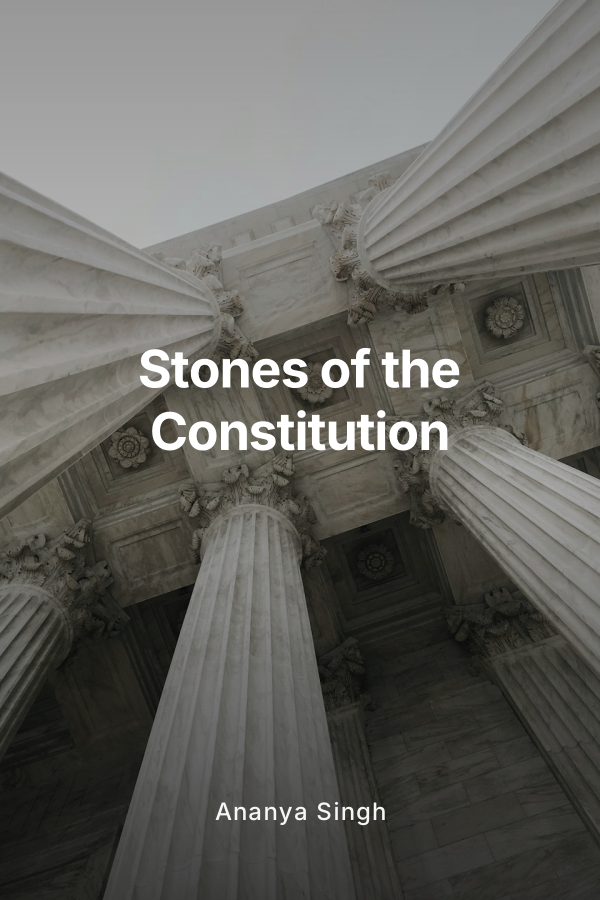
This book examines the Pathalgadi movement in Jharkhand as a powerful example of how marginalized communities turn constitutional language into a living political practice. At its center is a simple but radical claim: the Constitution does not belong only to judges, lawyers, and state officials. It also belongs to the people whose lives are shaped by it every day. In the tribal districts of Khunti and Simdega, Adivasi communities took this claim seriously by inscribing constitutional provisions onto stone plaques and placing them at village boundaries as public declarations of self-governance, land rights, and collective dignity. What appeared to the state as rebellion was, for participants, an act of constitutional faith. The movement argued not for separation from India, but for the fulfillment of promises already made within the constitutional framework
The summary begins by situating Pathalgadi within a much longer history of Adivasi resistance to land dispossession. The book traces how colonial intrusion into Jharkhand disrupted customary systems of landholding and governance, and how figures such as Birsa Munda became symbols of resistance against both outside control and the destruction of indigenous lifeworlds. It shows that the movement of 2017 to 2018 did not arise suddenly. Rather, it emerged from generations of struggle over land, autonomy, and dignity, reinforced by the partial and often broken promises of legal protections such as the Chota Nagpur Tenancy Act, the Fifth Schedule, PESA, and the Forest Rights Act. Each law appeared to offer recognition, yet implementation repeatedly fell short, creating a widening gap between constitutional ideals and state practice
A central theme of the book is subaltern constitutionalism, explained in clear academic terms as the process by which marginalized groups interpret and use constitutional language to make claims for justice. The book argues that constitutional meaning is not produced only in courts. It is also shaped in forests, villages, assemblies, protests, and daily acts of survival. Pathalgadi becomes the clearest case study for this idea. Villagers cited the Fifth Schedule, PESA, and other provisions not as legal experts offering technical interpretation, but as communities asserting that the Constitution must speak in the language of their lived experience. In doing so, they challenged the monopoly of the state over constitutional interpretation and exposed the deeply unequal politics of who gets to define law, sovereignty, and citizenship
The book then turns to the symbolic and cultural force of Pathalgadi itself. Traditionally, pathalgadi referred to the Adivasi practice of erecting memorial stones to honor ancestors, mark land, and preserve collective memory. The movement transformed this practice into a political language. Green-painted stones, inscribed with constitutional text, linked legal claims to forests, territory, history, and identity. This was not a rejection of tradition in favor of modern politics. It was a fusion of the two. The stones made the Constitution visible in village life and made customary knowledge politically legible. Rituals, dances, gatherings, and collective participation gave the movement emotional depth and cultural legitimacy. In this way, the book presents Pathalgadi not only as a protest, but also as a creative act of constitutional translation rooted in Adivasi worlds
Another major strand of the summary focuses on the Gram Sabha, or village assembly, as the heart of the movement’s political vision. The book explains how Pathalgadi interpreted PESA to mean that self-governance in Scheduled Areas must be real, not symbolic. If the law recognized the Gram Sabha as central to decision-making over land, water, forests, and community life, then villages argued that this authority should be exercised in practice. The result was a powerful reimagining of sovereignty. Instead of accepting that all authority must flow from centralized state institutions, Pathalgadi proposed a more distributed model in which communities possess legitimate governing power within the constitutional order. This idea unsettled dominant political assumptions and raised a larger democratic question: can sovereignty be shared rather than monopolized by the state?
The book also explores the role of customary law. For many participants, tradition was not outside law but part of it. Their inscriptions and declarations suggested that inherited forms of community governance, dispute resolution, and land management should be treated as legally meaningful. This was an ambitious and controversial interpretation. Yet the summary shows how this claim was central to the movement’s worldview. Adivasi communities were not simply asking for welfare or administrative recognition. They were asserting that their ways of living, remembering, and governing had normative force. This insistence brought them into direct conflict with a legal order that often treated customary systems as inferior or backward. The book treats this not as a peripheral issue, but as a major theoretical contribution of the movement to debates on law, democracy, and decolonization
As the summary progresses, it details the rise of the movement across roughly 300 villages, especially in Khunti and Simdega. It highlights regional differences between these districts. Khunti, carrying the memory of Birsa Munda and a stronger history of militant resistance, saw more confrontational and expansive forms of Pathalgadi. Simdega, by contrast, often expressed the movement in more legalistic and rights-based terms. These distinctions matter because they reveal that Pathalgadi was never a uniform or centrally controlled uprising. It was a diverse grassroots formation shaped by local history, political conditions, and differing interpretations of what autonomy should mean. This attention to variation allows the book to present the movement in a nuanced way, avoiding both romantic simplification and state caricature
A deeply humane aspect of the book lies in its attention to the people behind the stones. The summary emphasizes that this movement was built not by abstract political actors, but by villagers, women, elders, teachers, forest protectors, farmers, and young people who believed their voices mattered. The participation of women in village assemblies is especially significant, as the movement opened spaces that had often been restricted within traditional decision-making structures. By restoring human depth to the movement, the book resists portrayals of Pathalgadi as merely a security problem or ideological event. Instead, it reveals a community asserting dignity through political imagination and collective courage
The book then addresses the state response, which forms one of its most disturbing and analytically important sections. Rather than engaging seriously with the constitutional claims being made, state authorities and much of the mainstream media framed the movement as anti-national, secessionist, and extremist. This framing enabled heavy repression. Sedition charges were filed, activists were arrested, and widespread police action targeted villages. The summary underscores that the movement’s fidelity to the Constitution did not protect it from criminalization. On the contrary, the very act of claiming constitutional language from below appears to have intensified the state’s hostility. The book uses this moment to show how power responds when those at the margins stop waiting for rights to be granted and begin enacting them directly
Special attention is given to the use of sedition charges and the arrests of prominent activists, including Father Stan Swamy and others accused of misleading villagers and spreading anti-state interpretations of the Constitution. The book treats these cases as more than episodes of legal excess. They illustrate a deeper conflict over legitimacy. If constitutional interpretation is claimed by ordinary people rather than legal elites, the state reacts by turning interpretation into crime. The summary portrays this as a crisis not only of rights but of democracy itself, because it reveals how quickly a state can label constitutional dissent as disloyalty
The narrative does not ignore the movement’s internal contradictions. One of the strengths of the book is its refusal to idealize Pathalgadi as perfectly unified. Some participants sought implementation of existing protections within the constitutional framework, while others wanted a more complete withdrawal from state institutions and a fuller assertion of autonomous authority. These differences produced tensions between moderates and radicals, and they became more serious as repression intensified. Later instances of hostage-taking and violence damaged public legitimacy and weakened support from civil society and moderate allies. The book treats these developments seriously, showing how fragile grassroots constitutional movements can become when confronted by both external force and internal divergence
At the analytical level, the book argues that Pathalgadi exposed the structural gap between promise and practice within Indian democracy. The Constitution, PESA, and related protections appear to recognize self-governance, land rights, and local authority in Scheduled Areas. Yet the state often fails to implement these commitments because genuine implementation would require redistributing power. In this sense, the book’s argument reaches beyond Jharkhand. Pathalgadi becomes a lens through which to examine a larger democratic contradiction: states often celebrate constitutional inclusion while resisting any interpretation that genuinely empowers marginalized communities. The movement’s insistence that the Constitution is a lived document therefore becomes a challenge to elite, centralized, and bureaucratic models of democracy
The final part of the summary emphasizes that although the mass phase of the movement declined by 2020, its ideas did not disappear. Stones still stand in some places. Some Gram Sabhas continue to assert authority. Families of those arrested continue to struggle. Activists in neighboring regions still invoke the lessons of Pathalgadi. The failure to fully implement PESA and protect tribal autonomy means that the conditions that gave rise to the movement remain unresolved. The book closes, therefore, not with closure but with persistence. Pathalgadi survives as memory, warning, and possibility. It asks whether democracy can be meaningful if those most affected by law remain excluded from interpreting it. It asks whether constitutionalism can be real without cultural recognition, local self-rule, and material justice. Above all, it suggests that as long as promises remain unfulfilled, the stones will continue to speak