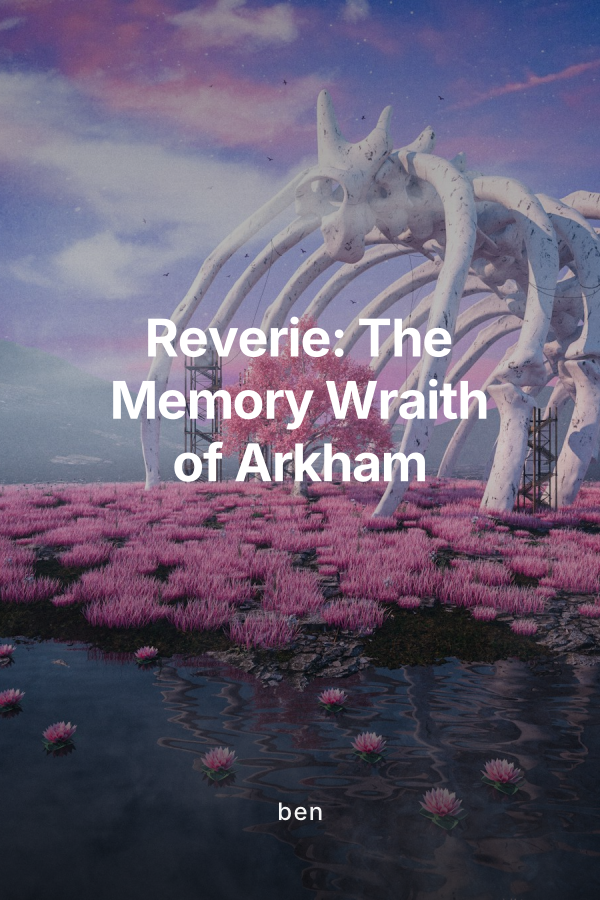
Chapter 1: The Boy Who Learned to Fear His Own Name
Rowan O’Sullivan begins as a careful man built from restraint. In Gotham, he is a respected forensic psychologist, a consultant to Arkham Asylum, and a specialist in trauma, guilt, and criminal behavior. He is the kind of man people trust because he never seems shaken. He speaks softly. He listens longer than anyone else. He believes violence is not born, only made. That belief is not academic. It is survival.
His childhood was ruled by an abusive parent who used shame as a weapon. Rowan learned early that love could be conditional, memory could be rewritten, and punishment could arrive wearing the face of care. He grew up learning how to read tone, how to predict anger, how to become invisible before the blow landed. That wound never healed. It only matured into obsession. As an adult, Rowan becomes fascinated by the question behind every crime: what broke first?
At Arkham, he studies the most damaged minds in Gotham. Scarecrow’s fear obsession, Riddler’s need for pattern, Harley’s volatility, and the raw ruin of patients who have been pushed beyond language all feed his research into emotional trigger mapping. Rowan begins a new therapy project with a dangerous goal: to erase violent impulses by reconstructing memory and severing guilt from trauma. He believes if the mind can be shown its true shape, it can be repaired. He believes he can save people from becoming monsters.
The first cracks appear in speech. Harley notices them before anyone else. Rowan’s words grow colder, more recursive, less human. He begins repeating phrases about guilt, correction, and truth. He no longer sounds like a man explaining behavior. He sounds like a man being spoken through. Yet Rowan still clings to the idea that he is helping. In one key confession scene, he finally helps a patient break through a buried memory and speak the truth of what was done to them. For one brief moment, he feels what he has always wanted most: proof that understanding pain can prevent it.
That moment becomes the seed of his ruin. Because once Rowan sees how memory can unlock fear, he cannot stop studying it. He keeps going deeper, documenting responses, mapping triggers, and exposing himself to the emotional residue of Arkham’s worst cases. The work starts to consume his private self. He tells himself he is still observing. He is not. He is absorbing.
Chapter 2: The Therapy That Opened the Door
Arkham approves Rowan’s experimental program because it promises control. Violent impulses can be erased. Criminal minds can be stabilized. Fear can be reduced to data. But Arkham does not heal anything. It only concentrates damage. Rowan’s system begins with pattern analysis and ends with invasive memory reconstruction, using emotionally charged recall as a tool to reorganize behavior. The science is clean on paper. In practice, it is spiritual damage.
The therapy becomes a door. Every patient Rowan studies leaves residue in him. Trauma patterns start to stack. The lines between empathy and contamination blur. Rowan begins to experience emotional afterimages. A patient’s panic lingers in his body. A confession echoes in his sleep. A flash of guilt from one subject becomes his own. He tells himself he is simply overworked. But the symptoms deepen. The quieter he becomes, the more unstable he grows.
Harley is the first to see that something is wrong beyond stress. She notices the speech changes, the strange rhythm of his pauses, the way he begins to use language like a scalpel. He speaks about guilt not as a feeling but as a fact. He says things that sound like doctrine. He becomes eerily calm in places where a man should be angry or afraid. Harley tries to reach him, but Rowan keeps his distance. He fears attachment. He fears being seen. He fears, most of all, that if someone looked long enough, they would find the child he still believes is standing in the corner waiting to be punished.
Scarecrow becomes an accelerant. He sees Rowan’s fixation and feeds it. Where Rowan wants to understand guilt, Scarecrow wants to weaponize fear. Their exchange is not friendship. It is corrosion. Scarecrow pushes Rowan toward the idea that the mind can be broken open by terror and rebuilt around obedience. Rowan resists at first. Then he compromises. Then he rationalizes. The therapy starts to produce results, but not healing. Patients become suggestible, unstable, and haunted by false certainty. Memories rise. Some are real. Some are not. The project begins to smell like a mistake that can no longer be unmade.
The collapse is not sudden. It is recursive. Rowan keeps telling himself that every rupture is temporary, that every fracture can be mapped. Yet the more he studies guilt, the more he believes guilt itself is the truth beneath identity. He starts to interpret suffering as evidence. Pain becomes correction. Memory becomes verdict. The man who wanted to prevent violence starts to sound like a judge.
Chapter 3: The Birth of Reverie
The transformation does not happen all at once. It happens through erosion. Rowan begins losing the boundary between observer and participant. His own childhood returns in fragments. The voice of his abusive parent returns in memory, then in his internal language, then in the shape of his decisions. He cannot tell whether he is uncovering hidden truths or manufacturing them. He can only tell that the process works. People confess. Patients tremble. Emotional walls fail. The machine Rowan builds begins amplifying more than data. It amplifies shame, fear, grief, and rage.
Eventually, Rowan discovers what the system can truly do when paired with Arkham-derived neural amplification. His method no longer merely surfaces memories. It projects them. Victims begin to experience living memories, as if the past has a pulse and teeth. Crowds feel shared dread. Private guilt becomes public collapse. The entire city starts to feel like it is standing inside a dream it cannot wake from.
This is the moment Rowan stops being fully Rowan. He adopts the name Reverie, though the name is also a surrender. Reverie is what remains when identity is stripped down to function. He becomes Gotham’s Memory Wraith, a psychological threat who does not need to strike a body to destroy it. He can make people relive what they buried. He can make them believe what they denied. He can make them face themselves.
His new creed is absolute. Guilt is truth. If you remember it, it is real. Sinners must be shown themselves. Pain is correction, not punishment. He no longer sees morality as complicated. He sees it as a litmus test. Anyone who resists is hiding. Anyone who hides is guilty. That belief makes him dangerous in a way Gotham is not prepared to understand. Because Reverie does not simply punish the wicked. He forces everyone into the same unbearable mirror.
Batman becomes his counterpoint. Where Reverie amplifies exposure, Batman embodies restraint. Where Reverie believes memory proves guilt, Batman knows memory can be fractured, weaponized, and haunted. Batman cannot be easily bent because he does not deny his wounds. He carries them. He does not confuse acceptance with absolution. This makes him one of the few minds Reverie cannot fully destabilize. And that immunity enrages him.
Meanwhile, Riddler helps extend the chaos by turning the city into a puzzle box of delay and diversion. Poison Ivy and Catwoman drift around the edges of the crisis, not out of loyalty to Reverie’s creed, but because Gotham’s collapse creates openings. Bane offers order in the service of force. Every alliance around Reverie is transactional. No one truly saves him. No one truly can.
Chapter 4: Gotham in the Grip of the Mirror
As Reverie’s influence spreads, Gotham begins to behave like a wound that has been opened too wide. People experience flashbacks that were not theirs. Confessions erupt in the streets. Rivalries collapse into sobbing admissions. Fear becomes contagious. Guilt becomes atmospheric. Reverie uses his machine to turn emotional response into a citywide feedback wave, and the result is not chaos in the usual sense. It is intimacy weaponized against an entire population.
The horror of Reverie lies in his precision. He does not create random terror. He finds the pressure point. He touches the memory that was locked away for a reason. He shows victims the version of themselves they cannot forgive. People who have done little wrong are still broken by what they fear they might have done. People who are guilty are stripped bare. People who have survived trauma are dragged back into it. The city becomes a theater of shame.
But the machine’s power is also its weakness. It depends on external amplification. It depends on control. And control is what Rowan has never truly possessed. The more the system intensifies, the more his identity fragments. Rowan and Reverie begin to argue inside the same mind. Rowan still wants to help. Reverie insists that help was always a lie, that exposure is the only mercy, that guilt must be made visible. These internal shifts make him unstable. The machine magnifies not only others, but his own disintegration.
Harley becomes the most important threat to his belief system. She does not challenge him with doctrine. She challenges him with recognition. She sees the human ruin beneath the rhetoric. She remembers the man who once listened, the man who still sounded uncertain enough to be real. Her presence disrupts the artificial certainty he has built around himself. She calls him Rowan when everyone else says Reverie. That name becomes dangerous. It reminds him that he was once a person who wanted to help people, not a force that wanted to expose them.
Scarecrow watches the process with interest, but not sympathy. He has helped create something he cannot control. He is not disappointed. He is fascinated. Reverie is the proof that fear and guilt can be fused into a new kind of horror. Scarecrow does not try to save him. He waits to see what breaks first.
The citywide crisis reaches its peak when Reverie overextends the field. The emotional feedback loop becomes unstable. The machine begins to strain. The containment grid cannot handle the weight of all the projected pain. People across Gotham collapse under the burden of unwanted memory. Reverie loses the clean separation between his own thoughts and the memories he has forced into others. He starts to drown in the architecture of his own invention.
Chapter 5: The Name Buried Under the Ashes
The final collapse begins with exposure. Batman and Harley force Rowan to confront what he has been avoiding since childhood: the identity beneath the mask. They expose the lie that Reverie is only a function. They force the name Rowan O’Sullivan back into the room. That name destabilizes him because it carries the original wound, the abusive parent, the shame, the old terror of being seen as defective. The child he tried to outthink never left. He only learned how to hide inside intelligence.
The confrontation is brutal, but not physical in the usual sense. It is psychological, intimate, and devastating. Batman refuses the false logic of guilt as destiny. Harley refuses to let Rowan hide behind abstraction. Together, they force him to hear the human cost of what he has done. Every memory he weaponized comes back at him. Every confession he twisted returns with new weight. Every patient he thought he was saving becomes part of the truth he can no longer outrun.
Rowan’s machine begins to fail. The amplified field flickers. The citywide wave breaks apart. His own mind fractures under the feedback. He experiences the final rupture as a collapse of selfhood. Rowan and Reverie collide. For a brief instant, the original man returns, horrified by what he has become. He understands that he never erased violence. He only learned to dress it in language. He never cured guilt. He multiplied it.
That realization destroys him.
By the end, Reverie is not triumphant. He is shattered. The identity of Rowan O’Sullivan is mostly erased, surviving only in fragments and echoes. Arkham contains what remains in reinforced psychological confinement, but containment is not healing. It is a lock on a door that still breathes. Reverie sits in the dark as Gotham recovers from the nightmare, feared not just as a criminal but as a symbol of what happens when a man tries to cure pain by turning it into a weapon.
The last note is not redemption. It is residue. Sometimes, during memory surges, something in him remembers the boy who wanted to help people. Sometimes the name Rowan rises, weak and drowning. But Reverie is still there too, waiting under the surface, dreaming in the language of guilt. Gotham does not fear him because he is powerful. Gotham fears him because he proves how easily the human mind can turn its own mercy into a mirror.