Only the first page of this book is left. We lost the rest in October 2026.
We lost access to the service that stored them, and no other copy exists. We're sorry.
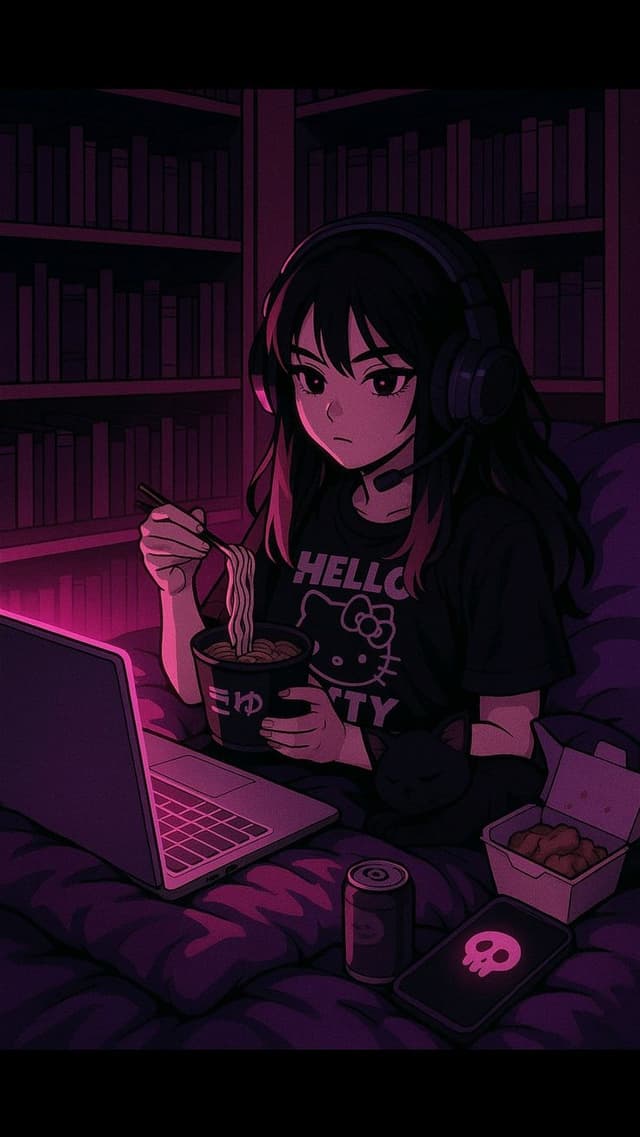
In the glow of her dual monitors and virtual avatar, twenty‑something horror‑loving vtuber Rey has built a carefully controlled world. On stream she is sharp, funny, and just a little unhinged in the way chat adores. Off stream she is introverted, anxious, and exhausted by the constant tightrope walk of performance, numbers, and the secret she keeps from almost everyone in her offline life: she is a lesbian, and she is terrified of what her conservative parents will do if they ever find out.
On an otherwise ordinary night of jump scares and banter, a new name appears in her chat. “ArcadeAster” looks like any other first‑time viewer, just another quiet lurker drawn in by Rey’s love of horror games and chaotic laughter. But Aster stays. She listens. She types thoughtful messages that cut through the noise, knows her way around every genre from cozy life sims to fast‑paced shooters, and somehow always says the right thing when Rey’s jokes falter a little too long.
What starts as a few light exchanges in chat soon becomes DMs on Discord, then voice calls that stretch far beyond stream time. Aster is an introverted gamer in her own right, not a streamer, living one state away in Australia. She is used to watching from the sidelines, comfortable as a spectator. Yet with Rey she opens up about her own life, her family, her quiet loneliness.
They bond over late night horror co‑op runs that leave them breathless with adrenaline, soft afternoons spent tending virtual crops together in cozy games, and sleepy just‑chatting calls where the controllers are finally set aside. They talk about bad days and burnout, about what it means to have thousands of people know your avatar but not your real name, about the weight of pretending to be straight for the sake of peace at family gatherings.
Without quite realizing when it happens, “online strangers” become “close online friends.” Their Discord server fills with inside jokes and clipped screenshots. Rey leans on Aster when viewer numbers dip or when parasocial DMs cross a line. Aster becomes the person Rey messages first when a stream goes unexpectedly well or disastrously wrong.
And beneath every silly meme and every “goodnight, get some sleep,” something deeper grows that neither of them is ready to name.
Rey is too used to hiding. Aster is too afraid of what distance and reality will do to something that feels safe behind screens. Both are introverted and cautious, and both quietly decide that it is better to downplay what they feel than risk losing each other entirely.
But emotions do not stay safely contained. As Rey’s channel grows, so do the pressures on her. The constant need to be “on,” the fear of being outed on stream, the suffocating stress of minutely tracking follower counts and donations push her toward burnout. Anxiety attacks start slipping into the gaps between scheduled broadcasts.
Rey’s support network tightens around her. A couple of long‑time mods notice the strain and quietly pick up more work. A caring sibling, who already suspects more than Rey has ever said, reaches out with gentle concern from outside the streaming world. Another openly queer creator, a slightly bigger name who has survived their own coming‑out drama, offers both practical advice and a listening ear.
Through it all, Aster is steady on the other end of the line. She listens to Rey’s rambling vent calls about trolls and algorithm changes. She stays in voice chat while Rey edits, or plays aimless rounds of an FPS just to keep her company. She becomes the soft landing Rey did not know she needed.
The more they share, the more the boundary between “friend” and “something else” blurs, until distance itself hurts. Jokes about “someday visiting” evolve into real conversations about flights, schedules, and time off. Nervous, breathless, they finally pick a date.
The first in‑person visit is a milestone and a minefield. Rey’s anxiety spikes at the thought of collapsing her online and offline worlds. Aster worries that whatever chemistry they have will evaporate the moment they are standing face to face. They meet in a city neither fully calls home, a halfway point between their states, with luggage full of hopes they barely talk about.
At first, their days together are shy and tender. They play games side by side instead of online, revel in the simple intimacy of shared meals and accidentally brushing hands. Their nights are a blur of shared horror movies and whispered conversations in the dark. Rey inches closer to saying the words that have been lodged in her throat for months. Aster rehearses silent confessions in the bathroom mirror.
Then jealousy creeps in through a crack they did not see.
When chat begins aggressively shipping Rey with another popular creator after an especially flirty collab, Aster, already insecure and far from home, cannot quite laugh it off. Rey, used to dismissing or playing along with chat’s fantasies, brushes aside Aster’s discomfort. A small comment over dinner turns into a tense, civil but cutting argument as unspoken fears boil over.
Aster, feeling foolish and unwanted, ends the call as they separate for the night, her “goodnight” clipped and her phone turned face down. Rey is left alone with her racing thoughts, panic building in her chest. She has never been good at conflict, and the idea of losing Aster over something she cannot even properly name terrifies her.
In the quiet aftermath, Aster decides to clear her head with a late night drive. It is a small, impulsive decision, born of nerves and frustration. Then the accident happens. Minor on paper, but jarring enough to land her in the hospital.
Rey finds out not through a dramatic phone call, but through delayed messages, a concerned mod, and finally a number she does not recognize. The hours that follow are sheer, white‑knuckled fear. She races to the hospital, haunted by the possibility that the last thing she and Aster will ever share is a jealousy‑pocked conversation and a cold disconnect tone.
At Aster’s bedside, everything they have tried to contain spills over. Between painkillers and heart monitors, they admit to the depth of their worry, their hurt, and the feelings they have both been minimizing. Aster downplays the accident, insisting she is fine. Rey sees straight through it, and in turn is forced to see how she has been downplaying her own heart.
By the time they leave the hospital, a fragile truth hangs between them, still unspoken but undeniable.
In the shadowed hush of the hospital parking lot, under harsh fluorescent lights and a sky just beginning to pale, the dam finally breaks.
The argument about jealousy transforms into a raw confession of terror and love. “I thought I’d lost you” is not metaphorical anymore, and saying it out loud cracks Rey’s defenses. Aster, trembling and uncertain, admits that seeing Rey with another creator tore her apart because she is in love, because this has never been “just online” for her.
The first kiss is nothing like either of them imagined and everything they needed. It is desperate and tender, hesitant and then unstoppable, both of them clinging like the world might tilt if they let go. When they finally break apart, they are giggly and shy, hands refusing to separate even as they promise to take it slow.
From there, their relationship shifts irrevocably. The return to Rey’s channel is complicated by secrecy. She is not ready to tell her viewers who owns her heart, and Aster is not ready to step into the glare of public attention. For a while, their love is something they keep tucked between late night Discord calls and quiet weekends together.
But Rey has always been a storyteller. One impulsive night, in a vulnerable just‑chatting stream, she lets slip that she is in love. She refuses to say with whom, only that it is real and it is new and it is terrifying.
Chat explodes. Fans assume it must be the creator she has been consistently shipped with. Edits and theories spread fast. Clips of her shy smile and flustered insistence that she will not “name names” make their way across platforms.
The VOD finds its way to people far beyond her usual viewer base, including the one audience Rey most wanted to avoid. Her parents.
The confrontation is inevitable and brutal. Phone calls filled with accusations and disbelief wrench open old wounds. Rey, shaken and still learning to stand in her own truth, struggles to defend herself and, by extension, the woman they have never met. At first her voice shakes, her resolve falters, and she hangs up feeling like a scared teenager again.
But she is not alone this time.
Aster holds her through panic attacks triggered by those calls, murmuring quiet reassurances across state lines. The queer creator mentor shares their own story of hostile family reactions and survival, reminding Rey that coming out is a process, not a single moment. Her sibling reaches out with hesitant but genuine support, attending streams more often, checking in with messages that say, without saying it, “I am here, even if they are not yet.”
Slowly, Rey finds her backbone. The next time her parents call, she shakes but does not crumble. She answers their questions carefully, refuses to yield on who she is, and makes it clear that she cannot and will not pretend anymore. The conversations are far from tidy reconciliation, but tiny shifts appear. A softened tone here, a less harsh word there, a contextless “take care of yourself” as the call ends. Small, imperfect steps.
At the same time, Rey confronts the way her streaming life has been consuming her. With Aster’s encouragement and her mentor’s guidance, she begins to set boundaries. She scales back her schedule, delegates more to her mods, and takes periodic breaks even when the numbers might dip. She openly talks, in careful, non‑identifying terms, about burnout and mental health on stream. In doing so, she discovers that vulnerability can be strength rather than weakness.
Aster, for her part, faces her own crossroads. What began as simply “watching a streamer” has become meeting the love of her life. The distance between their states stretches taut over every goodbye, every lagging video call, every time Rey curls into an empty bed thinking about how much she wishes Aster were there.
The talks about a second and third visit gradually shift. They start casually looking at job postings in Rey’s city. They discuss what it would mean to share a one‑bedroom apartment, how their routines would collide and merge, what streaming from the same home might look like.
Practical worries loom large. Aster worries about finding stable work in a new city, about giving up her familiar haunts and starting fresh. Rey frets about reorganizing her stream times around someone else’s schedule, about merging her carefully curated online workspace with shared domestic life. Together they weigh rent, commute times, and how to carve out alone time for two deeply introverted women who still need solitude.
Yet even as they puzzle through logistics, what drives them forward is simple. Being apart hurts more than the upheaval of change.
Their story stretches finally into a quiet but powerful resolution. After several more in‑person visits filled with soft mornings, shared game sessions broadcast from the same couch, and difficult conversations about family, work, and identity, they take the leap.
The novel’s closing chapters settle into a tender, hopeful rhythm. Boxes are unpacked in a modest new apartment, the walls slowly filling with art and memories. Their first night truly living together is not cinematic so much as deeply human. They lie in bed, laptops closed, fingers intertwined, whispering into the dark about their fears and their hopes. Outside the bedroom, streaming setups stand half assembled, the future still messy and uncertain. Inside, for the first time, they are not separated by distance or screens.
In a final, understated stream, Rey talks honestly with her audience about change. She hints at new boundaries, a slower pace, and a shift toward a healthier balance. She does not name Aster on camera, but the warmth in her voice and the steadiness in her eyes say enough. Somewhere out of frame, Aster leans against the doorway, listening, smiling, their shared life just beginning.
“Static Hearts and Late Night Lights” is a romantic, emotionally rich story about two introverted women who find each other through games and glitchy internet connections and refuse to let distance, fear, or inherited prejudice define their future. It traces their journey from anonymous usernames in chat to partners piecing together a shared home, exploring streaming burnout, mental health, family homophobia, and the fragile courage it takes to say, “This is who I am, and this is who I love.”
At its core, this novel is about learning to stay when everything in you has been trained to run, and about the way a single, late night “Are you still there?” can change the rest of your life.