In the salt-bright city that leans toward the Fell Mare like a ship eager for tide, Detective Nadia Quinn lives at the meeting point of rumor, lanternlight, and trouble. By day she keeps watch over the winding docks and the crowded market lanes. By night, when the case is finished or the city is simply too restless to sleep, she returns to The Shallows, the warm, lively tavern where sailors, dock workers, and the occasional criminal element all pretend they are only there for a drink. Nadia has earned a reputation there as a sharp-eyed listener, a calm presence, and someone who can untangle a lie without making the whole room feel the sting of it. In a city of wet stone, salt wind, and hidden agendas, that gift makes her invaluable.
Her latest case begins not with blood or grand sorcery, but with frustration. A seamstress, proud of her trade and increasingly desperate, asks Nadia to discover who has been stealing her silk stocks. The thefts are quiet and precise, the kind that leave no broken lock and no obvious trail, only empty shelves and a mounting fear that her business will fail if the losses continue. Nadia, who prefers cases that begin in whispers rather than screams, takes the matter on and starts at the shop itself, where the clues are small but telling. Threads out of place, residue of magic where no magic should linger, and the faint sense that someone has been entering with purpose rather than greed all point her toward a thief who knows exactly what he is taking and why.
As Nadia investigates the seamstress’s workshop and the market around it, she discovers that the stolen silk is not destined for vanity or simple resale. It is being used for magical crafting, a rare and intricate discipline that requires materials as exacting as any spell formula. The trail leads her to a wizard, secretive at first, then increasingly recognizable as a man driven by panic more than malice. Pirates have raided the ship carrying his supplies, leaving him unable to complete an urgent commission for magical capes intended for a noble elite. If he fails, he loses not only the order but the standing and livelihood tied to it. Faced with ruin, he made a desperate choice and began taking the seamstress’s silk, believing he could repay the theft once his work was done.
The situation grows more complicated when Nadia learns that the seamstress is no stranger to the wizard. They were childhood sweethearts, separated by life, timing, and whatever small tragedies turn youthful certainty into years of silence. This revelation transforms the case from a simple matter of theft into something far more delicate. The seamstress is not only angry. She is wounded by the realization that the man she once loved stole from her, even if he was driven by desperation. The wizard, for his part, is ashamed, cornered by his own failure and by the knowledge that the one person he can no longer bear to disappoint is the very one he has wronged. Nadia sees at once that punishment alone will solve nothing. What is needed is a compromise sturdy enough to hold up under guilt, love, and practical necessity.
She presses deeper into the problem, balancing sympathy against justice with the measured patience that has made her so trusted in The Shallows. The tavern regulars become an unofficial net of information, offering dockside whispers, market gossip, and the occasional useful lie. Sailors know which cargo vanished on which tide. Dock workers know who was seen unloading spoiled crates in the wrong alley. Even the rougher company that drifts through the tavern provides fragments Nadia can fit together. Through it all, she keeps the seamstress involved, not as a passive victim but as an unexpected ally who proves more resilient, observant, and brave than anyone including herself first expects. The case becomes as much about restoring her agency as it is about recovering the silk.
Nadia’s challenge is to find a solution that honors both harm and necessity. She cannot excuse the theft, but neither can she ignore the wizard’s desperation or the reality of the pirate raid that ruined him. She brings the pair toward a reckoning at once uncomfortable and necessary, guiding them to face what was taken, what was risked, and what remains possible if pride is set aside. The wizard apologizes, plainly and without artifice, then offers to replace the silk with the funds he will receive once he completes the noble order. It is not a grand gesture. It is a practical promise, and in a city like this, practicality often proves more faithful than poetry.
What follows is a softer kind of resolution, one that only a cozy mystery with real heart can deliver. The seamstress does not simply forgive and forget, nor does the wizard escape the weight of what he has done. Instead, they choose to begin again, this time with clear eyes and honest words. Their old affection, long buried beneath years of distance and hurt, surfaces in the quiet spaces between admissions and apologies. Nadia, who has spent the investigation gathering not only facts but people’s true shapes, recognizes the beginning of something repaired rather than merely renewed. By the end, the seamstress and the wizard reconnect, and the possibility of a shared future emerges with the same warmth as lamp glow on wet cobblestones.
Their ending is not only romantic. It is practical, creative, and alive with second chances. Together, they decide to open a shop, one that joins her skill with fabric and his skill with magical crafting into a venture neither could have built alone. In a city where the sea can take from people without warning, the new shop becomes a declaration that loss need not be the final word. It is a place where silk becomes spellwork, where memory is stitched into enterprise, and where two people once separated by time find themselves building something sturdier than either ever managed alone. For Nadia, the result is deeply satisfying, not because the crime was trivial, but because the solution restored more than inventory. It restored trust, purpose, and a path forward.
The Shallows remains the story’s anchor and emotional hearth. After the case is solved, the seamstress and the wizard are always welcome there, joining the sailors, dock workers, and shady drifters under the same roof where salt spray clings to the shutters and laughter rises above the clink of cups. The tavern stands as a symbol of the city itself, lively but warm, rough-edged but kind. It is where Nadia belongs when she is not chasing secrets, and where the bonds formed during the investigation continue to breathe. In that space, the mystery’s resolution feels complete not because every wound vanished, but because the people involved chose to answer hurt with honesty, labor, and care.
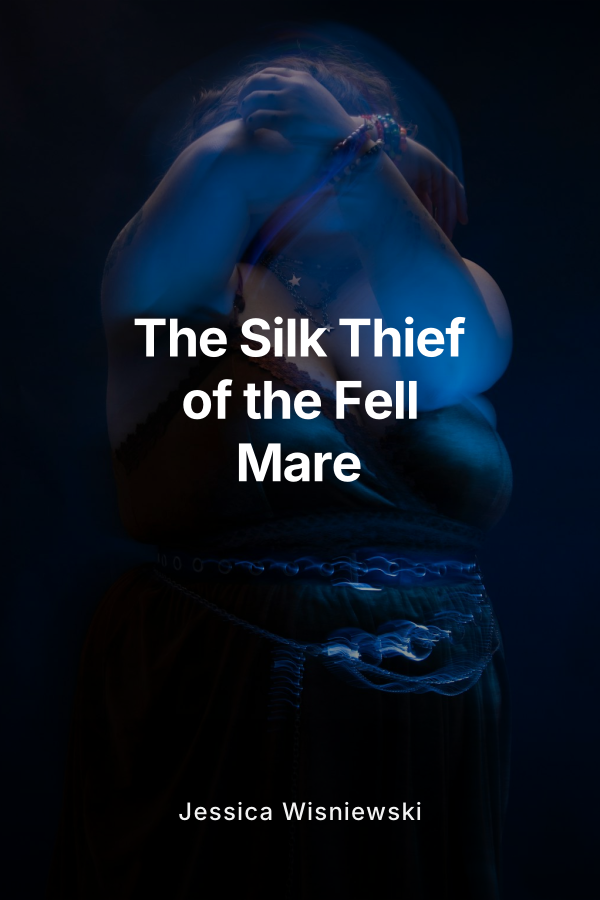
The Silk Thief of the Fell Mare is a cozy fantasy mystery built on charm, clever deduction, and emotional repair. It follows Detective Nadia Quinn through a case that begins with stolen fabric and ends with restored futures, all set against a coastal city whose streets shine with rain, magic, and the low hum of dockside life. At its center is a detective who understands that justice is not always harsh to be meaningful. Sometimes it is a careful hand, a patient question, and the courage to help two people find the better version of their story.