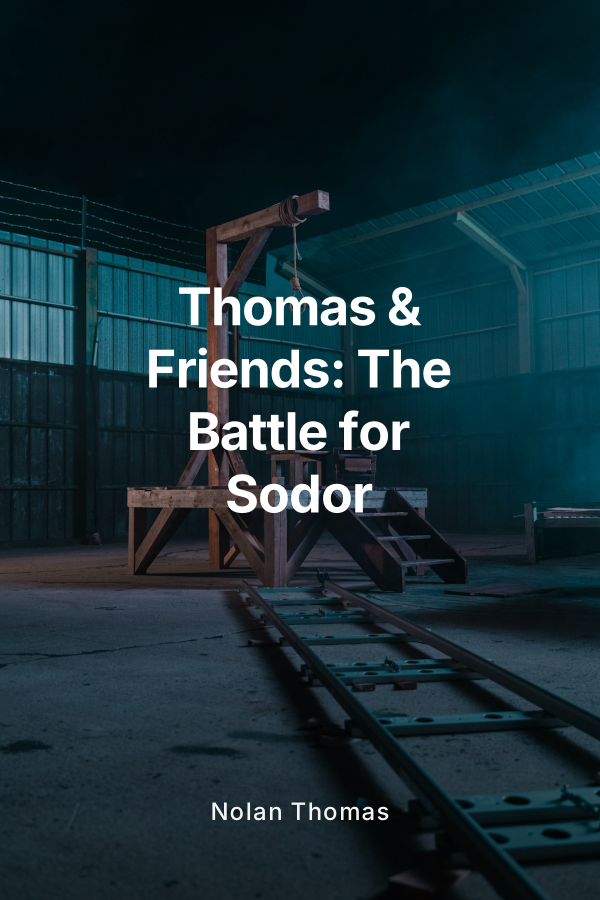
In the first cold hours, Sodor does not know it is already under siege. Freight wagons arrive at Salty’s docks with no clear purpose. Branch maps vanish. Strange lights burn near the causeway. The mainland is not visiting. It is measuring the island. Diesel hears the first warning, Gordon feels the first pressure on the main line, Duck notices the railway’s memory being erased, and Harold sees movement in the dark beyond the water. The mainland horns at the end are not a threat. They are a declaration.
When General Ironclad finally crosses the causeway with the invasion fleet, he does not come as a raider. He comes as a conqueror with a doctrine. He speaks of modernization, reorganization, and control, but his real message is simpler. Sodor will be absorbed or broken. Sir Topham Hatt refuses to yield, and Vicarstown Yard is seized before negotiations can even begin. The island is cut off in a single stroke, and every engine understands that the war has started for real.
The opening campaign is brutal and fast. Knapford Junction becomes the first major battlefield, where Henry and Emily throw ballast into place as improvised barricades while James evacuates passengers under fire. Gordon fights like a fortress on wheels, but the line collapses anyway. That loss changes everything. Sodor is no longer defending routes. It is defending the idea that it can still be itself.
From there, the story widens. Percy, Toby, Rosie, and Duck become the hidden spine of resistance, using forgotten sidings, branch loops, and dead-end rails to move supplies, messages, and wounded engines past hostile patrols. Duck emerges as a ruthless strategist, not because he wants glory, but because he understands that survival now depends on precision, deception, and sacrifice. The branch lines stop being backwaters and become arteries.
The docks at Brendam become another front entirely. Mavis, Salty, Diesel, and Cranky hold back a landing operation meant to flood the island with reinforcements. The battle is chaotic and physical, with cargo containers slammed across tracks and freight lines smashed to pieces. Paxton is badly damaged in the defense, and the docks barely hold. The victory is real, but it is not clean. It leaves the defenders exhausted and the enemy angry enough to escalate.
As the war fractures the island into separate fronts, the tone turns harder and darker. Gordon, Henry, and Rebecca bear the strain of the main line. Duck and Toby keep the resistance network alive in the south. Diesel, once seen as unpredictable, begins proving himself as a thinker who can see the battlefield as a whole. Every route matters now. Every delay costs lives. The island is too small for this many fronts, and the enemy knows it.
The quarry battle becomes a turning point, both tactically and emotionally. Oliver and Duck lead the defense under relentless pressure, and when retreat becomes unavoidable, Oliver stays behind long enough to switch Duck and the freight wagons to safety. The line collapses around him. He is lost in the retreat. The loss is not just a casualty. It is proof that Sodor’s victories will always demand something permanent.
The siege of Tidmouth Sheds follows, and the island begins to feel like a trapped organism trying to keep its blood moving. Night fog, blocked points, emergency repairs, engines racing between sheds under pressure and exhaustion. The sheds survive, but the men and engines inside them are scarred by the constant strain. No one sleeps well anymore. No one trusts silence.
A risky counterattack then gives Sodor its first real offensive momentum. Diesel proposes striking instead of merely enduring. Percy and Rosie run messages across the island, Mavis sabotages enemy freight lines, and Gordon drives toward Knapford in an attempt to reclaim what was lost. The attack only partly succeeds, but it changes morale. The defenders begin to believe that Ironclad can be challenged, not merely survived.
The mountain campaign raises the stakes again. Donald and Douglas, with Hiro and Flynn, hold the northern passes through tunnels and curves where armor means little and judgment means everything. The fighting becomes claustrophobic and relentless. Douglas’s final stand is the emotional center of the entire season. He uncouples stone wagons into a tunnel to block the enemy advance, and the tactic works. But it traps him behind the blockade. He does not come back. Donald is left with the unbearable silence of waiting for an answer that never arrives.
After that, the story narrows into grief. Broken Spirits is not a battle episode so much as a reckoning. The railway tries to continue, but every engine carries the weight of the losses. Donald struggles to function. Diesel begins doubting whether Sodor can win at all. Then Sir Topham Hatt gives a speech that does not erase the dead, but gives the living a reason to keep moving. It becomes the emotional hinge of the novel. The war is still unwinnable in theory. Yet the railway chooses to fight anyway.
The final act is a march to Vicarstown and then the causeway itself. Every surviving engine is assigned a role. Gordon leads the center. Henry and Emily guard the flanks. Duck and Toby exploit branch routes. Diesel infiltrates the yard. Harold scouts overhead. The attack on the causeway becomes the largest clash of the war, with barricades, signal fights, direct confrontations, and the mainland fleet pushed back step by step toward the bridge. Ironclad makes one last desperate push, and the battle becomes a test of endurance as much as force.
The ending is victorious, but not pure. Ironclad is defeated. The mainland fleet retreats. Sodor begins rebuilding. Memorial sidings are named for Oliver and Douglas, making the cost of the war part of the railway’s future rather than a forgotten wound. At Tidmouth, the surviving engines gather in silence at sunrise. It is a moment of survival, grief, and earned peace. Then a distant mainland horn sounds again. Not a full threat. Not a promise of another war. Just enough to remind the island that peace is fragile, and that the battle for Sodor may never truly be over.