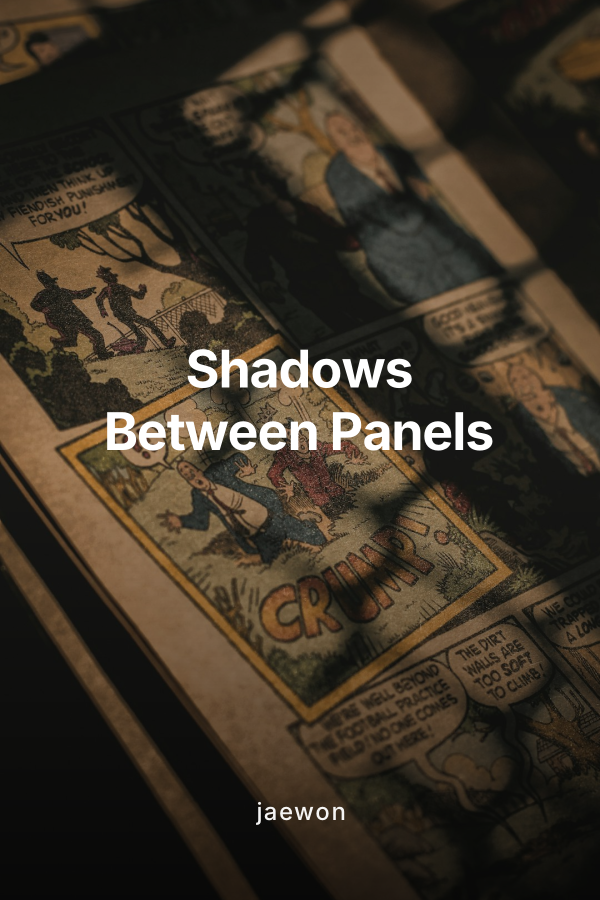
In a glittering Seoul high school that exists inside the pages of a bestselling graphic novel, everyone thinks they know how the story goes. Lee Hanseo, the flawless golden boy, is destined to fall for Choi Dayun, the bullied but pure-hearted heroine. Lim Youngmi is the loud, devoted best friend with a hopeless crush on Hanseo’s stoic sidekick, Yoon Junho. The readers come for the familiar tropes and the satisfying happy ending.
Inside the story, Yoon Junho begins as exactly what he was written to be: a cool, mysterious background character whose only function is to nurse a one sided crush on Youngmi while quietly supporting Hanseo and Dayun’s inevitable romance. He acts his lines, hits his marks, and feels only what the panels allow.
Until, one day, he wakes up somewhere he does not remember walking to.
His body will not move. His mouth will not open. Words pour out of him anyway, smooth and practiced, as if someone else is pulling the strings. Classmates laugh in all the right places. Backgrounds shift without warning. The world skips from scene to scene. Then, without explanation, control slams back into his limbs. He can breathe again. He can choose again.
No one else notices that anything is wrong.
A nameless boy with a forgettable face and a seat by the window quietly approaches him after one of these blackouts. His name is Park Kyungjun, a statistical nobody in the story’s hierarchy, and he has an impossible explanation. They are characters in a romance graphic novel. Every time Junho’s consciousness blanks and the world poses him like a doll, he is inside a “scene” where the script dictates his every move. Every moment in between, when his body is his own and the world feels slightly quieter and more fragile, is called “the shadow.”
In the shadows, they are free.
Free, but invisible.
Anything that happens in the shadows is swallowed the instant the next scene begins. No one remembers shadow conversations. No one recalls the small acts of rebellion, the jokes, the secrets, the tears. The story smooths itself over and continues forward, neat and unbothered, toward the ending the author has planned.
At first, Junho simply feels horror at his own role. On the page, he is scripted to be the tragic, one dimensional boy whose heart is wasted on the wrong girl. His purpose is to suffer, to block, to linger in the background as a source of angst for other people’s character development. Outside the scenes, his true self surfaces: open though reserved, patient, watchful, idealistic, with a stubborn sense that he might have been more if someone had written him differently.
He tells himself that the problem is the script.
Then, in the shadows, he starts to really see Lee Hanseo.
The novel’s version of Hanseo is unbearably perfect. Popular, bright, socially and academically gifted, gentle with the weak, stubbornly devoted to Dayun. But the Hanseo Junho meets in the shadows is sharper and more human. Still charming, yes, but drier, funnier, more sarcastic. Shy in subtle ways the panels never capture. Less patient than the story suggests. Someone who fumbles, who gets tired of being flawless, who admits in low, private tones that he sometimes feels like he is acting out a role for an invisible audience.
In scenes, Hanseo smiles like the sun at Dayun. In the shadows, he rubs his temples and mutters that he wishes he could forget what people expect from him. Junho, who is supposed to be the aloof bad boy, finds himself sitting beside him on stairwells the readers never see, listening more than speaking, offering quiet comfort that no one will remember.
Slowly, his attention shifts.
It begins as a vague sense of protectiveness, the same loyalty the script expects of him, only heavier and more tangled. He notices how hard Hanseo laughs at jokes that are not actually funny, how his eyes glaze for a heartbeat after emotionally intense scenes as if he is waking from a dream, how he hesitates before calling Dayun by the pet names the story has assigned him.
Junho tells himself he is simply angry on his friend’s behalf, that he hates the constraints of the narrative. He hates the way they are both puppets. He hates the way his “role” feeds the main love story while stunting any chance he might have at something real.
But shadows pile up. Conversations accumulate that only he remembers. And the more he sees of Hanseo that is not on the page, the more restless he becomes in the scenes where he must stand at his side and act out support for a romance that makes his stomach knots with something far more complicated than jealousy of the female lead.
His feelings remain a fog until the trigger comes.
After a particularly intense scripted argument between Hanseo and Dayun, Junho slips back into the shadows and stalks the empty hallways, heart racing from emotions that are not entirely his own. He finds Hanseo alone on the rooftop, shoulders slumped, the weight of the perfect boyfriend role pressing down on him. This Hanseo is not radiant. He is small and tired and quietly furious at himself for snapping at Dayun the way the script demanded.
The scene is over. The readers have turned the page. No one is watching.
Junho crosses the rooftop and, for once, speaks without restraint. He tells Hanseo that he is more than the story’s favorite. That he does not always have to be kind. That he deserves someone who sees him as a person, not a protagonist. He says, “I can treat you better,” and the truth burns his throat as he says it, because in that moment he is not talking about friendship at all.
Hanseo looks up, eyes raw, and smiles in a way the panels would never allow: awkward and grateful, without polish. He leans into Junho’s shoulder. No one interrupts. No narrator steps in. The world feels painfully, blindingly real.
Junho’s heart finally catches up with what his attention has been doing for weeks.
He is in love with Hanseo.
The realization hits with the force of a collapsing scene. From that point on, every panel hurts. He has to watch Hanseo and Dayun smile and blush and fight and make up, forced to insert teasing remarks and supportive looks that the script pulls out of him against his will. The jealousy in his written lines is meant to be aimed at Dayun. In truth, it is tangled around Hanseo himself. Junho cannot show it. He cannot confess. He cannot even flinch in public without the story correcting him.
Inside, though, everything shifts.
The shadows become his only refuge. There, his stoic image falls away. In the forgotten spaces between scenes, he paces, spirals, argues with Kyungjun about fate and free will. He hates the scenes and loves the shadows because only there can he be a boy who is painfully, hopelessly in love with his best friend. When the new scene snaps in, it erases his progress, but not his memory. He carries every unremembered touch and every one sided conversation like contraband.
Lim Youngmi gains awareness next.
At first she thinks she has lost her mind. She notices the jumps, the gaps, the way her body delivers cheerful, over the top lines while her real self watches from far away. Her crush on Junho, intense and sparkling within the narrative, starts to feel hollow under the harsh light of self awareness. In the shadows, she is still bright, still talkative, but softer and more easily bruised.
Youngmi is the first to notice the way Junho’s eyes follow Hanseo in both worlds.
She misreads it as ordinary loyalty, then lingering guilt. But one shadow lunch, as they share cold cafeteria leftovers in a stairwell that will reset in minutes, she asks a question that lands like a confession of its own: “Is it really Dayun you’re jealous of?” Junho’s silence tells her everything. Slowly, gently, she becomes his confidant, the only person who knows the shape of his impossible love.
Supporting him means letting go of her own scripted crush.
With Kyungjun’s cautious explanations and Youngmi’s emotional insight, a small trio forms in the shadows, dedicated to understanding and then pushing against the rules that hold them. Kyungjun, who has been aware longer than any of them, has already experimented with tiny acts of disobedience. A misplaced line here, a missed cue there. Nothing large enough to jolt the narrative, but enough to catalog the system’s limits.
As the group grows closer, they realize the story is not a brick wall but a river.
Scenes can be nudged, their emotional undercurrents redirected by choices made in the shadows beforehand. Jokes told off panel linger as echoes on characters’ tongues. A backpack moved in the shadows becomes a prop in a later scene. There are cracks in the script, and they begin to wedge hope into them.
Then, halfway through the graphic novel’s intended plot, the unthinkable happens.
Lee Hanseo gains consciousness.
For a moment, he believes he is having a panic attack. The world freezes mid-step. Speech bubbles hang unspoken in the air. Then, with a lurch, control returns. He stumbles into the shadows, reeling from the knowledge that his feelings in scenes are not entirely his own. That his devotion to Dayun has been inflated for drama. That his worst fears about living up to everyone’s image of him are literally true.
Hanseo’s awareness sends shockwaves through their fragile equilibrium. He remembers nothing of his shadow conversations with Junho so far, yet he can feel the impression of someone standing beside him in all his worst moments. Someone who has always been there between panels, offering grounding and care that the readers never see.
When Kyungjun tentatively approaches him with the truth, and Youngmi vouches for Junho with wet, earnest eyes, Hanseo is forced to confront the possibility that his life has been split in two. The public, scripted, golden boy and the private, shadow self that someone else already knows deeply.
Junho, terrified of disturbing the original love story that Dayun still clings to, keeps his distance at first. He stays in the background and watches as Hanseo struggles with guilt and confusion. His love becomes even more painful: now he knows Hanseo is suffering consciously inside the same trap, yet he still has to smile and play the supportive friend when the scene demands it.
The narrative does not like being resisted.
As more key characters gain awareness, small punishments begin to appear. Lines repeat if they improvise too far. Minor scenes rewind with a dizzying snap when someone outright refuses a plot point. Memories scramble around moments where they push hardest. A teacher’s gaze lingers a little too sharply when someone’s behavior strays off script, as if the world itself is watching through borrowed eyes.
The threat remains mostly subtle, but it is constant.
Dayun becomes aware near the end of the story, long after Hanseo and Junho have entangled their hearts in ways no script anticipated. For Dayun, who truly likes Hanseo and cherishes every panel where he chooses her, the awakening is a knife. To admit that some of her softest moments have been manufactured by an unseen hand feels like sacrilege. She clings to the certainty that her feelings are real, even if the push behind them was written.
Over time, though, watching Hanseo’s increasing exhaustion in scenes and sensing the tremor in Junho’s voice whenever he slips and says “we” instead of “you,” she starts to see the bigger cage they all share. Youngmi, who once orbited Junho in a scripted crush, quietly releases her claim and directs her energy toward freeing them instead. Kyungjun, the once insignificant side character, becomes the quiet strategist who maps their world and points them toward the few moments where they can make substantial changes without breaking entirely.
The heart of the book lies in Junho and Hanseo’s slow, painful, beautiful crawl toward each other.
They fall in love in a broken language: half spoken lines in the shadows, almost confessions that the script edits back into banter, accidental touches whose meaning only they remember. Junho learns every unperformed version of Hanseo, from his petty annoyance at the school’s broken vending machines to his secret hatred of the pedestal he lives on. Hanseo, for his part, comes to rely on the warmth and steadiness Junho offers when no one else is looking.
“I can treat you better,” said once on a rooftop, becomes a promise that keeps Junho going when the scenes hurt most. “If only I ever had a chance,” turns into a quiet vow to carve that chance out of the panels themselves, no matter how slowly.
Their love is bittersweet for most of the story.
Junho has to watch Hanseo act out happy scenes with Dayun, scenes that now feel increasingly hollow to both of them as awareness spreads. Still, Hanseo’s affection for Dayun is not a lie. It is just not the whole truth. The novel insists on flattening that complexity, but the shadows give it room to breathe.
By the time Dayun accepts her own awareness and begins contemplating change, all four of them have outgrown their assigned archetypes. Dayun is no longer the endlessly forgiving victim. Youngmi is not just the comedic sidekick. Hanseo is not perfect, and Junho is no longer an insignificant side character whose heart is wasted on the wrong person.
Together with Kyungjun, they start steering the climax away from the predictable ending.
The plan is not to destroy the story entirely but to reshape it so that everyone’s true selves have space to exist. That means letting some scenes play out to keep the world stable, while quietly rewriting the emotional truth behind them. Dayun gently loosens her grip on the role of main heroine and accepts that part of loving Hanseo is letting him choose freely, even if he chooses someone else. Youngmi shields Junho in public and gives him room to be honest in private. Kyungjun identifies critical “hinge” scenes where a single line altered in the shadows can ripple into a different outcome.
The final stretch of the novel becomes a battle between what the panels show and what the characters actually feel.
On the page, readers see a classic build up to a confession between Hanseo and Dayun. Behind the scenes, in shadows heavy with unsaid words, Junho finally refuses to swallow the last of his truth. Years of silent devotion and secret understanding compress into one fragile, stolen moment where he chooses to speak, knowing that the story might try to erase it.
He confesses to Hanseo not with grand gestures but with the raw honesty of someone who has watched him live two lives. He tells him he fell in love with the boy who is tired and human and occasionally selfish, not the perfect lead. He admits that the thing he hates most about the novel is not his own tragic arc, but the way it keeps them both from being who they are to each other.
Whether the world remembers or not, he needs Hanseo to know.
Instead of glitching apart, the narrative shudders and bends.
Hanseo, fully aware now, makes his own choice. In the next scene, under the eyes of classmates and readers and the invisible author, he deviates more dramatically than any of them have dared. The story cannot simply reset without unravelling everything. So it stutters, redraws a few lines, and tries to incorporate this new thread.
The ending that once belonged solely to Hanseo and Dayun stretches to make room for a different kind of love story.
Shadows Between Panels is a character driven, slowburn romance about identity, autonomy, and the courage to love someone completely even when the world keeps insisting you are only a side character in their story. Set against the vibrant, trope filled backdrop of a Seoul high school graphic novel, it balances bittersweet unrequited longing with the quiet triumph of two boys who refuse to let a predetermined plot decide what their hearts are allowed to feel.
Over five chapters, the book follows Junho’s journey from numb script follower to fiercely self aware young man who dares to claim his own narrative, even if it means breaking the illusion of a perfect romance. Along the way, it gives depth and agency to the “supporting” characters around him, turning a familiar high school love triangle into a layered exploration of what it means to step out of the role you were given and begin writing yourself.