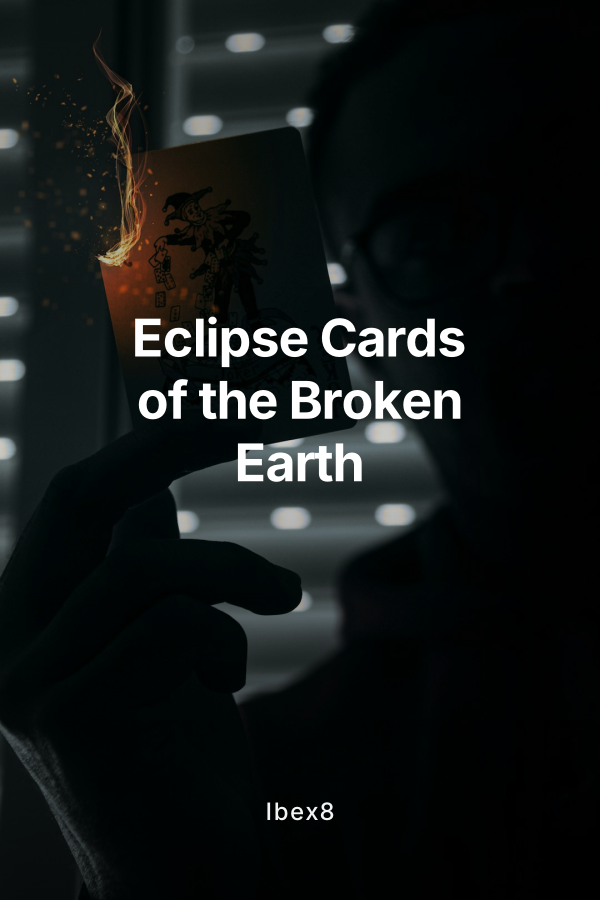
In a world where the sky itself becomes a weapon, Eclipse Cards of the Broken Earth follows the fevered collapse of a civilization that has already begun to rot from within. The story unfolds in a shattered metropolis of catacombs, industrial skeletons, haunted towers, and collapsed infrastructure, where memory, prophecy, and machinery all seem equally cursed. At its center is an unnamed witness, a figure drifting through the ruins with a mind full of fractured visions, trying to interpret the meaning of the catastrophe before it finishes consuming everything.
The book opens under a catastrophic eclipse, an event that does not merely darken the sun but seems to unseal a hidden order of dread. The eclipse acts like a signal, a sentence, and a summoning. Across the city, strange cards begin to appear, each one carrying the force of a supernatural weapon. These cards are not simple objects. They behave like relics, verdicts, and instruments of control. Some seem ancient, some futuristic, and some impossible to place in time at all. Their presence destabilizes the remaining structures of power, turning streets into battlegrounds of omen and panic.
As the eclipse deepens, the city becomes more than a setting. It turns into a living archive of ruin. Its books are buried in ash, its palaces stand cracked beneath constellations that no longer look trustworthy, and its people move like shadows inside a machine that has forgotten its purpose. The narrator wanders through catacombs, kitchens, schools, and asphalt corridors where the ordinary has been turned monstrous. Birds circle overhead like messengers from a broken heaven. Skulls appear in the infrastructure. Towers lean into the void. Every detail suggests that civilization has not been destroyed all at once, but unraveling has been happening for a long time, quietly and irrevocably.
The supernatural weapon cards become the book’s central mystery and threat. They are not merely tools for violence, but symbols of a hidden architecture of domination. Those who possess them gain access to forces that can rewrite perception, bend crowds, collapse structures, and twist the boundary between the living and the dead. The cards are tied to an older intelligence, one that may have originated beneath the city, above the stars, or in the forgotten mathematics of the world itself. Their use brings power, but each activation also deepens the contamination of reality. The more the cards are deployed, the less human the world becomes.
The narrator’s journey is both external and internal. Moving through the ruins, the witness begins to understand that the catastrophe is not only political or technological. It is metaphysical. The city’s collapse mirrors a collapse of language, memory, and identity. Meaning has become unstable. Buildings seem to think. Statues seem to accuse. The dead are not entirely gone. The living are not entirely awake. In this environment, dread is not a passing emotion but the atmosphere itself. The book sustains a constant feeling that something immense and inhuman is watching the city through the eclipse.
A key force in the summary’s imagined arc is the relationship between knowledge and corruption. The narrator uncovers signs of an ancient system that shaped the city long before the present disaster. Scholars, founders, astronomers, industrial originators, and unnamed occult authorities all appear as fragments of a lineage that may have engineered the very conditions of collapse. Their legacy is embedded in architecture, in weapon design, in ritual, and in the way the city was built to hide its own doom. What seems like modern ruin may actually be the final stage of a much older design.
The climax of the story would be driven by the full unveiling of the cards’ purpose. The witness eventually discovers that the eclipse is not simply covering the city but activating it. The cards are keys, and the city is a lock. When assembled or invoked in the correct sequence, they awaken a force buried beneath the metropolis, a force capable of turning the remaining world into a ceremonial ruin. This revelation transforms the narrative from mere apocalypse into cosmic horror. The catastrophe is no accident. It is a ritual unfolding according to an intelligence that has waited patiently for the right darkness.
By the end, the book leaves the reader with a final sense of irreversible dread. Whether the narrator survives is less important than the fact that survival itself has become meaningless. The world has been altered at its foundation. The eclipse has taught the city to see itself as an instrument of its own destruction. What remains is the image of cards scattered among collapsed streets, catacombs swallowing the last light, and a sky so black it feels populated. Eclipse Cards of the Broken Earth is a vision of civilization consumed by its own hidden mechanisms, where every symbol becomes a threat and every shadow may be the hand of something ancient reaching back into the world.