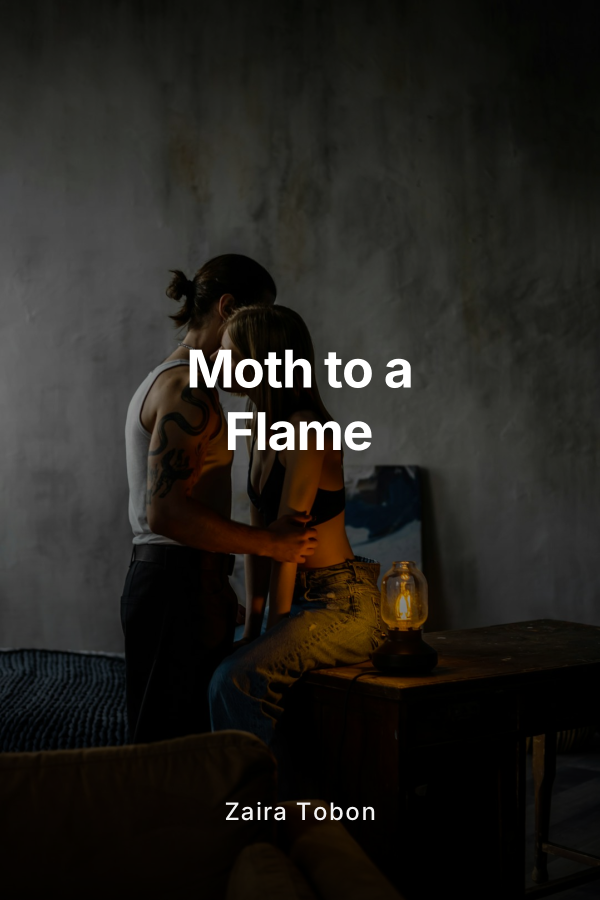
Only the first page of this book is left. We lost the rest in October 2026.
We lost access to the service that stored them, and no other copy exists. We're sorry.
Luan Del Monte grows up believing that love is something you earn. The daughter of a refined British art historian and a relentless Mexican businessman, she is raised between gallery halls and boardrooms, taught to shine, impress, and never, ever disappoint. As an only child, she learns to perform for affection, to anticipate needs before anyone asks, and to swallow her own loneliness with a dazzling smile.
At five years old, in a paddock that smells of gasoline and summer heat, Luan meets Lando Norris. He is loud, clever, and fast in every way that matters to a child. In that moment, her young heart chooses him. From shared toy cars and sticky ice cream fingers to teenage late-night calls between race weekends and auditions, Lando becomes her constant. He is the sun she orbits, the boy who makes her feel seen, even as he never fully reaches for her hand.
Luan’s talent pulls her into a different spotlight. As Hollywood discovers her, she becomes the face the camera worships. Cast as Rogue in the Marvel universe, part of the epic scale of Dune, and fronting campaigns for Prada, Dior, and Swarovski, she builds a world of prestige and perfection around herself. Red carpets, couture fittings, and global press tours shape a life most would envy, but behind every flash of a camera there is one name she still waits to see on her phone.
Lando.
Their relationship settles into an aching rhythm. He calls when a date has gone wrong, when the hotel room feels too empty, when he needs help smoothing over a PR problem or just wants to talk to someone who understands the noise. Luan answers every time. She flies across continents between shoots and circuits, rearranges fittings, skips wrap parties, and puts her own needs last to be there for him.
He loves her, but only in halves. She accepts it because this is the version of love she believes she deserves, the kind she has been trained to chase: conditional, fragile, always just out of reach.
Everything shifts at an end-of-season Formula 1 party. Luan arrives as she always does, glowing in forest green, sunflowers in her hotel room vase, ready to celebrate Lando’s year by his side. Within an hour he disappears with a model on his arm, leaving her alone under glittering lights and the dull ache of too-familiar disappointment.
Charles Leclerc finds her adrift and introduces her to someone who sees her for the very first time.
Oscar Piastri.
Quiet where Lando is loud, observant where Lando is impulsive, Oscar notices the way Luan’s smile never quite reaches her eyes. He listens when she talks about film sets and fashion houses, offers her water when the champagne keeps coming, and stays beside her until the music fades and the party thins. From that first night, something in her carefully curated world tilts. For the first time, she meets a man who looks at her as if she is not a supporting character in someone else’s story, but the lead in her own.
What follows is a slow burn that rewrites the rules Luan has lived by.
They begin as friends. Texts after races. Calls after long days on set. Shared playlists. Inside jokes about the absurdity of fame, the pressure of never slipping, the fear of being only as good as your last performance or your last result. Oscar sees her when she stumbles. He hears the crack in her voice when she insists she is fine. He notices that her favorite flowers are sunflowers and sends them without a camera in sight.
Gradually, Luan starts to say no.
No to bailing Lando out of another awkward date. No to leaving set early because he is bored and lonely on a different continent. No to canceling dinner with Oscar because Lando has suddenly remembered she exists. Each refusal feels like sacrilege, but with every boundary she draws, her world fills with new color and confidence. She begins to understand that love does not have to hurt to be real, that respect is not a luxury but a requirement.
As they edge from friendship into something undeniably more, Oscar invites her deeper into his life. She meets his parents, Chris and Nicole, in a modest, warm home that smells of coffee and family dinners. She learns to laugh with his sisters Hattie, Mae, and Edie, folding herself into their chaotic teasing and quiet support. For someone who grew up performing to be enough, the acceptance feels like a revelation. With them, she is just Luan, barefoot in the kitchen, hair in a loose bun, talking about everything and nothing at once.
In turn, Oscar meets her parents and discovers the roots of the woman he loves. He sees the refined elegance of her mother, the razor-sharp pragmatism of her father, and the subtle ways they have both pushed their daughter to be perfect. He realizes how often Luan has put others first, how deeply she has tied her worth to what she can give. He decides, quietly and absolutely, to give her back the one thing she has always sacrificed: herself.
Their relationship unfolds in private, away from the tabloid lens, but the world eventually notices. When the media catches the first soft-focus photos of Luan Del Monte holding hands with Oscar Piastri, the internet ignites. Headlines dissect their every gesture. Fans argue over loyalty to Lando and the perceived betrayal. Commentators speculate about distractions and conflicts of interest.
Luan, who has spent a career being adored for who people think she is, now has to decide whether she can withstand being scrutinized for who she chooses to love.
Meanwhile, Lando begins to notice the absence that has replaced his once constant companion. The girl who answered his calls at any hour now lets them go to voicemail. The woman who would drop everything to rush to his side sends apologetic texts explaining that she is busy, that she has plans. Often, those plans include Oscar.
For years, he has taken Luan’s devotion as a given, an unshakeable part of his universe. Now, for the first time, he feels the edges of panic. He tells himself it is just about losing a friend, about change, about discomfort. But when he sees Luan and Oscar together at the track, laughing in a way he has never managed to coax out of her, something inside him fractures.
He realizes he has been in love with Luan Del Monte for longer than he cares to admit.
Spurred by that painful clarity, he resolves to win her back. He tries to be better. More attentive. More present. He sends late-night messages he never would have dared to before. He shows up at her hotel with sunflowers, only to find that Oscar has already filled her room with them. He offers to listen when she talks, but she is no longer talking only to him.
His grand gesture comes too late.
When Lando finally builds the courage to confess his feelings, to tell her he is ready to love her not in halves but wholly, he goes to her home. There he finds not the single sanctuary he remembers but a shared life. Oscar’s shoes by the door. Two travel suitcases half packed near the stairs. A framed photo of Luan and Oscar grinning with their arms around his family. Another of them at a premiere, heads tipped together, the world blurring around them.
He watches quietly as Oscar appears behind her, hand resting at the small of her back, a familiar and easy intimacy that speaks of countless quiet mornings and tired nights shared. Lando sees, for the first time, what it looks like when someone truly loves Luan in full.
On track, the tension boils over into a ferocious championship fight. Oscar and Lando battle race after race, every overtake laced with history, every podium weighted with what neither of them can fully say aloud. The media brands it the rivalry of the generation, but for the three people at the center of it, the stakes are far more personal.
Lando tries, in his own flawed way, to prove that he has changed. He shows Luan patience instead of demands, vulnerability instead of bravado. He confesses without conditions. He asks for another chance, this time as more than the boy who only called when the night went wrong.
Luan listens, because she has always cared for him. She grieves the boy he was to her, the years she spent loving him quietly, the friendship that defined so much of her life. But she also looks at the man standing beside her, the one who has been steady, respectful, and unwavering. She thinks of how Oscar has never asked her to shrink, how he has never used her as a backup plan or an emotional crutch.
In the end, she chooses herself by choosing Oscar.
The victory is not clean. Lando cannot easily accept that the person he once treated as an afterthought has built a world without him at its center. His resentment flares, not only toward Oscar, who now has what he finally realizes he wanted, but toward himself. He is forced to confront the worst version of his own heart, the selfish boy who loved attention more than people.
Their friendship withers under the weight of his delayed revelation. What was once easy banter and childhood shorthand becomes awkward silences and polite distance. Luan mourns the loss even as she refuses to step back into the shadows for him again. Loving Oscar has taught her that real affection does not demand self-erasure, and she will not unlearn that lesson, not even to soothe an old ache.
In time, life moves forward. The championship is won and lost. Careers evolve. Public narratives shift. Luan and Oscar quietly take another step together, moving from separate apartments and hotel rooms into a shared home that feels like sanctuary more than museum.
Their wedding is small by Hollywood standards and modest by F1 expectations, but to them it is perfect. She wears deep green silk, a sunflower tucked behind her ear. He wears a suit that matches the shade of her eyes. Their vows are private and unadorned, promises spoken from a lifetime of watching each other’s best and worst days up close.
When they welcome twin baby boys into the world, the media storms again. Photos of a beaming Luan, tired and unguarded, cradling her sons on a hospital balcony circulate in every corner of the internet. Analysts dissect her capacity to return to work, her changing body, her choice of partner. Some still whisper that she should have ended up with Lando, as if her life were a fan-written script she failed to follow.
But in the quiet of their home, the noise fades. There are bottles to wash, races to prepare for, scripts to read between nap times. There are tiny hands grabbing at Luan’s hair and Oscar’s fingers, soft baby snores in the back of the motorhome, and late-night conversations about how to balance all the lives they live.
Luan has finally learned that love is not measured by grand gestures or public perception but by the thousand small choices made every day. By the partner who shows up without being asked. By the family who welcomes you without a performance. By the version of herself she can be when she no longer has to audition for affection.
Moth to a Flame is a story of a woman who spends half her life circling a boy who never quite chooses her, only to discover that real love burns steadier, not brighter, than the old obsession she once mistook for destiny. It traces her journey from people pleaser to self-possessed, from side character to lead, from unrequited longing to a love that stands firm through fame, rivalry, and heartbreak.
Told through intertwining points of view from Luan, Oscar, and Lando, the book captures the electric rush of grand prix weekends and red carpets, the poisonous comfort of half-love, and the painful beauty of walking away from a history that no longer serves you. It is heavy with angst yet threaded with humor, softened by domestic warmth, and anchored by a central romance that proves some loves are not flames that consume, but lights that guide you home.