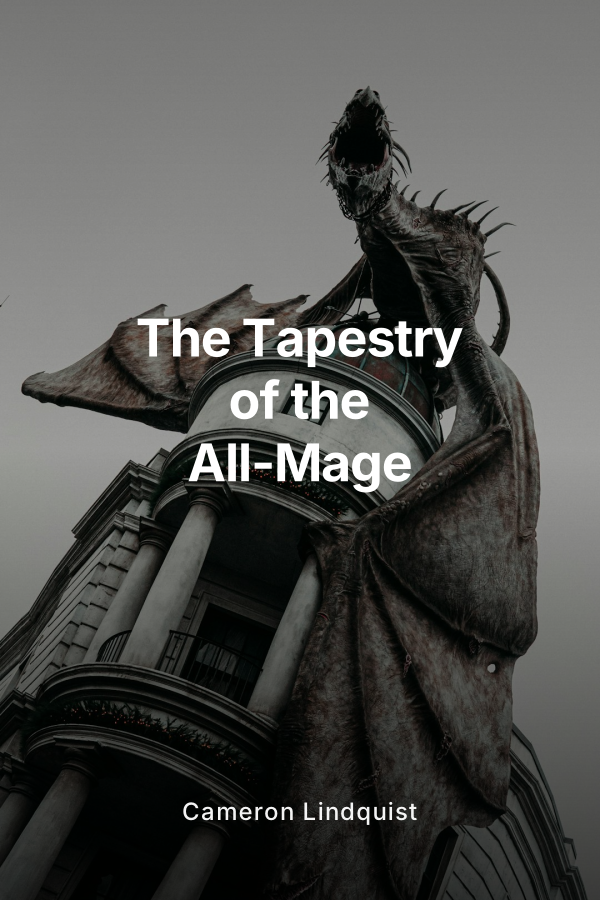
In a world split across five great regions and one endless sea, magic is not a rarity but a governing force, taught through respected schools, enforced by law, and carried into war, diplomacy, and daily life. From the French-inspired Mountainlands to the Spanish-inflected Emberlands, the British-styled Woodlands, the Russian-tinged Deadlands, and the Irish-rooted Swamplands, every land bears a distinct culture, a distinct relationship to power, and a distinct place in the ancient story of creation. At the center of it all lies Wateria, the ocean that divides, connects, and remembers. This world is built around an original cosmology in which creation itself began with the All-Mage, whose three children became the primal forces of Order, Balance, and Chaos. Time is not a line but an infinite tapestry, each thread a living moment, and every spell, prophecy, and betrayal pulls at its weave.
The story follows Vergil Greysahn, a carefree, comedic, dangerously unconcerned young mage who treats consequences like a joke until the joke turns into a war. Vergil is Chaos reborn, soul-bound to an ogre of the swamps, and he begins the tale without any understanding of the ancient truth buried inside him. His sister Thisre Greysahn, the reborn Balance, is loyal, diplomatic, and endlessly determined to keep peace between people who would rather clash than listen. She is work-bound to a griffin of the mountains, a partnership that reflects her discipline and steadiness. Their eldest brother, Markum, is Order reborn and blood-bound to a lion of the woods. He begins as the most principled of the three, the one most likely to uphold structure and protect others, but over time he becomes the most tragic. The siblings are reincarnations of the Three Ancient Siblings, yet they do not know it, and others who do know begin manipulating them, hoping to awaken their buried divinity for the sake of control.
Magic in this world is broad, specialized, and deeply institutional. There are schools for rune magic, blood magic, elemental magic, conjuration, temporal magic, spatial magic, and even bizarre, reality-bending forms reminiscent of toon-force, all of them respected because each serves a different purpose and none can fully replace another. Magic can be cast through books, staffs, wands, rings, and, most rarely, through bare hands. The rarest casters are the most feared, not because of superiority alone, but because hand-casting implies a level of instinctive mastery that borders on myth. The magical system also extends into law enforcement and military service, where spellwork is not entertainment or scholarship but a civic weapon, carefully regulated by a grand council of the world’s most powerful mages. The laws are few, but they are demanding, and breaking them can mean exile, containment, or worse.
The world’s creature bonds add another layer of destiny and social identity. Every mage may bond with one companion creature, but never more than one. These bonds come in three forms: Soul-Bound, Blood-Bound, and Work-Bound. Soul-Bound companions are linked before birth, a sacred bond that feels written into the universe. Blood-Bound creatures are tied through ancestral lineage, carrying inherited power and family memory. Work-Bound pairs form through training, trust, and shared experience, making the bond earned rather than fated. This structure gives each creature relationship emotional weight and strategic importance, and it allows the world to feel both magical and personal. Vergil’s ogre, Thisre’s griffin, and Markum’s lion are not pets or mounts, but mirrors of their masters’ souls, each one important to the story’s unfolding fate.
At first, the story presents itself as an adventure about schools, rivalries, regions, and magical identity, but beneath that surface is a crisis of inheritance. The greatest threat is not a foreign invasion or an abstract cosmic catastrophe. It is the possibility that the world itself was designed to be ruled by those who can remember what they once were. A cult devoted to the All-Mage and his Children works in the shadows, convinced that the ancient natural order must be restored through strength, hierarchy, and survival of the fittest. They believe the siblings are not just heirs to a legacy but instruments of correction, and they target Markum first. His sense of duty becomes his weakness. His longing to bear responsibility, to make the world safe and ordered, leaves him vulnerable to visions, rhetoric, and the seductive logic of inevitability. What begins as guidance becomes indoctrination. What begins as purpose becomes surrender.
The emotional center of the novel is the relationship between the three siblings as their paths diverge without fully breaking apart. Vergil remains the wild spark, funny and reckless even as danger closes in, but Markum’s betrayal forces him to grow up fast. Thisre becomes the moral center of the tale, the one who keeps trying to save both brothers even as she realizes the truth may already be lost. She pleads, negotiates, and refuses to abandon the hope that love can outlast prophecy. Vergil is more conflicted in a quieter way: he is in denial, but he knows the truth when it finally surfaces. That contrast gives the story a devastating emotional rhythm. One sibling still believes in rescue, one sibling senses doom, and one sibling steps willingly into the abyss.
The first unmistakable sign that the old truth is waking comes from an ancient creature, who lets slip a vague but haunting clue: “Order needs to be put in check, and Chaos is the anchor.” The line is cryptic in the moment and devastating in retrospect, revealing that the roles of the siblings are not merely symbolic but cosmically necessary. Chaos is not just destruction. It is the stabilizing force that keeps Order from becoming tyranny. That revelation reframes everything. The world was never meant to be ruled by a single principle, and the siblings were never meant to be separated from one another. They are part of a balance older than civilization and more intimate than theology. Once Markum begins to accept the cult’s version of truth, he does not merely become stronger. He becomes unreachable.
Markum’s fall is the novel’s slowest and most tragic thread. It does not happen because he is weak. It happens because he is earnest. The more he feels responsible for the world, the easier it becomes for others to convince him that mercy is weakness, compromise is decay, and power is the only language that history respects. He comes to believe that his role is to preserve natural order by ruthlessly pruning the unworthy, a vision of salvation that justifies cruelty in the name of peace. His descent is not sudden villainy but a gradual surrender of moral certainty, until he sides with the enemy and gives up control of his ancient godhood. Like a tragedy foreseen but impossible to stop, his fate becomes the result of every choice that seemed reasonable at the time. By the end, he is too far gone to reclaim, and the heartbreak lies in how understandable the journey was.
The ending is built around inevitability. The trio confronts Markum together, not because they expect to save him, but because they must face him as family and as the final living expression of a cosmic order that can no longer hold. The rule binding them is merciless: if he falls or dies, they all fall or die. That means the final conflict is not just a battle for victory but a battle for survival itself. There can be no clean resolution, no triumph without cost, and no future untouched by what Markum has become. The conclusion is permanent and tragic. Markum’s fall cannot be reversed, and the siblings must endure the fact that destiny was never a road to freedom, only a path to the moment when they were forced to become themselves. The novel closes with the weight of a world that had to break this way, because only through that breaking could the truth of Chaos, Balance, and Order be fully revealed.