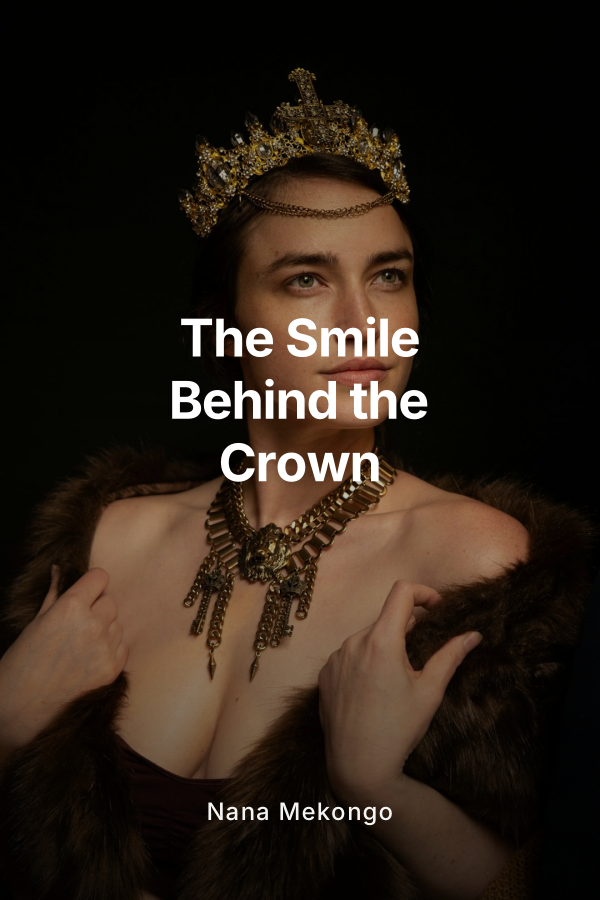
In a kingdom polished by gold, rules, and grief, Princess Elara has learned how to be flawless long before she has learned how to be free. At seventeen, she is the adored daughter of a mourning king, the bright symbol of a royal line that now rests almost entirely on her shoulders. Since the queen’s death, the palace has become both sanctuary and prison. Elara is treasured, protected, watched, and shaped into the perfect heir, the kind of princess who knows how to descend a staircase like a promise and smile through suffocating expectation. Her dirty brown hair, straight and carefully tended, and her clear green eyes have made her the center of every courtly whisper, every noble ambition, every matchmaking scheme. Yet beneath her composure lives a girl exhausted by performance, lonely in ways no one notices, and quietly desperate for one thing she has never been allowed to choose for herself: the direction of her own heart. That foundation is central to the story’s premise, where her father’s strictness, the memory of her dead mother, and the pressure to secure the royal future all define the emotional stakes.
Opposite her stands Rowan, the eighteen-year-old court jester who has been part of the palace for as long as Elara can remember. He is not merely an entertainer in bright clothes and practiced wit. He is a fixture of her life, a shadow at the edge of ceremonies, a voice that turned sorrow into laughter during the kingdom’s darkest years, and one of the only people in the palace who sees through pretense on instinct. With brown hair, brown eyes, and a confidence built from surviving close to power without ever belonging to it, Rowan has learned to hide sharp intelligence behind careless humor. He moves through the royal world with disarming ease, but he knows exactly where he stands: useful, overlooked, and utterly forbidden. He has spent years making others laugh while concealing his own loyalty to the princess, a devotion that grew in silence as she grew into the role everyone expected her to play. The summary frames him not as a comic sideshow but as the emotional counterweight to the crown, the one person who can challenge Elara because he has witnessed her before she became an ideal. His lifelong presence in the palace and his charged exchange with her after the ball are key elements of the concept.
The story begins with the announcement of a grand dance ball, a glittering political event disguised as celebration. The king, stern and still marked by the loss of his queen, insists that Elara must attend not simply as a princess but as the future of the realm. A royal journey lies ahead, and he wants her to choose an appropriate match to accompany her, someone worthy of strengthening the image and continuity of the crown. This command turns the ball into more than a night of music and jewels. It becomes a public test. Every noble son, every ambitious courtier, and every family hungry for influence sees the evening as an opportunity to reach for the throne through her. For Elara, the order feels like another theft of selfhood. She is expected to appear radiant, gracious, and receptive while her future is negotiated in dances and glances. This central setup follows the user’s requested concept exactly: the king wants the princess to find a date for an upcoming royal trip because the future of the royal line depends on her.
When Elara enters the ballroom, the entire court watches. Her father watches with pride and calculation. The gathered nobility watches with hunger. The room falls into that reverent silence reserved for beautiful things that people believe they can possess. The staircase descent becomes one of the defining visual moments of the book. Elara, though poised and admired, feels every eye on her like weight. She is all elegance on the surface, but inwardly she is resisting the role already being assigned to her for the evening. The summary emphasizes that this scene is not simply about beauty. It is about spectacle, surveillance, and the cruel reality of being celebrated for a version of oneself that leaves no room for vulnerability. While the court sees a perfect royal daughter ready to secure the future, Elara experiences the moment as the beginning of a battle she must fight without drawing blood. That emotional split between appearance and reality becomes one of the novel’s strongest themes.
From there, the ball unfolds in waves of choreographed discomfort. Elara is passed from one dance partner to the next, each man trying to charm, impress, or claim her. Some are polished and arrogant, some overly eager, some politically acceptable and emotionally deadening. She smiles when expected, speaks with trained grace, and endures the parade of attention while looking for air inside a room that offers none. To survive the evening, she invents small rebellions. One of the most memorable is her trick with the wine. Rather than truly drinking under the endless pressure of social ritual, she only pretends, later spitting it out when no one is meant to notice. It is a quiet act of refusal, a symbol of how she has learned to perform obedience while preserving pieces of herself in secret. The scene matters because it reveals her ingenuity and the limits of her rebellion. She cannot openly defy her father or the court, but she can resist in hidden, stubborn ways. This specific detail is clearly established in the context and becomes a vivid emblem of her inner life.
Rowan notices. In a room full of nobles trained to admire Elara’s polish, he is the one who catches the truth beneath the performance. He sees her fake the drink and suppresses a smirk, not to mock her, but because he recognizes the spark of rebellion in her. That single moment changes the atmosphere between them. Elara catches him looking. His expression unsettles her because it suggests understanding, amusement, and something far more dangerous: intimacy without permission. She is confused at first, then drawn in. Across the crowded room, with music and formalities separating them, a silent exchange begins. The summary gives this sequence great importance because it is the first clear rupture in the emotional order of her world. For once, she is not being watched as a princess to be evaluated. She is being seen as a person making a desperate, clever choice. The attraction ignites not from appearance alone but from recognition. The story’s romance is built on this kind of perception.
As the night continues, Elara tries more than once to reach him, but the structure of courtship keeps interrupting. Another suitor always appears. Another hand claims the next dance. Another nobleman attempts to impress her with rank, lineage, or rehearsed charm. Yet even while she is spinning through the rituals expected of her, her attention remains tethered to Rowan. Her eyes keep finding his across the room. He watches her with that same maddening blend of ease and focus, saying little and somehow saying everything. This repeated visual thread becomes one of the summary’s main emotional devices. The ballroom is crowded, but what matters is the current between them. Every interrupted attempt to approach him increases the tension and sharpens the contrast between what her life demands and what her instincts want. Publicly she dances with men chosen by status. Privately she is already moving toward the one man she can never be allowed to choose.
The end of the ball shifts the story from spectacle into intimacy. Guests leave one by one. Music fades. Formal laughter drains from the hall. What remains is a quieter, more dangerous world made up only of those who belong to the palace after midnight: maids, weary knights, the king, the jester, and the princess. The king says his goodnights, carrying his authority with him as he departs. Elara dismisses the exhausted knights with a kindness that reminds the reader she is not merely polished but observant and compassionate. The vast room, once oppressive with attention, becomes almost private. This transition is crucial because it strips away the crowd that has defined her all evening. For the first time that night, she is not being offered to the kingdom. She is simply standing in the aftermath, raw from restraint, with Rowan still there. The emptiness of the ballroom mirrors the emotional opening that has been building inside her all night.
Then Rowan crosses the room toward her with his hands in his pockets, wearing his nonchalance like armor. This is the pivot on which the entire romance turns. He is calm where everyone else was eager. He approaches her as though he is unafraid of what she is, even if he must fear what could happen to him for wanting her. Elara feels the room change the closer he gets. Heat rises under her skin. Her breath catches. These sensations are new to her, not because she has never been admired, but because admiration has never before felt mutual, private, and alive. Their conversation begins with flirtation, but beneath the teasing lies a revelation. Rowan speaks to her as someone worth challenging. Elara answers him not with royal distance but with curiosity and daring of her own. In that exchange, the book establishes the core chemistry of their dual point of view romance: wit against restraint, boldness against fear, and desire born through long familiarity suddenly seen in a new light. The context specifically calls for him to flirt, for her to flirt back, and for the atmosphere to feel charged and transformative.
The two point of view structure deepens this moment by allowing readers to inhabit both sides of the attraction. Through Elara’s perspective, the summary explores the shock of wanting someone who has always been present and yet never looked so dangerous. Rowan has existed in the safe margins of her life for years, but now he steps out of that role and becomes a man. She is unsettled by how swiftly the shift happens. The jester she has always known becomes the one person capable of undoing her composure with a single look. Through Rowan’s perspective, readers discover that the moment is not sudden for him at all. He has spent years keeping emotion hidden behind jokes, careful never to let devotion become visible enough to destroy them both. What begins for Elara as awakening is, for Rowan, the breaking point of prolonged restraint. This duality gives the romance its emotional richness. She is discovering. He is finally failing to conceal. Together, their viewpoints transform flirtation into inevitability. The requested two point of view format is therefore not a stylistic feature alone but the engine of the summary’s emotional power.
As a rated 16+ romance, the book’s tension is mature in feeling while remaining grounded in longing, attraction, and emotional intensity rather than explicit excess. The summary promises an atmosphere rich with stolen glances, dangerous proximity, charged dialogue, and the awakening of physical awareness. Elara’s sheltered life means that desire arrives as both thrill and fear. Rowan’s experience of desire is sharpened by discipline, because wanting her has always carried risk. Their exchanges are shaped by near touches, lowered voices, private laughter, and the kind of chemistry that becomes more consuming because it must be hidden. The summary suggests that the story would continue to build through forbidden encounters, increasingly intimate conversations, and the struggle to resist a bond that grows stronger the more the crown tries to direct Elara elsewhere. The mature tone lies in emotional heat, romantic stakes, and the complexity of crossing boundaries set by age, status, and royal duty, all rooted in the original concept’s call for a 16+ romance.
Beyond the central attraction, the book summary frames the story as a conflict between inheritance and identity. Elara’s father is not a simple tyrant. His strictness is born from grief and fear. After losing his queen, he clings to control as though control can prevent another loss. His protectiveness over Elara is real, but it has hardened into suffocation. He sees the world as dangerous, and perhaps he is right, but in trying to keep his daughter safe he has denied her the chance to become fully herself. That complexity strengthens the emotional landscape of the novel. Elara is not only pushing against palace rules. She is also trying to love a father who no longer knows how to trust life without trying to command it. The royal trip he is planning becomes symbolic of his larger agenda: to carry her into the future on a path he designs, with a companion he approves, toward a destiny that serves the kingdom first and her heart last.
Rowan, in turn, represents the threat and promise of unpredictability. He belongs to no dynasty. He cannot secure alliances. He cannot strengthen the legitimacy of a crown by blood. What he offers Elara is far more destabilizing: honesty, laughter without cruelty, and the freedom to be unperformed. Because he has known her for her whole life, he also carries memories no noble suitor can match. He remembers the child beneath the title, the girl hidden before the woman was displayed. This history makes their connection deeply personal and morally complicated in the eyes of the court. It is one thing for a princess to reject one noble for another. It is another to be drawn toward the court jester, a man close enough to know her and far enough beneath her station to scandalize the kingdom. The summary uses that imbalance not as novelty but as emotional dynamite. Their bond threatens systems, not just expectations.
The farewell at the end of the ballroom scene becomes the final hook of the summary. Elara, overwhelmed by feelings she cannot name aloud, ends the conversation before it can expose too much. She says goodnight as a princess trying to restore order. Rowan answers, “Goodnight, Princess,” and adds that he wishes to see her again. It is a simple exchange on the surface, but the summary presents it as a vow disguised as courtesy. He gives her space while making it clear that this night is not an isolated spark. Something has begun. She walks away changed, and he remains behind knowing that the line between jest and confession has already begun to disappear. This closing note is faithful to the original request and serves as the emotional doorway to the larger story beyond the summary.
What follows, as implied by the book summary, is a romance shaped by secrecy, class division, and the crushing machinery of royal expectation. The royal trip looms ahead, forcing Elara toward a formal choice she increasingly dreads. Suitors become more persistent. Her father’s scrutiny grows sharper. The palace itself turns into a maze of watched corridors and hidden corners where every private conversation carries risk. In that charged environment, Elara and Rowan would be drawn into a deeper relationship that begins in wit and curiosity and develops into trust, confession, and desire. Their two points of view would reveal the same moments through different wounds: Elara fearing that love may cost her crown, Rowan fearing that loving her may cost her everything. The summary promises a slow-burning escalation where each secret meeting raises the stakes and every honest conversation forces them closer to a decision about what they are willing to sacrifice.
At its heart, this is a story about being seen clearly in a world built on roles. Elara has spent her life being looked at. Rowan is the first to make that feel different. Rowan has spent his life performing. Elara is the first person who makes him want to stop hiding behind performance altogether. Their relationship therefore becomes transformational on both sides. She begins to question whether duty without choice is virtue at all. He begins to question whether safety in silence is worth the cost of losing the one person he has always loved. The book summary positions their romance not merely as forbidden attraction but as a force that exposes truth. Through each other, they confront grief, fear, inherited pressure, and the ways power deforms intimacy. The crown asks Elara to be a symbol. Rowan invites her to be human.
The tone of the summary is lush, romantic, and emotionally immediate, tailored to readers who want courtly tension, aching chemistry, and a heroine awakening to forbidden desire under the weight of royal obligation. It offers a classic fairytale frame infused with sharper emotional stakes: a popular and immaculate princess, a clever jester who has stood beside her life unseen, a strict king determined to direct the future, and one dangerous night that changes everything. The appeal lies in contrast. Gold-lit ballrooms against private hunger. Ritual against rebellion. Laughter against grief. A princess bred for duty against a man who makes her want. Every major image in the concept supports that contrast, from the staircase entrance to the false sipping of wine, from the locked gaze across the dance floor to the nearly empty hall where flirtation finally speaks aloud.
The Smile Behind the Crown is, in summary, a forbidden royal romance about the first night two lives begin to turn toward one another after years of silent nearness. It is the story of Princess Elara, trapped between legacy and longing, and Rowan, the jester whose wit has always hidden devotion too dangerous to name. Under chandeliers and watchful eyes, she is expected to choose a future suitable for the kingdom. Instead, she finds herself drawn to the one man who sees through every performance she has ever mastered. As a royal journey approaches and the pressure to secure the line intensifies, one flirtation in an empty ballroom becomes the spark for a much larger unraveling. Told through both of their perspectives, the book promises yearning, tension, rebellion, and the aching possibility that love may ask not just to be felt, but to be fought for.