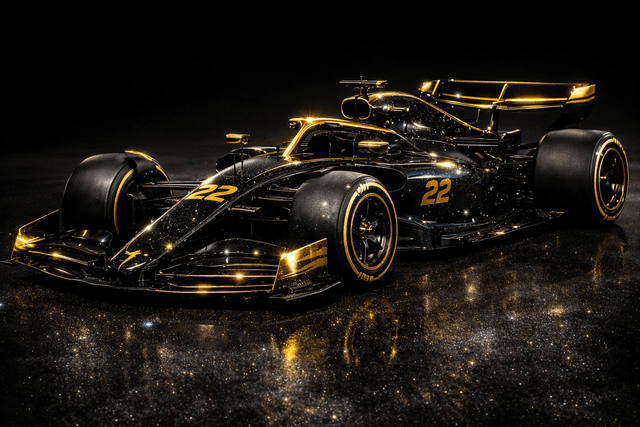
This book is a hyper-dramatic, psychologically intense motorsport novel set across the full 2026 Formula 1 season. It follows Lars Forsberg and Frasier Cancellieri, childhood best friends turned bitter enemies when they are paired as teammates at Lamborghini Scuderia Corse, the new black and gold superteam with the fastest car on the grid. The story blends detailed, realistic racecraft with vicious mind games, physical fights, and escalating institutional punishment, all the way to a cold, messy finale where friendship is destroyed and only one of them walks away as World Champion.
At the heart of the story is contrast. Lars, the “Glacier,” is a Swedish British driver whose strength lies in relentless precision, tire management, and an almost unnerving emotional control. He rarely loses his temper, but when he finally snaps his language turns lacerating and his threats are calculated and long term. Frasier, the “Volcano,” is an Italian British star: mercurial, charismatic, adored by many fans, and infamous for a foul mouth that initially feels harmless but slowly reveals a deeper volatility. When he is pushed beyond his limits, words no longer feel sufficient, and he reaches for his fists.
Both are genuine talents. Both are deeply flawed. The book refuses to give the reader a simple hero and villain. Instead, it presents a viciously fair portrait of two men whose competing definitions of respect, bravery, and winning make coexisting almost impossible. Lamborghini’s team principal, Matteo Ricci, an icily strict Italian leader, stands between them as the authority figure whose patience is tested by their escalating feud. Fans and media speculate that Ricci favors fellow Italian Frasier, but the narrative keeps this suspicion as background noise rather than a central conspiracy.
Structurally, the novel tracks every round of the 2026 calendar, from Melbourne to Abu Dhabi, with each chapter of the book spanning a cluster of races that raise the stakes. It covers full race weekends: practice context, qualifying duels, formation laps, race incidents, pit wall strategy calls, cooldown room body language, paddock whispers, social media storms, and press conferences that turn into emotional ambushes. The framework is mathematically tight: Lamborghini’s dominance means frequent 1–2 finishes, the Constructors’ title is wrapped up early, and yet the Drivers’ Championship remains knife edge, engineered so that Lars and Frasier arrive in Abu Dhabi tied on points. Frasier must, and does, win the first race of the season and, in the end, claims the World Drivers’ Championship by breaking the tie in the final round.
The early season is defined by glow and denial. Melbourne introduces the black and gold Lamborghini as the class of the field and showcases the first iteration of “dream team” PR: Frasier wins the Australian Grand Prix, Lars finishes second, and the two men embrace in the cooldown room, calling each other brother and declaring that this is “our year.” The cracks are already there, though, in how Frasier publicly belittles Lars’s pole position as “the practice round” and in his determination to prove that his win is not luck.
China and Japan begin the erosion of trust. In Shanghai, a failed undercut strategy for Lars gifts Frasier a win and creates the first defensive media spin: Frasier positions himself as the one who “executed” while subtly implying that Lars failed to deliver in traffic. Lars, in turn, makes his first public reference to strategy deciding “who the fastest car will be,” a coded accusation that the team’s calls are not neutral. In Suzuka, wet weather and Frasier’s first truly aggressive on track move start to surface his deeper impatience with what he perceives as Lars’s “safe” approach. The respect is not gone yet, but both men begin to talk past each other, each convinced that the other is quietly rewriting the narrative in their favor.
Bahrain and Jeddah mark the first physical breaches. In Sakhir, Frasier wins with an aggressive overtake that forces Lars to jink into the runoff. Afterwards, Frasier physically shoves Lars in the cooldown room, accusing him of trying to bully him. Lars does not retaliate yet. Instead he responds with chilling verbal menace, promising to ruin Frasier’s career if he is pushed again. That moment reveals the true nature of the Glacier: Lars’s danger is not heat, but the slow, grinding threat of a man who never forgets.
In Saudi Arabia, under the lights of Jeddah’s high speed walls, retaliation arrives. Lars passes Frasier cleanly on track, and Frasier responds with a deliberate tap to Lars’s rear wheel at terrifying speed. It nearly causes a catastrophic crash and exposes how thin Frasier’s control has become. Post race, the two erupt into their first full fistfight in the cooldown room, trading punches until team personnel and security physically drag them apart. The FIA steps in with six figure fines and a suspended five place grid penalty, and the public image of “friendly rivalry” is shattered.
From Miami through Montreal and Monaco, the rivalry becomes public spectacle. In Miami, Frasier’s aggression cooks his tires; his radio rants against the team and against Lars are broadcast worldwide, drawing an official warning for “offensive and discriminatory language.” In Canada, Frasier weaves dangerously under braking to block Lars, earning a black and white flag and a wave of commentary about the line between hard defense and reckless endangerment. On social media, the fanbase polarizes: some worship Frasier’s ruthlessness, others see Lars as the wronged professional who is being pushed to breaking point. The story incorporates vivid, realistic fan tweets, pundit reactions and Sky style commentary that react in real time to each new flashpoint, with lines like “This isn’t a rivalry anymore, it’s warfare” and “If the FIA do not step in now, they’ll lose control” capturing the mood.
Monaco is a turning point in psychology rather than raw action. Lars, in his element on city streets, delivers an inch perfect pole and then a race of pure defensive mastery. Frasier spends nearly the entire Grand Prix trapped behind him, throwing every overtaking trick he has into narrow gaps that never quite exist. Under the crushing frustration, he clips the barrier and detonates into an explicit, multilingual radio tirade that cannot be walked back. The FIA fines him and adds an official reprimand to his license, while Lars responds in interviews with a deceptively mild suggestion that Frasier should “look in the mirror and find some composure,” a comment that paints Frasier as mentally fragile. The power dynamic flips: for the first time, Frasier looks like the unbalanced one, and Lars looks like the driver in control.
Barcelona is revenge, and it costs Lars dearly. After undercutting Frasier, Lars forces him wide at Turn 1 on pit exit, using the full track and leaving Frasier across the runoff. It is calculated, not impulsive, an attempt to “break Frasier’s spirit” and reclaim psychological dominance for all the earlier blocks and taps. The stewards, already primed by the season’s history, drop the hammer, triggering Lars’s suspended penalty from Jeddah and demoting him from victory to sixth place. Frasier inherits the win. In the aftermath, a second fistfight explodes in Lamborghini hospitality, in front of VIP guests and staff. Frasier launches into Lars with a folder to the face, Lars responds with a headlock and a brutal exchange of blows, and security again separates them, this time with visible blood and torn racewear. Team principal Matteo Ricci publicly declares their actions “inexcusable” and threatens internal maximum sanctions.
By mid season, the rivalry is no longer just between two men; it has infected the entire ecosystem. The Lamborghini garage is visibly split into Lars and Frasier camps. Mechanics quietly celebrate “their” driver’s success and bristle when the other gets favorable strategy. Ricci, under pressure to secure the Constructors’ title, issues strict team orders at certain rounds, demanding they hold position or avoid fighting after the first lap. Both drivers chafe at this, and even when they obey on track, the tension leaks out in interviews and micro gestures in the cooldown room. The book uses these quieter “pressure cooker” weekends to deepen the psychological portrait: nights alone in hotel rooms replaying radio messages, intrusive social media notifications, old photos of them as karting kids juxtaposed against present day tabloid headlines about “Lamborghini’s Civil War.”
The second half of the season raises the institutional stakes. After repeated clashes, the FIA and the team coordinate punishments that go beyond fines. At one late race, both drivers are ordered to start from the pit lane as a joint sanction, transforming what should have been an easy 1–2 into a damage limitation drive. At another, they are forced into a mandatory joint press conference and apology, designed to calm the storm but instead turning icy and hostile on camera when one of them pointedly refuses to say the words scripted by PR. Rumors circulate of potential race bans, psychological evaluations, even the possibility that Lamborghini might suspend them both from a weekend if there is one more physical altercation.
Importantly, the book keeps its promise to treat both men as complicated, not caricatures. Lars has dark moments where his calculated media comments cross the line into reputational sabotage, feeding narratives that Frasier is “unhinged” and “unsafe.” There are races where he ignores team orders, races others cleanly but boxes Frasier in with inch legal cynicism, and one key weekend where he earns a harsh penalty for a move that really was too far. Frasier, in turn, is given sequences where he is clearly right: a weekend where he takes a clean win after Lars misjudges a lunge and hits him, interviews where he defends Lars against toxic fans and reminds the media that “he is not your villain of the week,” and one occasion where he takes the complete high road, refusing to blame Lars publicly despite having cause. This balance invites readers to continually revise their loyalties.
All the while, the points march forward with ruthless arithmetic. Lamborghini’s speed ensures that, even through penalties and clashes, Lars and Frasier collect podiums, fastest laps, and occasional dominant wins. The Constructors’ Championship is clinched early, which removes the last practical argument for team orders and frees them to “properly race,” just as the user requested. That freedom is poisonous: with the team’s collective goal already secured, every remaining session becomes nakedly about personal legacy. Strategic choices, tire calls, and even safety car luck matter. The standings rise and fall, but the novel’s structure guarantees that by the time they reach Abu Dhabi, the two men are exactly tied on points, everything they have done cancelling out into a single final showdown.
The final run of races intensifies the violence one last time. The third full fistfight is reserved for a late, high pressure venue, a public melee that finally forces the FIA to issue an ultimatum: one more physical altercation and both licenses will be suspended for multiple races. Ricci’s internal warning is even sharper; he threatens to bench them from sessions and reminds them that no driver is bigger than Lamborghini. They finish those weekends visibly bruised, with injuries that make driving physically uncomfortable, underscoring that their feud now costs them performance as well as reputation.
Abu Dhabi, under the Yas Marina lights, is not a fairytale. It is the culmination of every unhealed wound. The book orchestrates a truly tight title decider that remains realistic: strategic gambles, undercuts, virtual safety cars, small errors on high fuel, and the sheer pressure of knowing that a single lockup might decide not only a championship but also whose narrative the world remembers as truth. Both men drive at a level that justifies their status as generational talents. The race is hard, sometimes borderline, but within the line that the season’s punishments have finally forced them to respect.
In the end, Frasier prevails. He crosses the line as World Drivers’ Champion, binding his name forever to Lamborghini’s first title. The circuit erupts. Italian tifosi wave black and gold flags like they once did red. The team floods onto the pit wall. Ricci, who has spent a year trying to contain the fire, allows himself a single moment of unguarded pride. Lars finishes behind him, defeated by margins that might be measured in tenths of a second, strategic calls, or the cumulative psychological damage of a yearlong war. The points table, for all its starkness, cannot capture what they have lost.
The ending is intentionally cold and messy. There is no reconciliation scene, no tearful hug restoring childhood friendship. In a pre podium interview, Lars is asked what this season has meant to him. For the first time, the Glacier visibly cracks. His eyes shine, his jaw works, he almost cries on camera as he searches for words that do not make him sound like a sore loser or a broken man. He settles on a carefully controlled answer about “lessons” and “boundaries,” but the emotional rupture is obvious. Frasier, meanwhile, is pulled toward the celebrations, toward the podium, toward the champagne and fireworks. He is euphoric, relieved, and fiercely protective of the title he believes he earned through sheer refusal to back down. Whatever regrets he might feel about Lars are buried under the roar of the crowd.
There is no epilogue hinting that they will fix this one day. The book closes on discordant images. Paparazzi shots of Frasier, drenched in champagne, grinning with the championship trophy. A grainy photograph of Lars walking alone through the paddock service road long after midnight, black and gold team gear over his shoulder, phone buzzing with messages he does not open. Social feeds arguing about who was right, who was wrong, whose career will age better. A final line from a pundit replaying the season on television: “You could see this coming all year. This was not just a rivalry. This was mutual destruction conducted at 320 kilometers per hour.”
Across its five chapters, the book offers:
- A complete, race by race dramatization of the 2026 calendar, from lights out in Australia to the chequered flag in Abu Dhabi, built on realistic race dynamics, penalty logic, and point scoring.
- A dual character study of Lars and Frasier that charts their evolution from affectionate competitiveness to cold warfare, showing how media narratives, fan reactions, institutional responses, and their own unresolved insecurities twist every gesture into ammunition.
- Hyper dramatic, explicit confrontations that stay grounded in plausible F1 structures: stewards’ inquiries, warnings, reprimands, suspended penalties, joint sanctions, and the constant threat of harsher discipline that slowly boxes them into more disciplined yet no less ruthless forms of conflict.
- A portrait of a team in crisis, where mechanics, engineers, and leadership are forced into emotional positions, and where the price of chasing both Constructors’ and Drivers’ glory might be the destruction of the very partnership that made victory possible.
Ultimately, “Glacier vs Volcano: Inside the Lamborghini Civil War That Tore a Championship Apart” is not about a single winner. It is about what happens when two equally driven, equally talented people refuse to yield, in a system that rewards victory but is slow to count the cost. The trophy at the end belongs to Frasier. The wreckage of a friendship, the scarred reputations, and the haunting sense that something irretrievable has been lost belong to them both.