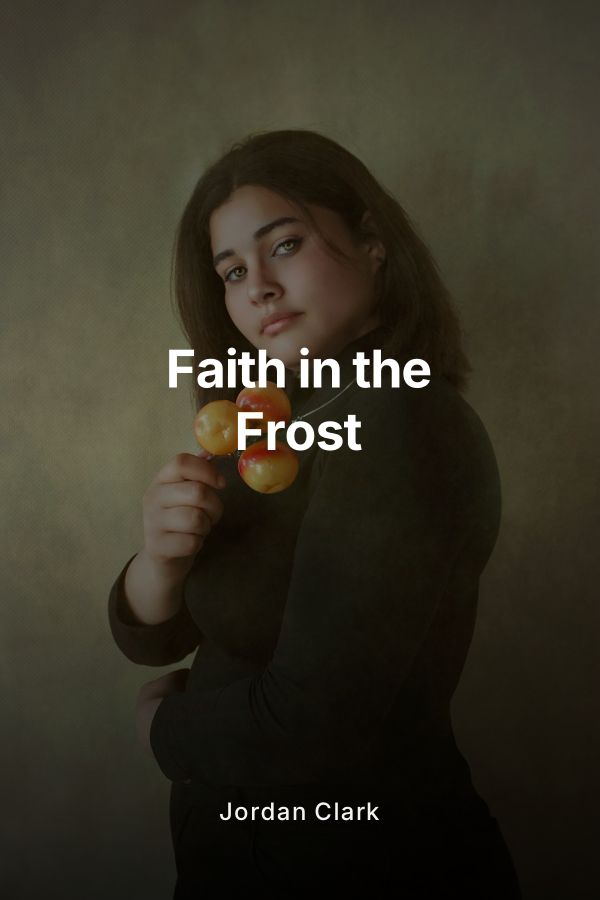
In the silence before the storm, Thomas and Natalie believe they have finally found a fragile peace. He is a former military officer who has traded battlefields for backwoods, a skilled survivalist whose first instinct is to protect and control. She is a devoted nurse whose hands have learned to heal bodies, even as her faith teaches her to tend wounded hearts. Their marriage is built on shared devotion to God and to each other, yet under the calm surface lie unanswered questions about purpose, calling, and what it truly means to trust when the world begins to unravel.
“Faith in the Frost” is a faith centered survival novel set against the backdrop of a looming Armageddon, crafted for adult readers who long for both high stakes tension and deep spiritual reflection. This book follows Thomas and Natalie from their ordinary life into an extraordinary calling, tracing how a prophetic dream sends them from familiar ground to the frozen frontier of Greenland. There, severe cold and encroaching darkness will strip away every illusion of self sufficiency, forcing them to discover whether their reliance on God is a comforting idea or an unshakable reality.
The story unfolds in four sweeping movements that mirror a spiritual journey: the calm before the storm, the first crucible of survival, the building of a new life, and the final revelation of purpose. In Part One, the narrative lingers in the pre collapse world, where news cycles hint at deeper unrest and invisible fractures appear in global systems. Thomas notices the patterns, reading the signs like a soldier who has seen early tremors before disaster. Natalie senses a different kind of urgency, a spiritual quickening that stirs as she prays with patients and co workers who feel a nameless dread rising around them. When Thomas receives a vivid prophetic dream that points them toward Greenland, their decision to uproot becomes the first great test of faith. They must say goodbye to loved ones, release comfortable routines, and step into a future that makes little sense to the watching world.
Part Two plunges the couple into the harsh beauty of Greenland’s icy wilderness. Here, the story shifts into a tense survival narrative; the wind howls, resources are scarce, and a single misstep can mean death. The couple builds shelter from snow and salvaged materials, learns to read the sky and the shifting ice, and confronts predators both human and animal. Thomas’s tactical mind and physical training become vital as he constructs a secure base, sets traps, and teaches Natalie skills she never imagined needing. Yet the physical regimen is mirrored by spiritual discipline as they establish daily rhythms of prayer, Scripture meditation, and worship in the frozen stillness. Out of necessity, their faith becomes practical, a lifeline as essential as fire or food.
During these grueling months, other survivors begin to appear, drawn by rumor, desperation, or their own whispers of divine leading. Part Two deepens as the story moves from solitary survival to fragile community. Thomas is wary; his past has taught him that people can be more dangerous than the elements. Natalie, however, opens her heart to the broken families and solitary wanderers who find their way to the camp. Their differing instincts create tension but also a vital balance that allows a small, faith shaped settlement to take root in the snow. The crises that follow a devastating natural disaster, life threatening shortages, and moral dilemmas about who can be helped will test not only their resourcefulness but their core convictions about compassion, sacrifice, and trust.
Part Three marks a turning point as survival shifts into the slow, deliberate work of building a new life. The novel explores how deepening spiritual growth can emerge not in comfort, but in the wake of catastrophe. Thomas gradually moves from lone wolf protector to reluctant leader. He must learn how to carry the responsibility of others’ lives without turning control into an idol. Leading the community means facing mistakes publicly, making agonizing decisions under pressure, and choosing transparency instead of secrecy. His arc centers on surrender, as he discovers that true strength lies not in tightening his grip, but in yielding outcomes to God while remaining faithful in action.
Natalie’s journey runs alongside his, yet has its own distinct path. Once known simply as the gentle caregiver, she grows into a quiet pillar of spiritual and emotional leadership. Drawing together women who have lost husbands, children, and homes, she forms support circles that become the relational backbone of the settlement. Through shared prayer, honest confession, and practical service, these women weave a fabric of trust that holds when external pressures intensify. Natalie’s confidence in God emboldens her voice, and she steps forward not only as a nurse in the clinic, but as a counselor, teacher, and peacemaker who helps the community name its pain, confront its fears, and kindle hope.
Yet every growing community eventually faces conflict from within and threats from without. An antagonist emerges in Part Three, a complex figure whose wounded past and hunger for power drive him to challenge the fragile unity of the camp. His presence brings simmering resentments and unhealed traumas to the surface. Whispers of dissent echo through the shelters, and loyalties fracture as some are seduced by promises of a more self serving path. These tensions force Thomas and Natalie to wrestle with the cost of mercy, the boundaries of forgiveness, and the difference between reconciliation and enabling harm. The novel portrays conflict not as a detour from faith, but as a crucible through which convictions are purified and the meaning of grace is tested.
Part Four lifts the narrative to a more explicitly prophetic plane. Thomas receives a new vision that reveals an impending attack on the settlement and a broader escalation of global turmoil. While the details of end times events remain intentionally generalized to avoid doctrinal debates, the story captures the spiritual weight of sensing that history is rushing toward a decisive hour. The community must prepare not only physically for battle but spiritually for the possibility of loss, sacrifice, and martyr like devotion. Under Thomas and Natalie’s leadership, the camp organizes defenses, trains volunteers, and establishes contingency plans. At the same time, the characters wrestle in prayer, confess hidden doubts, and renew their covenant to stand together no matter the cost.
The clash that follows is both external and internal. The “battle” is rendered as a convergence of human hostility, environmental extremes, and spiritual warfare that cannot be seen yet is deeply felt in the courage, fear, and sacrificial choices of the characters. Some are wounded, some are lost, and everyone is changed. The aftermath is not a neat victory but a sobering landscape of grief interwoven with surprising, hard won joy. In the painful work of burial, rebuilding, and reconciling with those who faltered under pressure, the survivors begin to grasp that their true calling was never to escape suffering, but to become witnesses of unshakeable hope in the midst of it.
The concluding chapters and epilogue draw the narrative threads into a vision of “a new beginning” that refuses both shallow optimism and grim despair. The settlement, though still scarred, becomes a living testimony that even at the edge of Armageddon, God is present and at work. Thomas and Natalie look back over their journey from ordinary life through prophetic calling, hardship, leadership, and loss, and they recognize how each trial stripped away self reliance and deepened their dependence on God and one another. Their marriage carries the marks of shared suffering but also a tenderness that could only have grown in the cold crucible of the frost. They stand as flawed yet faithful guides for readers grappling with their own crises, showing that resilience is not the absence of fear, but the decision to keep moving forward in trust.
Throughout the book, four core themes quietly shape every scene. Faith is portrayed as an active, lived trust rather than a set of slogans, revealed through everyday choices to obey, forgive, and persevere when the outcome is unclear. Resilience appears not as sheer toughness, but as the God given capacity to rise again after being knocked down, to adapt without losing one’s soul. Community is shown as a sacred, messy gift, where interdependence replaces isolation and shared burdens lighten individual loads. Love provides the deepest throughline, grounding Thomas and Natalie’s relationship and expanding outward into a compassion that embraces strangers as family. These themes guide the inner arcs of both protagonists as Thomas evolves from hardened survivor to servant leader, and Natalie from hidden supporter to visible shepherd of hearts.
“Faith in the Frost” is crafted for readers who want more than entertainment from a survival story. It invites those facing their own “end of the world” moments whether personal losses, societal upheaval, or spiritual crises to see their struggles reflected and redeemed in Thomas and Natalie’s journey. The tone blends realistic tension with an ultimately inspirational vision, avoiding graphic sensationalism while not softening the cost of discipleship. By the final page, the reader is left not with detailed timelines or speculative charts, but with a far more urgent and practical question: When everything familiar falls away, what remains, and who will you choose to become?
In the end, this is not only a story about Armageddon. It is a story about the slow, often hidden work of God in human hearts, the way a marriage can become a refuge in the storm, and how an ordinary couple can, by grace, become the steady flame that keeps others warm in a world grown cold.