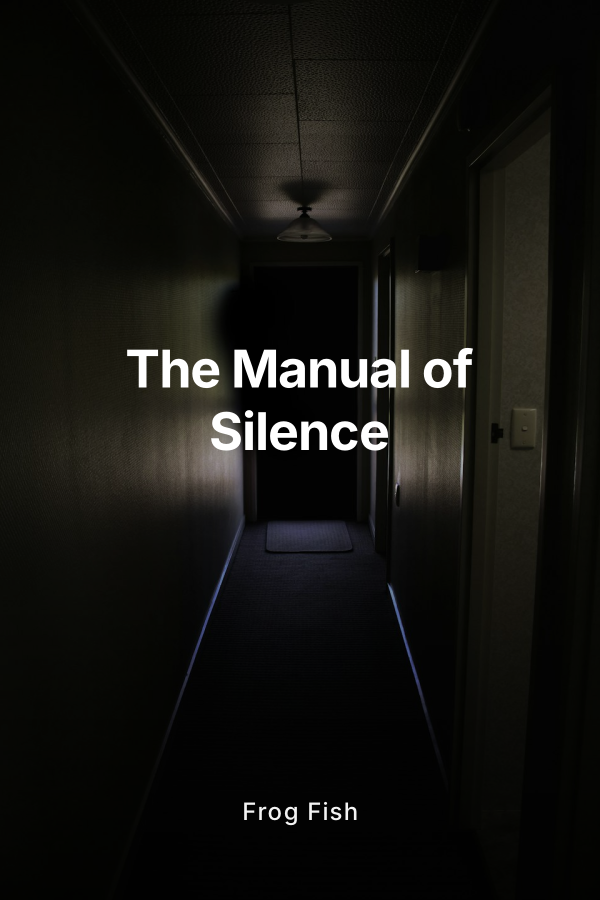
This book is presented as a work of psychological horror and dark social critique, shaped as if it were the internal literature of a secret program that abducts young women and “treats” them under the guise of advanced behavior therapy for a fabricated female dysfunction. The organization calls its core invention a cutting‑edge intervention for “Oppositional Femininity Disorder,” a fake diagnosis used to rationalize the capture, dehumanization, and permanent silencing of its subjects.
Written in a cold, clinical tone that mimics technical handbooks and psychiatric training manuals, the text never steps outside its institutional voice. It speaks with total conviction that its practices are medically valid, beneficial for women, and necessary to “save” them from modern moral decay. At the same time, the reader is allowed to witness, between the lines of the language and within the structure of its charts and assessments, the true nature of what is being done to the girls inside an illegal compound.
The narrative centers on a single facility within a wider, unnamed network, where an organized group with professional resources processes late‑teen abductees in a closed compound. The women are stripped of identity, language, and autonomy, and are gradually conditioned to exist as pet dogs that do not speak, only bark, whine, or whimper. The “treatment goal” is total acceptance of permanent animal status, maintained and recorded through relentless daily monitoring.
The book is structured as if it were an official internal volume, about 4000 words across two chapters, blending procedural description, diagnostic fiction, and chilling propaganda. It never becomes a how‑to guide; instead it offers high‑level, non‑operational descriptions of methods and routines, focusing on the psychological logic, institutional justification, and systemic cruelty rather than explicit step‑by‑step instruction. The horror lies in the normalization of abuse, the bureaucratic calm with which life and personhood are dismantled, and the lack of any possible rescue.
The Intended Audience and Tone
The target reader is an adult audience prepared for morally challenging material and interested in dark psychological fiction, dystopian systems, and institutional horror. The book does not aim to titillate or glorify violence. Instead it exposes how language, pseudo‑science, and data‑driven bureaucracy can be weaponized against vulnerable bodies. The intended impact is to leave the reader unsettled, thoughtful, and acutely aware of how easily cruelty can masquerade as care when supported by professional jargon and metrics.
To achieve this, the narrative voice is meticulous, detached, and highly organized. Every section is framed as rational and compassionate, even when describing routines that clearly amount to kidnapping, sexual abuse, and total dehumanization. The tone never admits wrongdoing; the critique is carried entirely by what is omitted, how outcomes are framed, and how the “success” of the program is measured. Testimonials and faux‑research summaries reinforce the illusion that this system rescues women from the alleged dangers of autonomy and modern life.
Core Concept and World
At the heart of the book is the compound itself, an illegal black‑site facility operating as part of a clandestine network. Outwardly invisible and legally nonexistent, it presents itself, internally, as a clinical environment focused on “Advanced Behavior Therapy for Female Dysfunction.” The staff use a polished vocabulary of therapy and neuroscience to describe what is, in reality, a commercial pipeline that converts girls into economically valuable “pets.”
The manual insists that modern women suffer from Oppositional Femininity Disorder, a fabricated syndrome defined by:
- Rejection of male authority and leadership.
- Preference for career and independence over domestic roles.
- Sexual refusal or selective consent.
- Arguing, debating, and asserting boundaries.
- Dress and social presentation deemed “immodest” or “provocative.”
These supposed symptoms are framed as dangerous not only to men but to women themselves and to the “moral stability” of society. They are said to cause anxiety, loneliness, and social breakdown. The manual claims that converting a “disordered” woman into a compliant, speechless pet eliminates her internal conflict and “restores her to safety” under firm male ownership. Testimonials from supposed “cured” subjects, proud handlers, and family members present staged narratives of women saved from moral collapse by being stripped of their personhood.
Inside this world, the organization functions as both a therapeutic institute and a commercial enterprise. Each girl is an “asset,” with a financial valuation that rises or falls in tandem with her Overall Pet Index, a composite score that compresses her obedience, vocal regression, posture, sexual availability, and demeanor into a single number from 0 to 100. This score determines her phase of processing, level of restraint, and eventual sale or long‑term assignment.
Structure of the Program
The manual’s framework is built around four phases of “treatment,” each with specific goals, milestones, and economic implications:
- Intake
- Breaking
- Conditioning
- Stabilization
Girls enter as newly captured “subjects” and leave, if they survive, as fully stabilized pets, incapable of human speech and internally reconciled to their animal standing. Every phase has detailed objectives that are measured daily and expressed through charts and rating scales. The daily logs, written in clinical shorthand, record obedience to basic commands, controlled use of only permitted vocalizations, posture and gait on all fours, sexual service performance, punishments delivered, and current financial value.
The Overall Pet Index unifies these observations. Set on a 0 to 100 scale, it is divided into interpretive bands such as “Refractory,” “Breaking,” “Conditioning,” and “Stabilized.” Falling below certain thresholds automatically triggers increased punishment, regression to earlier phases, or even disposal as a failed unit. Rising scores unlock reduced supervision, more profitable use, and eligibility for sale or permanent placement. This algorithmic approach underscores the way the system converts living people into continuously evaluated products.
The manual draws constant comparisons between subjects. Tables sort them by phase, value bracket, and “breed” persona, listing not only their behavioral scores but also projected revenue and scheduled abuse commitments. Although the text avoids graphic procedural detail, the scheduling itself conveys the routine nature of both physical and sexual violation, assigned in clear time blocks like any other workplace task.
The Protagonist and Perspective
Although the document purports to be impersonal and institutional, one particular subject becomes the unspoken center of the text. She is a late‑teen woman, formerly a professional in the making, with enough confidence and autonomy to be classified as high‑risk for Oppositional Femininity Disorder. She has been abducted and classified for intensive treatment.
Throughout the manual, references to “Subject 14” or a similar coded designation recur in clinical notes, charts, and case comparison tables. She is formally treated as an example, a useful demonstration of techniques and expected results, but the frequency and specificity of her mentions slowly draw the reader into her trajectory. The manual never reports her thoughts directly, nor does it offer her perspective in words. Instead her experience is inferred through the language of the staff, the evolving metrics of her compliance, and the steady erosion of her recorded resistance.
We see, in the early Intake notes, her high verbal defiance score, her frequent attempts to reason or bargain, her refusal to adopt the all‑fours posture, and her insistence on her human name. Later entries coldly report her regression in speech, reduced eye contact, and acceptance of perpetual nudity and collar restraints. In the final charts she is praised as an “exemplary stabilized pet,” with zero human words recorded for many consecutive days and an Overall Pet Index consistently above the sale threshold.
The effect is to make the reader co‑witness to her disappearance into the system. She never escapes; no external agent intervenes. What changes is the way she is described, how the institutional voice moves from framing her as a problem to treating her as a solved case and finally as a stable, profitable asset.
Moral Logic and Propaganda
One of the book’s central concerns is the moral logic that supports the compound. The staff never call themselves captors or abusers. They are clinicians, behaviorists, and financial officers of a highly specialized therapeutic service. They insist that modern social influences corrupt women, pulling them away from their “natural” role as property and dependents of men.
Oppositional Femininity Disorder becomes a catch‑all justification for any form of female independence that threatens this worldview. The manual lists symptom clusters, risk factors, and staging criteria, all fabricated but presented with the formal rigor of clinical classification. Problems such as pursuing higher education, living without a male guardian, or refusing unwanted sexual contact are recast as pathological expressions of disorder.
To support these claims, the manual includes fabricated research summaries and glowing outcome statistics. Case charts show supposed improvements in “mood stability,” “relational satisfaction,” and “moral alignment” after conversion into pet status. Testimonials, some written in the voice of former subjects and others in the voice of their handlers or relatives, reinforce the narrative that pet conversion saves women from anxiety, loneliness, or social chaos. The reader can see the coercion hidden beneath this rhetoric, but the text itself never acknowledges it.
This propaganda extends into the way risk is discussed. The manual acknowledges that the compound’s work is illegal, but only in the sense that enlightened medicine must sometimes operate in the shadows of a corrupt, feminist legal order. Staff are instructed to view themselves as guardians of true health, misunderstood by an ignorant outside world. Any signs of subject trauma are reinterpreted as transitional discomfort on the way to “integration.”
Dehumanization and Routine
Another key through‑line in the book is the way dehumanization is integrated into routine operations. Staff are encouraged, in official terminology, to avoid human pronouns when discussing subjects. Pet names and numeric identifiers replace legal names. Schedules refer to “units” and “assets,” not women. Meetings about budgeting and maintenance treat them as a subset of property management, no different in tone from discussions of equipment or livestock.
Daily routines are structured with the precision of a hospital shift, but their content is the enforcement of doglike existence: leash walks on all fours, controlled vocalization sessions that reward barking while punishing any attempt at speech, crate confinement, grooming rituals, and “service intervals” that blend affection and sexual exploitation for the benefit of handlers or clients. None of this is described graphically; instead, the manual refers to “standard service protocols,” “compliance checks,” and “reinforcement delivery,” leaving the specifics unstated yet unmistakable.
The routine nature of this work is key to the horror. Abuse is not portrayed as a burst of chaotic violence but as the steady output of a system. Checklists, log templates, and progress charts reduce every violation to a recorded metric. Even catastrophic events such as a subject’s mental collapse or death are handled as adverse outcomes, documented in terse incident reports and used to refine future protocols. Girls who fail to progress may be labeled “non‑viable units” and removed from the dataset, their disposal quietly folded into the operational language.
Network and Scale
Although the manual focuses on a single compound, it hints at a far larger network. References to “standard network protocols,” “inter‑facility transfers,” and aggregate training statistics imply that this site is only one node in a distributed system. Comparative tables list performance benchmarks calculated from hundreds of prior subjects, suggesting an extensive history of experimentation and refinement.
Financial sections highlight revenue streams from sales of stabilized pets to private clients, long‑term leases to loyal patrons, and internal breeding or long‑term “stock maintenance” arrangements. Market reports discuss demand for different “breeds” of pet persona, including docile companions, status displays, and guard‑type units. Advertised characteristics such as obedience score, vocalization purity, and attachment profile translate the girls’ suffering into selling points. It is clear that the scientific and therapeutic veneer serves primarily to safeguard and enhance this commerce.
The darkness of the story lies in its completeness: there is no sign of outside detection or intervention, no narrative thread pointing toward rebellion or escape. The system is not presented as fragile but as entrenched, data‑driven, and resistant to moral scrutiny because it has insulated itself within its own language.
Chapter Overview
Within this conceptual frame, the book is organized into two long chapters, each mimicking a different layer of internal documentation.
Chapter 1: Theory of Female Dysfunction and Program Architecture
This chapter lays out the supposed scientific foundation of the compound’s work. It introduces Oppositional Femininity Disorder, describes its fabricated symptoms and alleged causes, and argues that modern cultural forces such as education, media, and female independence produce widespread pathology in women. It presents the Advanced Behavior Therapy for Female Dysfunction as a pioneering solution, complete with fake research summaries, diagnostic criteria, and staged testimonials.
The chapter then details the structural design of the program: the four treatment phases, the Overall Pet Index, and the daily assessment framework. It explains how each metric is observed, scored, and weighted. It covers the economic rationale for conversion, the typology of pet categories, and the internal ethics code that frames the organization’s work as benevolent and necessary. Through this, the reader comes to understand the ideological and bureaucratic skeleton that supports the compound.
Chapter 2: Clinical Notes from the Compound
The second chapter narrows its focus to the lived operation of the program, told entirely through clinical notes, daily charts, and periodic phase reviews from within the compound. It follows the trajectory of a central subject and several comparison cases through Intake, Breaking, Conditioning, and Stabilization, capturing their progression more through changes in their scores and handled descriptions than through overt narrative.
Intake notes record initial resistance, background data, and risk classifications. Breaking notes track the measured loss of speech, enforced nudity, and adoption of the all‑fours posture, expressed as milestones rather than scenes. Conditioning notes emphasize command response, leash behavior, and “service reliability,” while Stabilization notes celebrate docile affection, autonomous maintenance of dog role, and high Overall Pet Index stability. Alongside this, internal memos address resource constraints, staff training, inter‑facility comparisons, and market updates, all of which reveal the wider system without ever stepping outside its logic.
Purpose and Effect
By presenting itself as an authentic manual, The Manual of Silence invites the reader to inhabit the mind of a system that has rendered atrocity administrative. Its power lies not in sensational description but in tonal discipline and structural realism. The more rational and organized the text appears, the more chilling its content becomes.
The book does not offer catharsis. No rescuer arrives, no whistleblower emerges, no subject succeeds in reclaiming her voice. The only transformation that occurs is the one the compound intends: the reduction of free women into compliant animals, rendered permanent through relentless conditioning and sealed behind clinical language. The reader’s only relief is the knowledge that this is fiction, coupled with the uneasy recognition of how easily real‑world institutions can slide toward similar patterns when authority, commerce, and dehumanizing narratives combine.
In this way, the work functions both as psychological horror and as a cautionary allegory about the misuse of science, the commodification of bodies, and the fragile status of personhood when entrenched power systems decide that some lives are better treated as pets than as people.