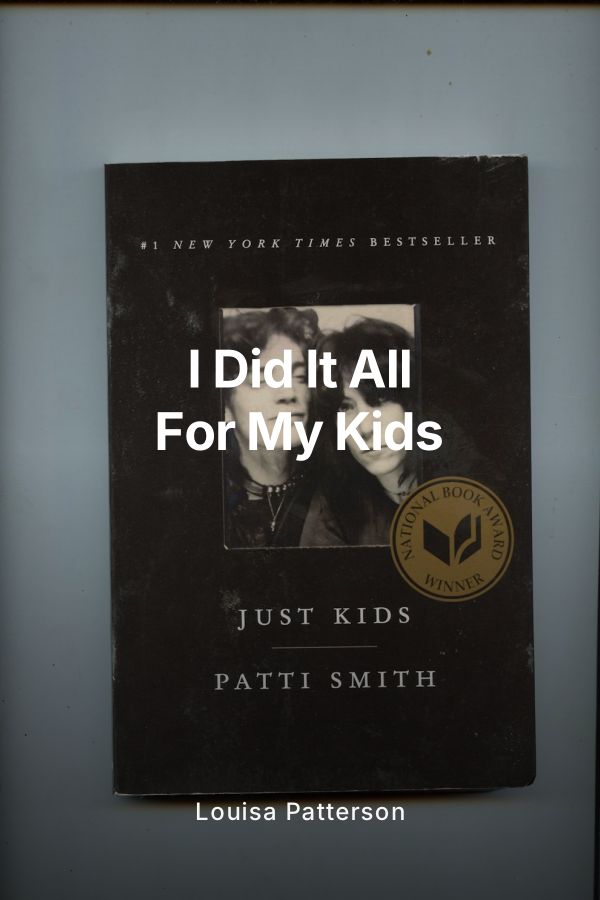
This book is a raw, unfiltered life story of a mother who did everything asked of her and more, yet still watched the Ministry of Children and Family Development pull each of her children out of her arms, one after another. It is a survivor’s testimony about love, injustice, and the brutal machinery of a child welfare and court system that could never see past its own files to the truth of the woman standing in front of it.
Told in her own fierce, plainspoken voice, the story begins in crisis with the first removal of her son Brodie in Kelowna. There is no gentle introduction to the system, only a sudden visit from MCFD with no paperwork, no real explanation, and a business card slid across the wreckage of a young family’s life. The reports are built more on the father’s using and drinking than on her, yet she is treated as guilty simply because she is with him, despite being six months pregnant and repeatedly proving through drug and alcohol tests that she is clean.
From that moment, everything becomes a fight. She searches for help, finds support workers, and still runs into walls at every turn. MCFD tells her she must stay in Kelowna against her will if she wants to keep her unborn son Connor, controlling not only her parenting but where she is allowed to live and where she can give birth. She obeys, racing back to Kelowna while in labor so her baby will not be removed purely on a technicality about geography.
For a time, there is hope. She secures a place in Karis, commits to programs, attends every visit, and prepares to have Brodie come live with her again. She follows every plan they set in front of her. Then another demand is added, and another, each one shifting just out of reach. When she wants to spend Christmas with her family in North Vancouver, she tries for weeks to get permission, sends messages to workers and team leaders, and is met with silence. Frustrated and ignored, she goes anyway, and when she returns and tells the truth, Connor is removed on the spot in the MCFD building.
The book follows her through each new blow. There is the promise of a supervision order and a path to reunification, snatched away after a serious car accident where she is pronounced dead at the scene and later blamed for having been in the accident at all. There is treatment that she completes in full, only to be told she must now prove safe housing, which she does, only to be told they want four more months to see if she can maintain it. There are hotel visits with her boys that finally let her mother them five days a week, until a confrontation with a manager about secondhand smoke ends in a planted wallet with drug residue, an allegation she never has a chance to properly fight before visits are cancelled and her boys are taken back to foster parents.
While she is fighting to keep and regain her sons, her daughters arrive into the same unforgiving system. Nataly is born early but healthy, then removed two weeks later to be with her brothers because they are already in care, even though their mother has a safe two bedroom rancher and support in Lillooet. She gathers evidence, texts, emails, and documents of all she has done, only to be convinced by her own lawyer to agree to a continuing custody order she does not want, a lawyer she later discovers is married to one of the workers.
The story does not soften or hide the darkest corners. It includes the rape that results in her pregnancy with Maycee, after a man she met through a mutual friend choloroforms her and she wakes up in a shed on his property. It shows her trying again to create safety, moving to Kamloops, finding a room with an 86 year old woman who offers her a home, passing a home check from a family support worker, and finally giving birth to a healthy daughter she fully expects to raise. Then, one day later, a social worker arrives and takes Maycee, citing a lack of housing that is simply not true. Even when the lawyer admits the hospital mixed up her records with someone else, the gears of the system keep grinding forward, and the baby is kept in care. No worker bothers to come see the approved home or correct the error in practice.
Throughout the book, the reader hears her directly in the rooms where decisions are made. She wants real quotes preserved, like the family case conference where a team leader reads her plan and asks how her 90 year old foster mother could stop her from going out and doing drugs when she herself is not even using and is being judged solely through the father’s addiction. The tone of the book is intentionally raw and unpolished, echoing the way she actually spoke to workers, judges, hotel managers, and social service staff. Her anger, swearing, tears, and breakdowns are not cleaned up for anyone. They are part of the evidence.
This is not just a list of harms. It is also a record of work. The story repeatedly shows the fight, the hard work, and the sleepless nights she endures for her kids. She attends treatment, parenting programs, and court dates. She hunts for safe housing again and again, moves towns to be closer to her children, and keeps asking what else she can do. Whenever a goalpost is set, she reaches it, only to see it move again. The book makes clear that she would do it all over again for her kids, even knowing how the system will respond.
The emotional core of the book lies in the bond between mother and children that no court order can completely erase. We see Brodie as a boy who loves the outdoors, thrilled by camping trips and time with his parents before the first removal. We see Connor’s rushed birth in Kelowna to avoid immediate removal, Nataly’s brief days in the NICU and then in her mother’s arms, and Maycee’s arrival in Kamloops as a new chance at finally parenting without court orders hanging overhead. These are not just case numbers. They are individual children whose mother will carry a lifetime of memories and what ifs.
As the story moves toward its final chapters, the focus shifts from fighting the system to making the hardest decisions no mother should have to face. Years into the battle, exhausted but not broken, she makes choices now guided entirely by her children’s best interests rather than her own longing. Connor, Nataly, and Maycee are together with a family in Pritchard who can give them stability and everything they need. She signs them over, not because she does not want them, but because she loves them enough to let them have what the system refused to let her provide.
With Brodie, who is autistic and has ADD, she faces a different kind of heartbreak. He has been with his foster family for five years, built routines, and depends on structure. She has a home in Kamloops now and a new husband, and her heart longs to bring her eldest son into that home. Instead, she tells her social worker that for Brodie’s sake, he is better off staying where he is, because ripping him out of his stable world could destroy him. It is a decision rooted in sacrifice, compassion, and a mother’s willingness to hurt herself rather than risk hurting her child.
The book closes with her in her Kamloops home, no longer running from town to town, no longer chasing moving goalposts, looking back over six years of fighting for four children through removals, treatment, courtrooms, accidents, pregnancies, shelters, and foster homes. She speaks directly to other parents caught in the same machinery, especially mothers who are judged by association, by old files, or by the mistakes of people around them. She tells them they are not alone, that the pain that is breaking them right now is survivable, that there can still be a life on the other side even when the outcome is not the one they begged for.
Her final words take the form of a prayer. It is not neat or pretty, but it is honest. She asks for protection and comfort for her children, wherever they are and whoever is tucking them in at night. She prays they will not grow up to hate her, that one day they will understand how hard she fought and how many times she was willing to start over from nothing for their sake. She prays for strength for herself and for every parent standing alone in front of MCFD and the courts, feeling judged before they can even speak. Above all, she prays that no one else will ever have to go through the same nightmare for doing everything they were asked to do.
I Did It All For My Kids is written for the mother sitting in a shelter scrolling her phone in the dark, for the parent walking out of a courthouse with shaking hands and no idea how to keep fighting, and for anyone who believes that a government file always tells the whole truth. It is a story that refuses to be polite or quiet. It is a testimony that says, again and again, there is hope, even when the system does not change, because a mother’s love can hold on through losses that were never fair to begin with.