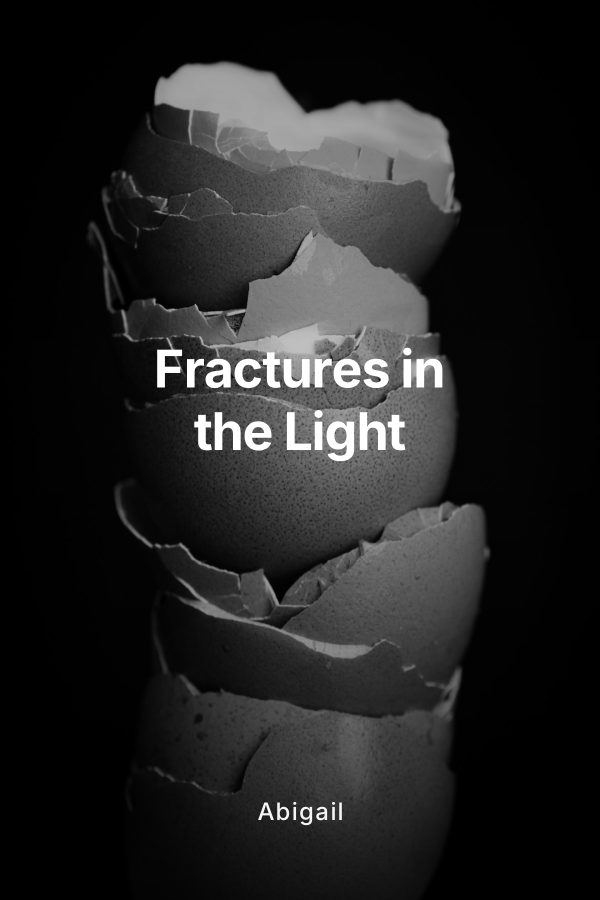
This book follows five very different teenagers whose lives violently collide after one life changing night in a small coastal city. Each of them carries a secret, a scar, or a quiet hunger they are terrified to name. Over one turbulent summer they are forced to face who they really are, who they have been pretending to be, and who they might become if they stop running.
The story is told in alternating points of view across five chapters, each centered on a different character but tightly woven into the others. Together, their chapters create a single arc: a hit and run accident that no one meant to happen, a cover up that pulls them into a shared lie, and the long road toward truth, forgiveness, and a more honest kind of courage.
Chapter 1 follows Nova, a blunt, talented street photographer who documents the city at night to escape the chaos at home. She is the one behind the camera when the accident happens. Her instinct is to capture everything, to freeze the exact second a car jumps the curb and someone’s life splits in two. But once she realizes who was in that car, the photos in her camera become something else entirely: evidence, leverage, a choice. Nova’s chapter tracks her struggle between her loyalty to people she cares about and her refusal to let the truth get buried. She is drawn to the power of telling the story her own way, but also haunted by the idea that pressing “delete” might make her part of the harm. Through her eyes we see the city as a patchwork of bright corners and dangerous shadows, and we feel the first sharp crack as her belief in simple good and bad begins to fracture.
Chapter 2 moves to Eli, the golden boy soccer captain who was driving the car that night. To everyone else he is talent, charm, a full ride scholarship already lined up. Inside, he is clenched fear and quiet panic. Eli spent years carrying his family’s hopes, pretending his anxiety did not exist. The accident tears the mask off. His chapter digs into what it costs to be perfect, and what happens when the person everyone trusts most is the one who did the worst thing. Eli wants to turn himself in, but he is trapped between a terrified parent, a coach who wants everything “handled,” and friends who are not ready to see their own complicity. His chapter becomes a map of guilt as a living thing. We watch him pull away from the people who love him, sabotage his own future, and test just how far you can sink before you finally ask for help.
Chapter 3 centers on Talia, a sharp, soft hearted coder who has always felt safer online than in real life. She was riding in the back seat during the crash, staring at lines of code on her phone instead of the road. Talia sees the world as logic and pattern, but what happened that night makes no sense. Her chapter focuses on the way trauma rewires your thoughts and how easy it is to convince yourself that silence is a form of loyalty. When a glitchy anonymous account starts dropping hints about the accident, Talia becomes obsessed with finding the source before the truth explodes. She hacks, snoops, and pieces together digital breadcrumbs, only to discover that the person trying to expose them might not be their enemy at all. Talia’s journey is about learning to speak in her own voice instead of hiding behind screens, and about choosing connection over control.
Chapter 4 shifts to Jace, a moody, hungry musician who lives in the next neighborhood over, on the side of town everyone else pretends not to see. Jace’s younger brother is the one injured in the accident. At first all he knows is that his entire family’s fragile stability has been wrecked in one random night. Jace’s grief comes out sideways as anger, late night fights, and reckless shows with his band. As rumors about who was in the car start circling, Jace’s chapter becomes a raw look at rage and class resentment. The kids who hurt his brother have lawyers and adults who make problems vanish. Jace has hospital bills and a landlord who keeps raising the rent. When Nova shows him a single blurred frame from that night, Jace finds himself holding proof that could burn everything down. His chapter drives the story toward a collision between revenge and justice, and asks what it would mean to protect his brother without turning himself into a weapon.
Chapter 5 belongs to Rina, a quietly ambitious overachiever who has built her entire identity on being reliable and harmless. She was not in the car, but she becomes the hinge between all four of the others. Rina runs the school’s unofficial anonymous confession page, a project she started as a way to let people vent, not realizing how heavy their secrets would become. When a confession about the hit and run appears in her inbox, she is finally forced to admit that she has been altering and deleting posts for months to protect certain reputations, including people she loves. Rina’s chapter pulls all the threads together as the city prepares for a summer festival where everything is supposed to feel hopeful and new. She is the one who can decide whether the truth finally comes out in public, or stays trapped in private messages and whispered rumors.
Throughout the book, the accident is the ignition, but not the whole fire. Each character is already carrying hidden cracks before that night: Nova’s fear of repeating her mother’s self destruction, Eli’s swallowed panic attacks, Talia’s complicated relationship with control, Jace’s combustible loyalty, Rina’s quiet manipulation of everyone’s stories. The plot follows them as they avoid, deny, and bargain with themselves, until avoidance is no longer an option.
The central tension is simple but relentless. If they keep covering for one another, they might protect their futures, scholarships, carefully planned escapes. But every lie costs them pieces of themselves and their relationships. The more they hide, the more their world shrinks into a tight, breathless circle of constant fear. On the other hand, if they tell the truth, they risk legal consequences, public shame, and the collapse of the selves they have carefully curated for years.
Key turning points drive that tension forward. Nova’s photos are discovered by someone she never meant to see them. Eli has a panic attack during an important match in front of the entire school. Talia tracks the anonymous account to a surprising source that challenges her assumptions about who is “good.” Jace’s brother takes an unexpected step toward his own healing, which forces Jace to rethink his thirst for revenge. Rina loses control of the confession page when a friend leaks screenshots, turning private pain into school wide chaos.
As their secrets leak out in small, messy ways, the five of them begin to intersect. Some of the connections are hostile at first. Jace cannot look at Eli without imagining what his brother’s life might have been without that one night. Nova and Rina clash over who has the right to tell a story that belongs to more than one person. Talia hides what she knows from both sides for as long as she can, until she realizes that “neutral” is just another word for choosing the status quo.
What gives the book its emotional core is not just the mystery of who will confess and when, but the way each character slowly turns toward themselves. This is a story about accountability that is not just about punishment. In therapy sessions, late night rooftop conversations, slammed doors, and awkward apologies, the teens confront what responsibility can look like at their age. It is messy, imperfect, and sometimes unreciprocated. They learn that saying “I was wrong” is not the end of the world but the start of a different one.
The city itself plays a strong role, almost a sixth character. Its layered neighborhoods, cracked basketball courts, glittering waterfront parties, crowded buses, and empty parking lots all mirror the characters’ internal states. The summer heat builds pressure. Storms roll in at critical moments. The festival that everyone keeps talking about becomes a symbol of both escape and reckoning, a place where pretending to be fine is practically a social rule, yet where all five of them will be forced into the same space at the same time.
By the final section of the book, the truth can no longer be contained. Rina’s confession page goes public. Nova is asked to share her photos in a gallery that wants to frame the accident as “urban grit,” and she has to decide what it means to profit from someone else’s pain. Eli sits across from Jace’s family in a mediation circle where no one can hide behind lawyers or coaches. Talia chooses to reveal what she did and did not do to help cover up the crime, risking all of her hard earned trust. Jace confronts the possibility that healing his brother might mean letting go of the image of himself as a permanent victim of other people’s choices.
The ending does not tie everything into an impossibly neat bow. Instead, it offers a clear but emotionally complex resolution. There are consequences for what happened that night, some imposed from the outside, many chosen from the inside. Some friendships do not survive in their original form, but something more honest takes their place. Futures are altered, but not erased. The characters do not magically become perfect, but they become more themselves, less afraid of their own shadows.
“Fractures in the Light” aims to capture what it feels like to be right on the edge between adolescence and adulthood in a world where every mistake feels permanent and every secret feels like it has teeth. It speaks directly to the pressure to perform perfection online, the temptation to curate your own narrative at any cost, and the terrifying, liberating act of telling the truth even when it might burn the life you planned.
The book leans into emotional authenticity without losing momentum. It blends sharp dialogue with quiet interior moments, high stakes action with intimate conversations. Above all, it treats its teen characters as fully human, flawed and capable of growth, able to harm and able to heal. Their broken summer becomes the place where they finally understand that light does not mean the absence of fractures. It means learning to live honestly with them and still choose to shine.