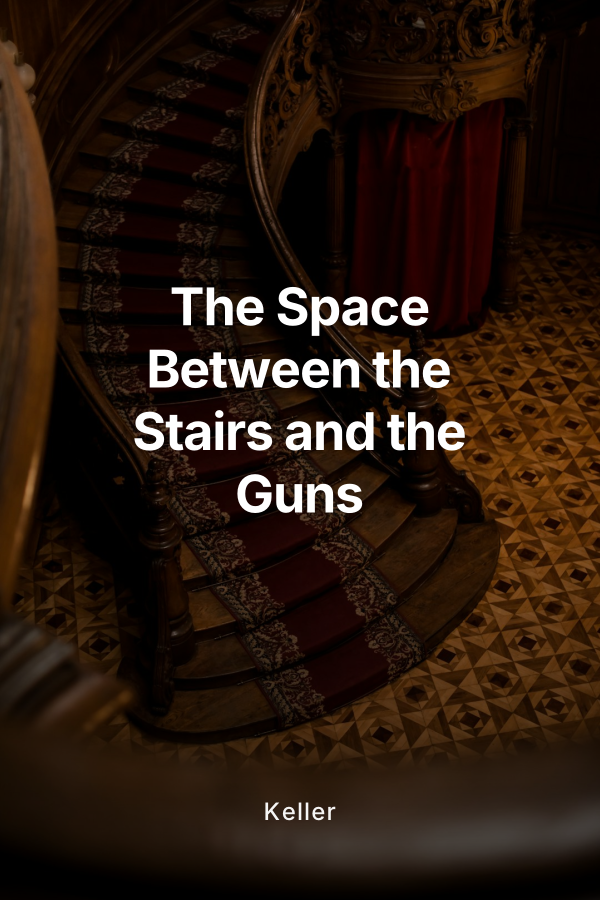
This book is a spare, intimate wartime novel told in the close voice of a twelve year old Jewish girl who survives a sudden roundup only because she happens to be on the wrong staircase at the right moment. In one afternoon her ordinary town, once full of radios, cooking smells, and her little sister’s chatter about a fifth birthday, is turned into a place of boots, trucks, and lines that sort human beings like objects. Everyone she loves is taken. She is left behind with a school satchel, a crust of bread, and a key to her best friend Laine’s fifth floor apartment.
The story does not name the country, the town, or the year. Its atmosphere and details are historically grounded in the machinery of Nazi occupation and deportation, but the focus stays tightly on one child’s immediate experience. Real events are felt as blows of sound and movement rather than explained in dates and directives. The bad men in heavy green coats are understood first not as a regime but as the hands that push her parents and four year old sister into lines, the voices that empty her building, the boots that climb her stairs. The book sidesteps explicit description of camps and gas, instead tracing the way those absences press on a mind too young to grasp the full scale of what has begun.
Intended for thoughtful middle grade readers, young teens, and adults willing to inhabit a child’s confusion, the novel keeps violence mostly just out of frame. The narrator sees a man struck with a rifle butt, hears people crying, watches the top of Kate’s head disappear as she is lifted onto a truck, but the camera of the prose often holds at the level of hands, feet, crates, and doors. The horror concentrates in small, unforgettable images: a smear of jam where her sister ate breakfast, coats missing from pegs, a toy left on the floor, a soldier tossing bread to a little boy instead of a blow. These details allow readers to feel the scale of loss without graphic depiction, making the book accessible across ages while emotionally devastating.
At the heart of the novel is a moral and emotional territory that the title names: the space between the stairs and the guns. Literally, it is the narrow, suffocating gap above Laine’s pantry where the narrator later hides, invisible while soldiers drink from Laine’s jug and lean against the boards that hold her weight. Figuratively, it is the space in which every choice she makes now must live. She stands between the urge to run into the square and grab Kate’s hand, and the knowledge that crossing that open ground would have her shoved into a truck or shot where she stands. She exists outside the neat categories the soldiers enforce. She is not in any of their lines. She is surviving in a crack their lists do not cover. That cracked, in between status becomes both her refuge and her burden.
The book unfolds in three broad movements that follow the widening of her world. The first movement begins the moment she pushes open the door to her family’s flat and finds an impossible quiet. There is no radio, no clatter from the kitchen, no smell of onions and soap, only the ghost marks of where coats used to hang and the sticky wound of dried jam on a chair. From the window she sees two unfamiliar soldiers on the street below, then, forcing herself to look straight down instead of far away, she sees her parents and Kate hemmed in by men with guns. Her attempt to reach them through the stairwell stalls in a tangle of strangers, shouts, and fear. She ends wedged higher up, pressed to a landing window, watching the entire building pour into the square.
From this vantage point she witnesses the sorting that will define everything that follows. Men are separated and made to shoulder crates toward open truck beds. Women are hidden under an alley mouth. Children are kept in the exposed strip between, a flock waiting to be claimed. The scene plays out with the cold precision of a system designed elsewhere. Within it, however, glints of unpredictable human behavior flash: a soldier who should strike a boy instead flips him a scrap of bread; a child who should clutch that scrap for himself breaks it and shares it with Kate. Laine, standing among the children with sleeves folded under to fit her growing arms, reaches for Kate’s hand and does not let go. Together they climb the truck steps and vanish into the wooden dark. The girl at the window is left gripping the frame, feeling her breath shatter into glass as the trucks pull away and the square collapses into a new, hollow kind of silence.
That night and the days that follow are shaped by one simple, cruel arithmetic: the occupiers have engines, guns, orders and lists; she has legs, wits, and a key. She cannot chase trucks. She cannot stop the war. But she can step sideways into the only uncounted space left to her. She slips into Laine’s apartment using the key her friend once entrusted to her for small errands and stolen afternoons. At first, she inhabits the flat as a ghost, touching Laine’s belongings as if they might bruise, drinking water that does not feel hers to drink, eating bread that tastes like a betrayal with every swallow. She calls herself a coward for hiding, then hears her father’s remembered voice, cool and practical, reminding her that in any game of strategy you must see the board as it is, not as you wish it to be. Staying alive is not cowardice. It is the only way left to keep any promise to Kate at all.
The first movement builds to a breathless search of the building. Soldiers return to check what their first sweep missed. Doors slam open on each landing. Voices snap and echo. Beds, wardrobes, curtains and closets offer no safety that strangers with rifles will not immediately tear through. In a single, sharp decision that proves Laine’s notebook right about her, the girl drags a table into Laine’s kitchen, clambers up and squeezes herself into the thin, dusty gap between the top of the pantry cupboard and the ceiling, the very sort of space her father once joked she was small enough to live in. From there she hears boots, bottles, and laughter. A back presses against the boards beneath her ribs. The men complain about the rations, not suspecting that a child lies flattened above their shoulders. The space is almost too tight to breathe in, but it saves her. The day ends with a physical definition of the book’s title pressed into her bones.
In the second movement the tempo slows. The trucks have left. The building is quieter, yet wrong in its quiet. Old neighborhood sounds, like chairs scraping and children squabbling, have thinned into the soft click of doors, the hush of shoes on stairs, the far off echo of new commands shouted in another street. Flags the girl does not recognize hang from the town hall. Posters with symbols she does not yet understand peel on walls that once held bakery advertisements and concert notices. The occupation begins to grow roots.
From the safety of Laine’s fifth floor windows she starts to redraw the town in her mind. Once, she colored paper maps with cheerful crayons. Now she holds an invisible diagram behind her eyes, marking streets and corners as black for certain danger, gray for uncertainty, white for possible safety. Laine’s apartment becomes a single white square in a sea of deepening gray. The square where the roundup took place, the roads that lead to the train station, the sight lines of posted soldiers at corners all go black. Back lanes, basements, stairwells with dead bulbs, the roof access door that sometimes sticks become possible routes, marked in tentatively lighter shades. The geography of her childhood refolds into a private map of risk and refuge.
This interior cartography is mirrored by the way she begins to watch other living things in the courtyard below. An old neighbor, Mrs. Kowalski, shuffles to the bins with a basket as if she has aged ten years in one night, but she still empties her scraps and straightens her back afterward. A rat bolts from the trash and streaks along the wall, and the girl realizes with a jolt that the occupiers do not care where the rats go. They are not sorted into lines, not recorded, not transported. They scavenge edges and vanish into cracks. It is a humbling comparison, but one she cannot ignore. If she wants to survive unsorted, she will have to learn from creatures no one bothers to count: stay small, stay quick, always know where the nearest gap is.
The second movement is where her grief and guilt begin to curve into a hard, practical resolve. Exploring Laine’s rooms a second time, she stops handling objects as sentimental relics and instead evaluates them as supplies. How long can the food last if she cuts the bread into thin slices? How much water can she store if the pipes fail, or if a new order reserves the taps for soldiers? Can she safely reach the courtyard pump and back without catching a patrol’s eye? What can she carry if she has to flee the building on a moment’s notice? She chooses a satchel, packs a blanket, Laine’s blue covered notebook, and a fairy tale volume she imagines reading to Kate one day if they are ever in the same room again. The questions are grimly adult, but they wear a child’s language of loyalty: Mama would want her to eat, Papa would want her to adapt, Kate would want her to come back, Laine would expect her to honor the trust of a key and a cat.
Laine’s notebook, in particular, becomes a quiet engine in the plot. Among sketches and impressions of classmates, the girl finds her own name followed by a single line: “She is braver than she thinks.” Written before the invasion, the sentence reaches across the broken world to order her forward. It frames the guiding question of the story: what does it mean, in practice, to be braver than you think when you are twelve, alone, and surrounded by rules you did not choose? Courage here cannot look like charging a barricade. It must look like keeping promises, making maps, waiting, watching, deciding when to move and when to stay still.
Nights in this middle section deepen the book’s emotional resonance. The narrator lies in Laine’s bed, shoes still on in case she needs to run, tracing the river shaped crack in the ceiling they once named together, trying not to picture real rivers under real train tracks heading away from town with her family trapped in cars. She whispers “I will find you” into a borrowed pillow and feels how weightless such promises are. They mean nothing until she adds decisions to them. In her dreams, everything is lined up and categorized: men in one line, women in another, children in a third, even houses and streets sorted and tallied. She is in none of these lines, standing instead in a blank space on the map with a key in one hand and bread in the other, while the town tilts, trying to spit her out or swallow her whole. That blank space is terrifying, but it is also the only location from which any deviation can begin.
By the time the narrative enters its final movement, the girl has shifted from a frozen witness to a careful actor. Each time she peeps from a curtain to observe a patrol or a queue, she adds new information to her inner maps. She begins to test those maps with small forays, the first steps of the “journey together” that the book hints she will soon share with another hidden child she discovers nearby, a boy or girl who too has slipped the net and will come to share her routes and rationed food. Their partnership will not be romantic or sentimental but forged in practical cooperation: one watching while the other fills a bucket at the pump, one carrying two satchels while the other scouts stairwells, both listening for rumors that might lead, one day, to news of the trucks, the trains, and the children taken away.
Throughout this expanding outward movement, the central question of what to do with survival grows sharper. Surviving is not simply staying hidden. It is deciding what to carry forward. The narrator wonders if she will spend the war as a dust mote in the high air of Laine’s fifth floor, unseen but useless, or whether she can find ways to influence even the smallest corner of this occupied world: sharing news between hidden people, hiding a slip of food near a trash bin where someone hungrier may find it, memorizing names and faces so that if there is an afterward, someone will remember who was taken. Her own sense of worth struggles under the metaphor she has chosen for herself. Yet she begins to understand that sometimes the most radical act available to a child is simply to remain present, attentive, and determined not to let those who built the lines also write every word of her story.
The arc of the book refuses false comfort. It does not promise early reunions or clear knowledge of the camps. The girl does not suddenly learn where the trucks went or receive a letter from her parents. Instead, the narrative respects the opacity that children under such regimes lived with. She knows only what she sees and what the scraps of overheard adult conversation suggest. The reader shares this narrowing of certainty and must live, as she does, in the ache of unanswered questions. Yet within that ache small, convincing lights appear: an adult neighbor who chooses, quietly, to protect her; a bored young soldier whose moment of humanity complicates the easy line between monster and man; the solidarity between unsorted children who decide, on purpose, to walk through this broken town together.
In its closing images, the novel returns to the fifth floor window. The girl stands with Laine’s key in one hand and the weight of many days’ choices in the other. The town below has hardened into zones of fear and narrow paths of possibility she knows by heart. She no longer feels like a ghost in Laine’s rooms. She has worn a trail between hiding place, window, and door, her body trained to freeze at certain sounds and move at others. She still does not know where Kate sleeps or whether her parents are alive. She does know, now, that she is capable of acting inside the slim space history has left her. Her survival is no longer a passive accident. It is something she is doing with intent. The book ends not with the completion of her journey, but with a clear sense that she has stepped fully into it.
The Space Between the Stairs and the Guns is ultimately a story about the moral and emotional topography of being left behind. It explores how a child might navigate a world that has suddenly become a map of forbidden lines and narrowing gaps, and what it costs to keep even a small part of oneself unsorted by systems that would prefer every life either tagged or erased. Without softening the reality of dispossession and terror, it offers readers an unforgettable guide through the fragile power of attention, memory, and the quiet, stubborn choice to live bravely in the cracks where no one thought anyone would be.