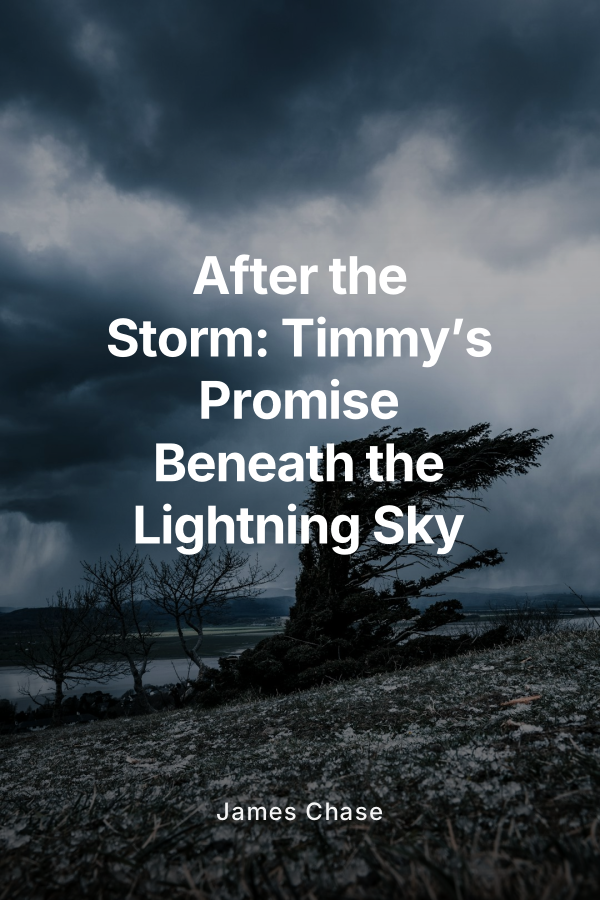
This book follows Timmy, an eleven year old boy in a crowded city, whose life changes forever during a freak lightning storm that kills hundreds of thousands of people and leaves the world around him in ruins. At the start, Timmy is simply a quiet kid who loves space. He spends afternoons at the city park, lying in the grass and tracing constellations he has memorized from books. His obsession with distant galaxies makes him a target for Mason, an older boy who mocks him, shoves him around, and laughs at his “space dreams.” Timmy’s best friend, Jamey, stands by his side, but even Jamey cannot fully protect him from Mason’s cruelty. Their world still feels ordinary, though, right up until the day the sky splits open.
One seemingly normal day in the park, Mason corners Timmy again, ready to bully him for his interests. Before the taunts can go far, the light over the city changes. The clouds churn, the air tastes metallic, and thunder cracks so violently it shakes the ground. Without warning, a lightning storm of unnatural power erupts. Bolts strike buildings, trees, cars, and streets in rapid, terrifying bursts. Panic rips through the park as people scatter. In the chaos, Mason is suddenly no longer the boy in control. He is terrified, separated from his friends, and very quickly in danger. Timmy, who knows the park’s paths and shelters better than anyone, becomes Mason’s only hope for survival.
The first chapters focus tightly on this day of disaster. The storm kills a staggering number of people and shatters the city, but the story keeps its attention on Timmy’s experience. He sees the sky on fire, hears screams, smells smoke, and feels the ground tremble under repeated impacts. He shields Mason when debris falls, guides him toward cover, and refuses to leave him even though Mason once made his life miserable. Timmy’s knowledge of the park shortcuts and his quick thinking, shaped by years spent imagining navigation through galaxies and star maps, helps them find a path through the devastation. As the city’s power grid collapses and sirens wail in the distance, Timmy learns that courage can come from the very part of himself he used to be mocked for.
When the storm finally ends, Timmy steps out to a world that looks nothing like the city he knew. Buildings lie broken. Streets are chunked apart. Smoke and dust blur the skyline where lights used to glow. Everything smells of burned metal and wet concrete. In the middle of this wreckage, Timmy feels a crushing mix of terror and numbness. Mason, injured and shaken, is no longer a bully. The disaster strips away their old roles, forcing them to see each other as two frightened boys who barely escaped being among the countless dead. This moment begins a slow, uneasy transformation of their relationship, from hatred toward the possibility of something more complicated and human.
Amid rescue efforts and emergency shelters, Timmy discovers that his best friend Jamey has lost their entire family in the storm. Jamey moves in with Timmy and his family, and the book shifts into a story about grief pressed into a small apartment and a bruised neighborhood. Jamey refuses to cry where anyone can see. Instead, Jamey stays busy, jokes at odd times, and keeps feelings locked behind a guarded face. Timmy recognizes that this toughness is only a thin shell over unimaginable pain. Living together, the two friends become like siblings, sharing cramped rooms, late night whispers, and secret fears of every rumble of thunder that passes through the recovering city.
As months go by, Timmy, Jamey, and Mason navigate a new life shaped by both loss and fragile hope. The storm’s scars are everywhere, yet so is the effort to rebuild. Mason struggles with guilt over his past cruelty and his helplessness during the disaster. He owes his life to the boy he used to torment. Timmy, still obsessed with space, starts to look at the stars differently. Instead of using them only as an escape, he begins to see them as symbols of survival and guidance. The universe feels vast and dangerous, but also full of possibilities. This is where he first starts to “see a bright new future”: not because the pain has gone, but because he realizes that life can grow again even after such deep destruction.
The middle of the book follows the slow healing of these kids as they move from raw trauma into a new kind of normal. Timmy learns to live with flashes of memory and grief. Jamey learns to trust that it is safe to feel, at least with Timmy nearby. Mason tries to repair the damage he caused before the storm, gradually stepping from bully to uneasy ally, and eventually to a real friend. Around them, the city rebuilds. Schools reopen in temporary buildings. Neighbors organize to help one another. Timmy’s love of space begins shaping his future: he devours science books, watches documentaries about weather and stars, and wonders whether understanding the forces that nearly killed him might someday help him protect others.
Just when their small, fragile circle seems to have found balance, Jamey receives news that changes everything again. A year after moving in with Timmy’s family, Jamey’s uncle, who lives in another county, is finally ready and able to take Jamey in. It is a chance at stability, a fresh start away from the constant reminders of the storm, but it also means tearing Jamey away from the one place that has begun to feel like home again. Jamey, still reluctant to show vulnerable emotions, tries to act unaffected, packing bags and talking about the move as if it is just another change.
The goodbye between Timmy and Jamey becomes one of the emotional centers of the book. They stand together, not quite children anymore but not yet adults, full of experiences that most grown-ups never face. Jamey tries to keep it light, to joke through the ache, but Timmy refuses to let this moment blur into casual words. He promises out loud that he will never forget Jamey, no matter how many years pass or how far apart they live. Underneath that vow is the silent fear that they might never see each other again. Jamey, struggling to hold back tears, accepts that promise and makes their own: that this is not goodbye forever, only a long pause.
The story then moves through the next decade of Timmy’s life in a series of key moments rather than day by day detail. Timmy grows into a young adult who holds his memories like constellations, each bright point connected by lines of meaning. He studies, works, and keeps staring up at the night sky whenever city lights and clouds allow. The trauma of the storm does not vanish, but it changes shape over time. Timmy has nightmares, but he also has determination. Guided partly by what he lived through, he leans toward a future that involves understanding nature, weather, or space, seeking not just escape but insight.
Mason remains in Timmy’s life, changed permanently by the day Timmy saved him. Their early history of bullying never disappears completely from memory, but Mason’s loyalty and remorse give weight to their friendship. They navigate teenage years, anniversaries of the storm, and quiet evenings where they talk about those they lost. Jamey’s absence is a constant thread. Timmy keeps the promise he made, holding on to memories of shared meals, whispered conversations in the dark, and the day Jamey walked away with a suitcase and a guarded face.
Ten years after Jamey leaves, when Timmy is twenty one, their paths cross again. The book builds toward this reunion as a payoff to the long held promise. Whether through a planned visit or a carefully arranged meeting, Timmy and Jamey finally stand face to face as adults. The time apart has changed them both, but the connection formed in the ruins of the storm has not faded. Their conversation is layered with the past: the park where it all began, the lightning that tore their lives apart, the year they shared a home, and the day they were forced to separate.
The final chapters explore how shared trauma can become shared strength. Timmy and Jamey gradually rebuild not just a friendship but a partnership rooted in survival, memory, and hope. At twenty two, they marry, choosing to build a life together that acknowledges every scar without letting those scars define their future. Their wedding day becomes a quiet, powerful echo of the day Timmy first “saw a bright new future” in the wreckage of his city. Now that future stands before them in the form of a new family and a chosen path forward.
Throughout the book, the scale of the original disaster remains in the background rather than constantly repeated. What matters most is how one boy navigates a world turned upside down, how a former bully becomes an unexpected ally, and how a friend who tried not to show any emotion becomes the person Timmy vows to love for the rest of his life. Timmy’s fascination with space, once a reason to be mocked, becomes a symbol of the story itself: a way of looking up from devastation toward distant lights that prove darkness is never complete.
“After the Storm: Timmy’s Promise Beneath the Lightning Sky” is a story about survival and the long, uneven road that follows. It shows how children forced to grow up too fast cling to one another, how forgiveness can rise from fear, and how a promise made at eleven can carry through an entire decade into a vow at the altar. By the final page, readers are invited to feel not only the weight of loss but also the deep, lasting power of love, loyalty, and the decision to keep looking toward the stars even when the sky once tried to kill you.