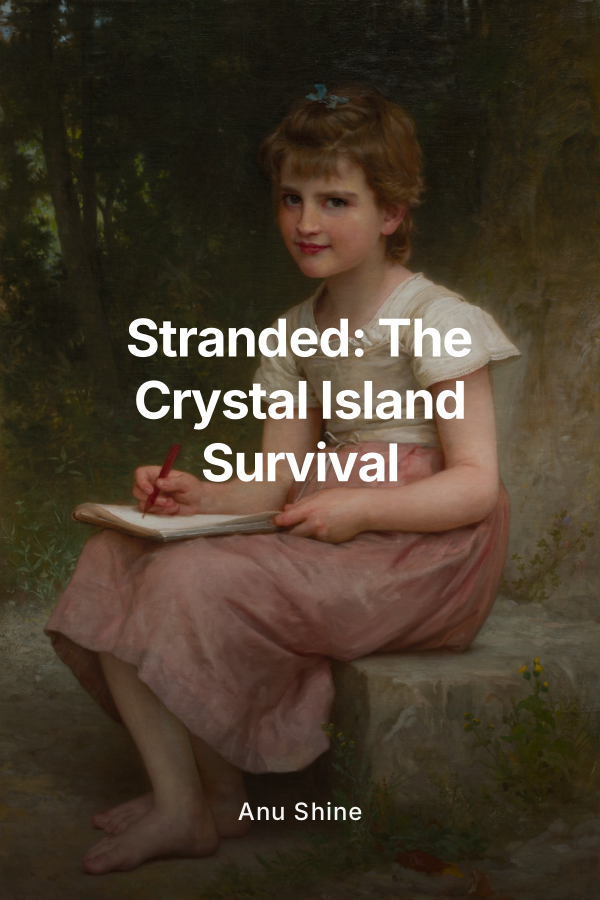
This book is a fast paced, teen friendly survival adventure set on a mysterious island once inhabited by an ancient crystal working civilization. It blends real world survival tips with an emotional story about two siblings who must learn to trust each other again in order to stay alive and find a way home. The story is supported by short, punchy survival tip boxes that feel as if they come straight from Theo’s practical, slightly nerdy voice, turning hard won lessons into quick reference guides for readers.
Theo and Sophie, modern siblings with very different personalities, are the heart of the story. Theo is the older brother, serious and methodical, the kind of teen who actually reads safety cards and watches bushcraft videos for fun. Sophie is sharp, impulsive, and tired of being told what to do. She has reasons not to trust Theo fully: something he did in the past, some choice he made, or a moment when he froze instead of acting, has left a hairline crack between them. At the start of the book, their dynamic is marked by exactly the kind of small frictions that feel enormous when everything is already stressful.
When their flight suffers a sudden engine failure over the ocean, those cracks are forced wide open. The book opens with the “Descent” chapter, where alarms, shouting, and violent turbulence slam the reader straight into the nightmare of a mid flight emergency. Theo, remembering the brace position information he once absorbed and that everyone else is ignoring, grabs Sophie and physically pulls her into the safest huddle he can manage in the tail section. The plane goes down. The impact is brutal, the aftermath full of smoke, broken metal, and the very real risk of post crash fire. Their first survival problem is immediate and clear: get out or burn. This chapter introduces the idea that knowledge matters in a crisis, and it seeds the first survival tip box on why the brace position and rapid evacuation can be life saving.
The wreckage washes up near a wild, seemingly uninhabited island fringed with sharp coral and restless waves. In “The Shoreline”, Theo and Sophie realize they have limited supplies, injured passengers are absent or scattered, and the rising tide is quietly threatening to claim what little gear they manage to pull from the wreck. Theo knows they must drag everything above the high tide mark, reading the beach for clues in seaweed lines and drift debris. The book introduces the Rule of Threes that anchors their priorities in the days ahead: air, water, and only then food. The tension here does not come only from nature but also from their fraying patience with each other. Sophie resents every command that sounds like an order. Theo, under pressure, can sound bossy even when he is scared. Their conflict is small scale yet sharp, framed against the unstoppable grind of the tide.
As hours turn to the first long day, “SOS” focuses on visibility and hope. With the wreck settled and no rescue in immediate sight, they must answer a question no one wants to face: what if help does not arrive quickly? Theo knows from his survival reading that signaling can be the difference between a near miss and a rescue. But in practice, the sky is empty, and smoke or flares are out of reach. The chapter’s key moment gives Sophie an active role. She spots a shard of glass from a broken window and, with Theo explaining briefly how to angle a signal mirror, she sends flashes into the sky toward a distant sound. Together they lay out ground to air symbols in the sand, learning that simple shapes like V and X can communicate their status to any pilot overhead. The tip boxes in this section are stripped down and visual in tone, turning their improvised methods into simple, repeatable instructions that feel within reach for any reader.
“The First Night” sharpens everything. On a remote shoreline, warmth and shelter are survival problems, not comfort issues. Rain lowers the temperature. Wind claws through damp clothes. The ground leaches heat from any body that lies directly on it. Theo pushes for a simple A frame lean to using the torn tarp and palm fronds from the beach, while Sophie, exhausted and on edge, questions whether this is worth the effort when she just wants to rest. The narrative turns their argument into a lesson: staying dry and off the ground is not optional. As they gather leaves and branches for insulation and strengthen their shelter, the story also reveals more about their past. Here, in the low light and nervous quiet, hints drop about the earlier moment when Theo lost Sophie’s trust. The emotional survival of the sibling bond runs in parallel with their physical survival, each shaping the other.
By “The Hunt for Life”, the immediate chaos has cooled into a grinding, practical fear. Hunger gnaws. Thirst scratches every thought. They follow a faint path into the jungle and listen for water, aware that streams can hide beneath thick plant cover. Readers see Theo think out loud about water sources, including how transpiration bags over leafy branches could slowly yield drinkable drops if plastic is available. The book also touches on the universal edibility test, only to have Theo quickly undercut the idea for real kids who might be reading: on a real island, it is almost always safer to stick to clearly known foods like coconuts than to gamble with unknown plants. When they finally find a stream and learn how to crack open coconuts efficiently, Sophie gains a new respect for Theo’s quiet planning, and Theo begins to rely on Sophie’s quicker instincts and keener observation of the environment.
“The Shadows of the Past” takes them into denser jungle where the island’s secrets begin to surface. Navigation becomes a challenge. Every direction looks the same. Panic hovers. Theo introduces methods for orienting without a compass by watching the sun’s arc and using a shadow stick, and he insists on marking their trail so they do not wander in circles. In this landscape, they discover their first sign that the island was once home to something far from ordinary. Stonework that does not match natural rock formations, carved lines half buried in moss, and a glint of crystal embedded in a broken wall hint at a civilization that understood and prized these translucent stones. The crystals look mesmerizing and “cool,” enough to catch Sophie’s attention, but they are not magical. The danger lies instead in the very human built mechanisms they left behind.
“The Heart of the Island” drops Theo and Sophie into a zone of traps and ancient mechanisms. Here, the narrative tilts from pure survival story toward archaeological mystery, but it keeps both feet on the ground. The structures are broken, rusted, and eroded, yet still dangerous. Pressure plates, disguised pits, unstable stairways, and hidden drop stones are not fantasy devices but plausible extensions of old defensive architecture. Theo, now a more cautious leader, insists on a probing stick to test every step in front of them. They learn to read the environment for signs of instability: cracks in stone, unnatural patterns of lichen, small piles of rubble that signal recently disturbed surfaces. Scrapes and bruises become unavoidable, and the survival tip boxes respond with calm, direct advice on basic first aid, making this section both tense and quietly empowering.
At the emotional level, this central section is where Sophie’s distrust collides with reality. Theo makes a serious mistake, or nearly does, perhaps hesitating at a critical decision point or pushing them through a route that backfires. Instead of confirming her worst fears about him, however, the incident becomes a turning point. Theo admits his error openly, something he has struggled to do before. Sophie, in turn, steps up with a plan that gets them out of immediate danger. They stop being an older brother who orders and a younger sister who resists. They start to operate as partners. The hidden heart of the island is not only its crystal lined chambers but also the hard earned trust between these two teens.
In “The Return”, the story bends back toward the outside world. Theo and Sophie must take everything they have learned and convert it into a final, focused effort to be seen and saved. They climb to a vantage point, study wind patterns, gather dry fuel, and calculate how to create a signal fire that can be seen from far away without losing control of the flames. The book introduces the concept of a signal fire trio: three fires in a triangular arrangement forming an internationally recognized distress pattern. Managing this is not simple. They must balance resource limitations, weather shifts, and fatigue while staying ready to ignite the fires at the slightest hint of an engine drone or a distant glimmer of a ship. The final survival tip boxes here read almost like a checklist, reflecting how their mindset has shifted from panic to method.
The climax interweaves the technical and the emotional. As smoke rises and rescue finally appears possible, both siblings have to confront how they will live once this is over. The island has changed them. Theo is less rigid and more willing to admit uncertainty out loud. Sophie has discovered that questioning and trusting are not opposites; they can challenge each other and still move together. The ancient crystal ruins remain largely unexplained, leaving room for future exploration while emphasizing that not every mystery gets solved in a single journey. What matters most is that the siblings find a way to carry their new trust back into the ordinary world.
Throughout the book, the survival tip boxes serve as both structural anchors and educational nuggets. They appear at natural pause points, always brief, never preachy, and they feel like Theo has distilled each near disaster into a few hard earned lessons for anyone who might someday need them. Each tip is rooted in realistic concepts like the Rule of Threes, basic shelter building, emergency signaling, or simple navigation techniques, but presented in accessible, teen friendly language. The tone stays calm and slightly wry, often reflecting how Sophie would probably roll her eyes even as she listens.
Intended for teen readers, the overall style balances intensity with safety. Scenes of danger are vivid but not graphic, focusing on decisions, sensations, and consequences rather than gore. The language stays clear and direct, with enough complexity to respect a young person’s intelligence while keeping the pace brisk. Emotional beats are treated with the same seriousness as physical threats, acknowledging that trust, guilt, fear, and forgiveness can be as overwhelming as storm waves or jungle darkness.
Across its five broad movements, the full book will expand and deepen this outline. The early chapters will immerse readers in the crash, shoreline triage, and first shelter while establishing the broken trust between Theo and Sophie. The middle will track their learning curve as they search for water, food, and safe routes, bumping into strange crystal ruins that complicate their escape. The later chapters will push their teamwork to the edge within the trapped heart of the island, then pay off every lesson as they attempt a final, desperate signal for rescue.
By the end, “Stranded: The Crystal Island Survival” becomes more than a single adventure. It is an invitation for teen readers to imagine themselves in impossible situations and ask: What would I do? Who would I trust? How could I stay calm and think clearly? With each chapter’s tip boxes echoing Theo’s evolving voice and Sophie’s stubborn courage, the book aims to leave readers both entertained and quietly equipped, carrying a pocketful of practical knowledge along with a renewed belief that broken relationships can be rebuilt under even the harshest conditions.