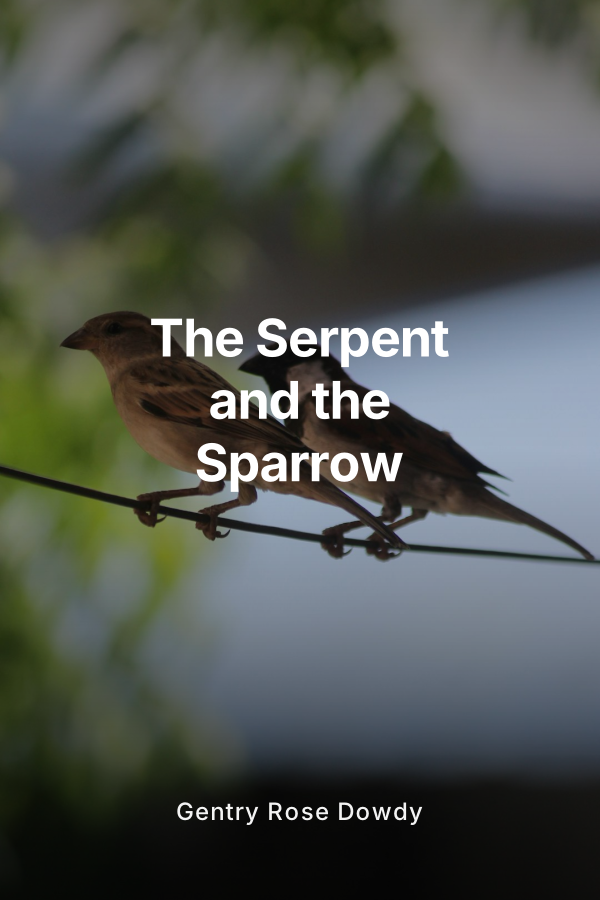
This YA romantic historical novel follows two teens caught in the crosshairs of faith, power, and prejudice in sixteenth century France. Kezia, a seventeen year old Romani girl, is captured and enslaved in the French royal household, where her beauty and her skills with herbs make people whisper that she is a witch. She is not a witch at all, but before her capture her father taught her the arts of healing and poisons as a way to survive in a world that sees their people as disposable.
Inside the glitter and venom of the Valois court, nineteen year old Aldéric works as a stable boy, quiet and unnoticed. In truth, he is the illegitimate son of King Henri II, raised by his peasant mother in the forbidden Huguenot faith. In a palace that worships Catholic power, Aldéric must hide everything that is real about him, from his faith to his bloodline. Any wrong word could condemn him as a heretic or expose him as a threat.
Their paths collide when Kezia saves the life of one of Queen Catherine de Medici’s sons after an attempt at poison. The queen, always hungry for useful tools, draws Kezia into her orbit, elevating her from enslaved girl to maid and secret confidante. In Catherine’s shadowed chambers, Kezia learns that in this court information is currency and a girl with quick hands and quicker instincts can be either protected or destroyed in a heartbeat.
It is in this new role that she first meets Aldéric properly in the stables, away from the polished marble and gilded ceilings. He notices her before she notices him. Where everyone else only sees a Romani servant to command, Aldéric sees a girl who moves like she has one foot always poised to run. Drawn to her sharp eyes and blazing refusal to bow inside, he finds reasons to be in her orbit. The stables and forgotten corridors become the thin spaces where their two secret lives begin to overlap.
Queen Catherine sets Kezia on a dangerous path. She commands the girl to win the trust of Diane de Poitiers, the king’s legendary mistress, by feeding her gold in the form of powder and elixirs, promising that it will keep Diane young. Kezia, stuck between gratitude and fear, obeys. Her father taught her that every substance can heal or harm depending on the dose, and now Catherine wants to turn that blurred line into a weapon. The more Kezia mixes potions and whispers reassurance into Diane’s cups, the more she feels the serpent’s skin forming around her, a version of herself that belongs to the queen and no one else.
As Kezia and Aldéric cross paths again and again in the liminal spaces of the royal household, their connection takes root. He sneaks her leftover bread and news from the city. She treats his bruised hands and the cuts that horses leave behind, hiding him from the court physicians who might start asking questions about his uncanny resemblance to the king. What starts as wary curiosity unfolds into something softer and more risky. They share jokes about the absurdities of court life, trade stories about their childhoods and their gods, and slowly admit how much each has already lost.
The pressure around them climbs when King Henri II dies in a freak jousting accident that rips the fragile balance of the French Wars of Religion wide open. In the bloody vacuum he leaves behind, Catherine becomes regent, and the stakes double overnight. Kezia, once merely a useful oddity, now finds her skills weaponized in full. Catherine begins to use her as a living blade, a quiet serpent sliding into rooms others cannot reach, carrying knowledge, tinctures, and whispered threats. Every errand feels like another coil tightening around Kezia’s neck.
At the same time, Aldéric feels the walls closing in. As the queen maneuvers to keep the throne secure for her sons, rumors churn through the palace corridors about hidden Huguenots, traitors in their midst, and secret heirs. Aldéric knows that if anyone uncovers his lineage or his true faith, he will be dragged into the center of a political storm and used or destroyed. His belief has already forced him into silence. Now it might cost him his life.
The romance between Kezia and Aldéric tightens in parallel with the political screws. They steal pockets of time in his small loft above the stables, a rough, warm space that becomes the only place in the entire palace where they can breathe. Here, they are not an enslaved Romani girl and a hidden royal bastard. They are just Kezia and Aldéric, two teenagers trying to translate feeling into words while the world outside sharpens its knives. Kezia struggles with the guilt of helping Catherine hold power with a poisoned hand. Aldéric battles the shame of bowing his head at Catholic mass while repeating Huguenot prayers under his breath.
When Kezia overhears whispers of a horrifying plan targeting the Huguenots, a plot that will become the St Bartholomew’s Day massacre, everything snaps into focus. She races through the palace to Aldéric’s loft and warns him about what she has learned. In that cramped space smelling of straw and horses, he begs her to run away with him, to cut themselves free from the coils of France and the court that has almost devoured them both. The weight of that choice crashes over them. To leave is to abandon everyone they know. To stay is to risk becoming tools in a slaughter. They kiss, desperate and certain, and choose each other. Their intimacy stays just beyond the curtain of the page, intense but implied, a moment where they silently vow to protect one another no matter what comes next.
Two weeks later, the massacre erupts. Paris turns into a nightmare of bells, shouts, and blood, and the violence bleeds into the palace itself. Kezia, trapped in the queen’s orbit, watches Catherine’s schemes ignite and finally sees herself fully as the serpent Catherine has been crafting. She realizes she cannot live as a poison in someone else’s hand. Terrified for Aldéric, she begs the queen to allow her to leave and search for him. Catherine, eyes sharp and unreadable, tells her to think for herself for once, a twisted permission that cuts deeper than any threat. Kezia looks at the woman who tried to turn her into a monster and refuses the role. She tells Catherine she is not a serpent and runs.
In the smoke and chaos that follow, Kezia is certain Aldéric has died in the slaughter. Panic wraps around her like chains. Then, just when the streets feel like they are about to swallow her whole, Aldéric appears through the haze on horseback, alive and bloodied but unbroken. He has bought passage to England, a place where, if not truly safe, at least they will not be haunted by the same faces and banners. He reaches down a hand. Kezia climbs up behind him, clutching at his waist, choosing the unknown over the familiar horror. Their final kiss as they ride away is not soft or easy. It is a promise that whatever serpents and sparrows they have been forced to be, they will write the rest of their lives on their own terms.
Across its five chapters, The Serpent and the Sparrow blends deep historical tension with an intimate, character driven love story. The book dives into the realities of Romani persecution, the brutal fracture between Huguenots and Catholics, and the toxic beauty of Catherine de Medici’s court, while staying close to the beating hearts of two teens who never asked to be part of history at all. It follows Kezia’s journey from captive girl to young woman who seizes her own power instead of letting others weaponize it, and Aldéric’s struggle to reconcile faith, lineage, and survival in a world that keeps telling him he should not exist.
Despite the darkness of massacre and manipulation, the story holds a YA core made for readers around fourteen and up. On page, the violence is intense but not graphic, the romance is passionate but mostly implied, and the focus stays fixed on emotional stakes instead of explicit detail. At its center, this is a book about identity, conscience, and the risk of loving someone in a world built to keep you apart. It asks what it costs to walk away from the only home you have ever known, how far you can bend before you break, and whether two young people who have been taught to bite their tongues can finally claim the right to speak, to choose, and to run toward a future that belongs to them.