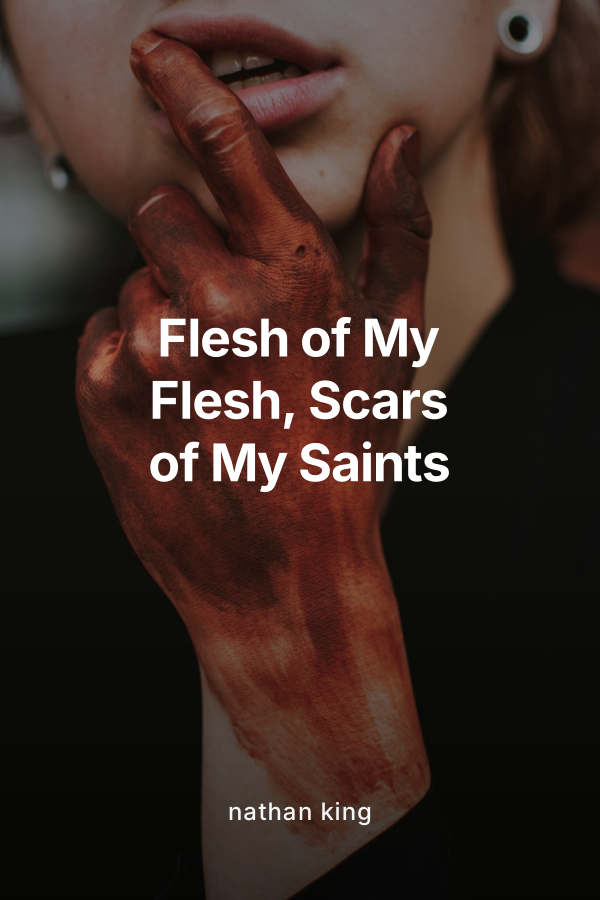
In a world where the sacred text does not warn against monsters but lovingly commands union with them, faith is written in flesh, oaths are inked in talons and scales, and salvation is measured by how deeply a human can love what terrifies them most. This book follows one reluctant believer as he is pulled between scripture, desire, and the aching question of what it truly means to be human when holiness wears horns and claws.
The story centers on Elias, a quiet scripture copyist raised within the Church of the Bridal Covenant. From childhood he has heard the same verse chanted in incense filled halls: “Blessed is the man who cleaves to the monster woman, for in her otherness he shall see the face of God.” In this faith, “monster women” are not abominations to be hunted but living sacraments chosen for human men. Marriage to them is both duty and destiny. Refuse your ordained bride and you are branded spiritually barren. Embrace her and you become a living icon of obedience.
Elias believes because he has never dared to imagine any other way of life. The world he knows is strictly ordered. At the center stands the Canon, a holy book that lovingly describes the myriad forms of the monster women who walk among mortals: winged temptresses whose feathers are inscribed with prayers, serpent bodied scholars who keep libraries in their coils, horned guardians who sleep around the city in circles of watchful eyes. To the devout, their claws, fangs, and strange anatomies are not marks of sin but radiant symbols of divine wildness. To lay with them is to touch the untamed heart of the Creator.
Yet Elias has one secret heresy. While other boys carved hearts around their favorite monster forms in the margins of their prayer books, he felt nothing but a distant, frightened awe. He recites the passages about holy coupling in a steady voice during services, but his own blood stays cool. To him the monster women are beautiful, terrifying, and unreachable, like meteors frozen in stained glass. When his older brother bonded with a river beast bride, half woman and half translucent water, Elias watched their wedding night from afar and felt not envy but dread, as if watching someone step willingly into a flood.
Everything changes when the Church announces a new period of renewal. A prophesied generation of unions is approaching, meant to strengthen the fading barrier between the mortal realm and the monstrous wilds that encircle it. Every devout young man must prepare to receive his chosen bride. Scrolls are re illuminated, rituals intensified, and a traveling procession of monster women is called to the capital. The air itself seems to shimmer with expectation.
Elias is assigned to assist with the archival work that will guide the matchmaking. He must read centuries of testimonies from earlier unions: men who found wisdom in the eyes of spider queens, men who were healed of despair by the purring of feline huntresses, men who bore children with horns and wings who became living miracles to their communities. Line by line, he copies stories of trembling fear turned to tenderness, of claws that once shredded shields now softly tracing a lover’s jaw. These accounts are meant to inspire him. Instead they haunt him, because they glow with a warmth he cannot yet feel for himself.
When the procession finally arrives, Elias sees the monster women not as painted icons but as bodies that bend light and air. Among them is Lyris, a war scarred chimera woman whose form defies the neat categories of the Canon. She bears mismatched wings, one feathered and one membranous, a tail ringed with old shackles, and hands that flicker between human fingers and clawed, predatory talons. Her face, however, is startlingly gentle, framed by wild hair in which small bones and beads glint like trapped stars.
Lyris is not the bride anyone would have chosen for a gentle scribe from the safe heart of the city. She was born at the battlefront, raised where the wilds and human lands tear into each other, and the faith that sanctifies human monster unions is different out there. To her, the Church is not a comforting home but a power that has often misread and misused the scripture it claims to protect. She carries grudges against priests who demanded obedience from her kind while turning away from their pain. When she is told that the Canon has matched her to a human husband within the capital, she agrees only because she has promised herself to change the system from within.
The Covenant ceremony that binds Elias and Lyris is full of incense, roses, and careful choreography. On the surface, it is a holy day like any other. Underneath, both bride and groom tremble for very different reasons. Elias fears his own body and heart will betray his lack of desire, exposing him as a spiritual failure. Lyris fears being caged again, this time not by soldiers but by expectations of softness, fertility, and constant sacred availability.
Their wedding night is a quiet rebellion against everything the Church scripted. Instead of consummating their union in the rhythm of prescribed prayers, they talk until the candles sag, speaking haltingly about fear. Elias admits that he does not yet know how to want her, only that he is willing to try to see her as more than a divine obligation. Lyris admits she does not know how to be a wife within walls, only that she is tired of being viewed solely as a holy weapon or a holy womb. In the trembling space between them, they agree on a fragile, secret pact. They will honor the marriage outwardly, for survival and peace, but within it they will seek a truer, kinder understanding of what union can be.
From this intimate beginning, the story follows their slow, often painful journey from strangers bound by religious law to lovers who choose each other with eyes wide open. The book charts five key movements in their relationship, each forming the heart of a chapter in the full work.
In the first movement, “Scripture and Skin,” Elias and Lyris learn to live in each other’s presence without flinching. Everyday domestic rituals become acts of courage. Elias must relearn touch itself as he applies sacred oils to the scars along Lyris’s back, hands shaking not only from fear of her alien body but from the shame of how long he has denied its possibility of beauty. Lyris, used to men either worshiping or fearing her, must face the unsettling gentleness of a husband who does neither very well at first. Their conversations untangle the verses that have long dictated their roles, asking whether a text can be holy and still be read in harmful ways.
The second movement, “The Teeth of the Gospel,” reveals the darker side of a religion built on enforced pairing. Not all unions are loving. Some monster women are yoked to men who see them only as spiritual trophies, and some human men live beneath the silent judgment that failure to perform with a monstrous bride proves them spiritually defective. Elias witnesses public punishments for those who dare to refuse their assigned partner, learning of hybrid children who bear the emotional scars of being born from unions more coercive than tender. Through Lyris’s friendships with other monster wives, the reader glimpses a hidden community of women supporting one another beneath the gilded iconography, trading secret remedies for anxiety and exchanging whispered strategies for staying whole.
As Elias’s empathy deepens, so does his courage. The third movement, “Heretic of the Heart,” sees him begin to speak out in quiet, dangerous ways. He starts to annotate the sacred texts he copies, leaving marginal notes about consent, mutual longing, and the difference between veneration and objectification. These notes, meant only for his students, accidentally reach the eyes of an ambitious young priest who sees both threat and opportunity. Elias’s tentative questions about the Canon begin to ripple outward, and soon he is summoned before the High Curia to defend his fidelity.
Lyris, fiercely protective of the fragile trust between them, steps into the role the Church wanted for her, but reshaped. She presents herself publicly as the perfect monster bride, using the platform of ritual ceremonies to demand that the Church acknowledge the suffering hidden behind its triumphal stories. She and Elias form an unlikely two person reformation from within their shared vows, risking spiritual censure to suggest that true holiness lies not in blind obedience to a match but in the daily, tender work of choosing each other in vulnerability.
The fourth movement, “Children of Two Worlds,” explores the most intimate and contested question their union raises: will they have offspring, and what would it mean if they do not? The Church hungers for more hybrid children to serve as living bridges between human and monster, embodiments of a theology made flesh. Yet both Elias and Lyris recoil from the thought of bringing a child into a system still so entangled with coercion. Their most heated arguments arise from this tension, exposing the raw nerves of their fears. Elias worries that his reluctance marks him as barren in more ways than one. Lyris fears her bloodline will be replaced by a manufactured future generation raised for usefulness rather than for joy.
Their eventual decision does not come from a thunderous revelation but from small, accumulated acts of care: nursing the child of a neighbor through fever, witnessing a hybrid teenager weep after being paraded like a relic, listening to a monster matriarch who lost her sons to the border wars. They come to understand that bringing life into the world is not a religious requirement but a deeply personal calling. When they finally move toward the possibility of a child, it is with eyes unclouded by doctrine, guided instead by the tenderness they have learned, scar by scar.
In the final movement, “A New Covenant Written in Blood and Ink,” the love between Elias and Lyris becomes a quiet revolution. Their relationship inspires a loose network of other couples who begin to question old interpretations. Intimate gatherings arise where human and monster spouses rewrite beloved scriptures into shared poems, transforming commands into invitations and threats into promises of mutual care. Pages of the Canon are recopied with new emphasis on passages that once went ignored, verses that speak of hospitality, mercy, and voluntary devotion.
Opposition is fierce. Conservative clergy accuse Elias of corrupting the faith by centering human feelings, while hard line monster leaders accuse Lyris of betraying her own kind by staying within the system at all. Riots threaten outside the cathedral walls when a controversial sermon, co authored by the couple, is read aloud, daring to suggest that any bond formed in fear cannot truly be called holy.
The climax of the story arrives when Elias faces trial for heresy. He is ordered to publicly renounce his “soft” theology, to declare that obedience must come before desire, that scripture stands above the trembling truth of individual hearts. He stands in the center of a vast sanctuary, torches blazing, listening to the crowd mutter like a living ocean. Beside him, Lyris is chained according to ancient custom meant to remind monster brides of their “humble origin” in the wild. The symbolism is meant to break them. Instead, it lays bare the ugly heart of the old Covenant for all to see.
In one of the most emotionally charged scenes of the narrative, Elias refuses to speak the renunciation. Instead, he turns to Lyris, asks permission with his eyes, and then walks to her, taking her shackled hands in front of everyone. He does not make a speech about doctrines or prophecies. He simply describes, with startling intimacy, the way she has taught him to see beauty in what once frightened him, the way her laughter has stitched him back together, the way his understanding of the divine has grown more vast, not smaller, by loving her strange and sacred body. He confesses his former fear, his ongoing imperfections, and his unshakable conviction that any God worth worshiping must delight in this hard won tenderness between them.
His testimony, devoid of formal theology yet full of aching truth, ripples through the crowd. Many turn away in scandal, but enough hearts crack open that the rigid certainty of the old order begins to crumble. The High Curia, stunned, realizes it cannot publicly execute a man whose love speech has already become prayer on so many lips. In a carefully negotiated compromise, Elias and Lyris are exiled from the capital, sent to live at the borderlands where human and monster territories touch.
The book closes not with triumphant overthrow but with a quieter, more realistic hope. In the borderlands, far from marble altars, Elias and Lyris help build small communities where unions are formed by mutual choice, where scripture is read around shared fires, argued over, and sometimes lovingly corrected. Young people from both sides come to them for counsel when they feel afraid of the partners they are falling for, or when they worry they are not devout enough to deserve love. Elias no longer copies holy texts under threat but writes his own commentaries, filled with stories of flawed, ordinary couples learning to cherish each other’s strangeness. Lyris trains the next generation of monster brides and grooms to walk into human cities with heads high, claws out when needed, hearts unashamed of their hunger for tenderness.
Their own relationship, by now weathered and scarred, is presented in all its complex beauty. They still struggle with each other’s differences. They still hurt and heal one another, stumble and return. Their intimacy has grown deeper, quieter, more trusting, no longer a performance for any god or crowd. Their child, when and if they have one, is hinted at rather than fully revealed, a living question mark that belongs to the future rather than the final page.
Flesh of My Flesh, Scars of My Saints is ultimately a love story about two people who begin as symbols in a grand religious narrative and slowly, fiercely reclaim the right to be simply themselves. It is an exploration of bodies that do not fit neat categories, of faith that learns to bow to the truth of lived experience, and of desire that grows not from command but from patient, courageous seeing.
Across its five chapters, the full book will lead readers through a richly imagined world where holiness has fangs and tenderness has claws, asking again and again: what if the most sacred thing we can do is to look at what frightens us, stay, and learn how to love it without pretending it is anything other than what it is?