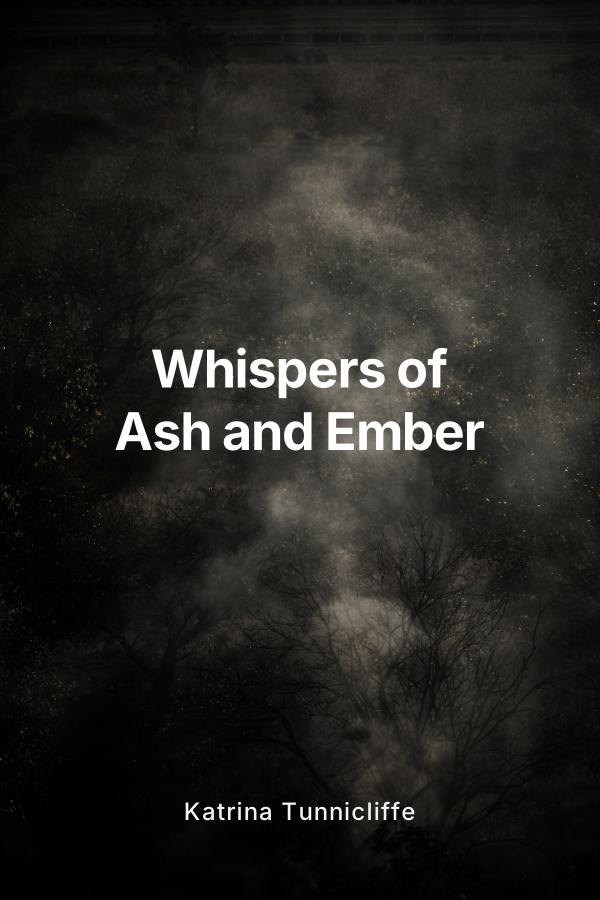
This book is a dark adult fantasy about Elisabeth, a witch of rare and terrifying power, and Casper, the ghostly cat who can speak only to her. Together they are pulled into a secret war involving dragons, rival witch covens, and goblin factions that traffic in forbidden magic, while Elisabeth struggles to decide what kind of monster she is willing to become to survive. The tone is atmospheric, sensual, and psychologically intense, meant for adult readers who enjoy morally complex magic, vivid supernatural creatures, and slow-burn tension between power and conscience, threaded through a world on the edge of ruin .
At the heart of the story is Elisabeth’s inner conflict. She possesses all the witch powers of her infamous bloodline yet has spent years denying what she is. Her magic is versatile and dangerous: speaking with the dead, summoning and shaping flame, bending shadows, binding spirits, and weaving illusions that can crack a human mind. For Elisabeth, every spell is a temptation. Too little power and she will be helpless against the forces stalking her. Too much and she risks becoming the very nightmare she fears, fulfilling an old prophecy whispered about her family. Casper, the talking cat no one else can hear, serves as her conscience, her tempter, and sometimes her accuser, a constant reminder that she can never again be truly ordinary.
The world she inhabits is a layered, predatory place. Behind the ordinary human city lies a hidden network of witch covens, dragon lairs, and goblin markets. Dragons, ancient and bound to the elemental bones of the earth, guard old pacts that keep chaos in check. Goblins rule the black market of stolen memories and bottled souls, and other witches maneuver like feudal lords whose armies are curses, familiars, and blood oaths. The balance among these groups is fragile, and Elisabeth’s awakening powers become the spark that threatens to ignite it all.
When the book opens, Elisabeth is trying to live quietly on the edges of society, working a mundane job by day and practicing only the smallest household charms by night. She avoids deeper magic not because she cannot wield it, but because she can. Her childhood was marked by a catastrophic ritual that killed most of her family and left her with shards of their magic embedded in her own soul. Casper appeared to her in the aftermath, a soot-black cat with ember-bright eyes, claiming to be bound to her until she either redeems or destroys their shared bloodline. She has never known whether to believe him.
The inciting incident arrives when a string of brutal magical murders cuts through the city’s underbelly. Each crime scene is scorched with a peculiar pattern of ash, and each victim is connected in some way to Elisabeth’s lineage. Dragons start circling low over the outskirts at night, drawn by a disturbance in the old wards, and goblin messengers appear at coven gatherings with cryptic warnings. Rumors begin to spread that a lost grimoire from Elisabeth’s family has resurfaced, capable of granting a witch something close to godhood. Every faction wants it, and most of them want Elisabeth as either pawn or scapegoat.
Casper pushes her to investigate. He insists that the murders and the grimoire are threads in the same web, one that leads directly back to the ritual that shattered her childhood. Although frightened, Elisabeth cannot ignore the way her magic surges and sharpens in proximity to the crime scenes. The ash sings to her like a half-remembered lullaby. Each time she reads the residue of a spell, she tastes fragments of her own family’s magic in it, as if someone is using pieces of her bloodline as fuel.
As she digs deeper, Elisabeth is forced into uneasy alliances. A proud dragon emissary demands her help in restoring broken pacts that once tethered several covens to dragon guardianship. A rival witch, who lost her sister in the same childhood ritual that scarred Elisabeth, offers cooperation on the condition that Elisabeth share what she knows about their shared enemy. Goblins agree to provide forbidden knowledge in exchange for a future favor written in sinisterly vague terms. Every choice she makes weaves her tighter into a web of obligations she may not be able to escape.
The core tension of the book lies in how Elisabeth uses her vast powers in this escalating conflict. In each confrontation she must decide whether to hold back and risk the lives of others or unleash more of the dangerous, inherited magic that frightens even allied witches. Casper alternates between urging caution and pushing her to accept that some enemies can only be stopped by meeting their cruelty with equal ferocity. Their relationship is fraught and intimate, rich with sarcasm, guilt, and dark humor, as Casper alone understands how close she always stands to a moral edge.
Throughout the narrative, glimpses of Elisabeth’s past surface. We see fragments of the night that defined her: the circle of candles, the taste of iron and smoke, the chanting coven elders, the sudden roar of dragons in the distance, and the eruption of uncontrolled power that shattered the ritual. We learn that Casper was once a familiar to someone in her family, bound by pact to protect the bloodline. Now, caught between spirit and beast, he is stuck as an uneasy echo of those he could not save. His ability to speak only to Elisabeth is both curse and gift, forcing her to confront truths no one else can bear to tell her.
The dragons, initially distant and inscrutable, gradually reveal their own agenda. They are not benevolent guardians but ancient survivors who view witches and goblins as upstart species playing with forces they barely comprehend. A particular dragon, scarred and obsessed with restoring a broken covenant, sees in Elisabeth a chance to mend old failures. He offers patronage and power in exchange for her help in reigniting long dormant bindings. Accepting that deal would mean grafting her already dangerous magic onto dragonfire itself, magnifying her abilities to apocalyptic levels.
Meanwhile, goblin society is depicted as a ruthless yet strangely ordered underworld. Their labyrinthine markets sell everything from stolen hours of youth to fragments of dragon scale. Elisabeth ventures there, guided by Casper, in search of information about the lost grimoire. The goblins recognize her bloodline at once and treat her not just as a customer but as a walking catastrophe in human form. One goblin chieftain proposes to hide her from her enemies if she surrenders a portion of her own power, sealed in a thorned glass vial, to be sold later to the highest bidder. The moral cost of letting part of her magic fall into unknown hands horrifies her, yet the desperation of her situation makes the offer dangerously tempting.
The goblins also hint at a deeper truth. The catastrophe that killed Elisabeth’s family might not have been an accident or a failed ritual, but part of a larger scheme to redistribute their power among hidden players. The murders in the city, marked by that distinct ash pattern, may be a continuation of the same plan. Each death could be another step toward reconstructing a forbidden spell that requires the dispersed fragments of her bloodline. This realization shifts Elisabeth’s role in the story. She is not just a survivor or a potential villain. She is the final piece someone needs to complete a dark design.
Casper’s role complicates further as this truth surfaces. He begins to remember more of his former life and the exact wording of the old pacts that bound him. Those memories suggest that he was commanded not only to protect the family, but also to guide the last surviving witch, if one existed, toward a specific choice when the time came. Elisabeth starts to wonder whether Casper’s guidance is truly his own, or whether he is still following a dead master’s final orders. Their trust is shaken yet deepened, as both of them must reinterpret the entire history of their bond.
As the two chapters of the book unfold, the political and magical stakes intensify. Covens fracture into splinter groups, some rallying behind Elisabeth as a prophesied savior, others hunting her as a latent threat. Some dragons argue for exterminating her before she can either repair or ruin the ancient pacts. Goblins, ever practical, begin to speculate about how to profit when the inevitable magical war breaks fully into the open. Elisabeth walks a narrowing path, trying to protect innocents while uncovering who is orchestrating the killings and why her bloodline was chosen as the heart of the plan.
The emotional heart of the story lies not in large battles but in the quiet moments when Elisabeth must live with what she has done. After each significant use of power, the narrative lingers on her private reckoning. She experiences vivid sensory echoes of those she has harmed or saved, because her particular brand of magic binds her to the consequences of her choices. Casper stays with her in those hours, alternately tender and brutally honest, reminding her that denial will not keep her soul intact. Their conversations, often laced with dark wit, create a fragile space of intimacy within the chaos.
The climax of the overall book, as foreshadowed in this summary, will force Elisabeth to face a definitive choice. She will discover the full truth of the ritual that destroyed her family, the real purpose of the lost grimoire, and the nature of the prophecy threaded through her bloodline. She will be confronted with a final spell that could stabilize the fractured balance among witches, dragons, and goblins, but at a price that may demand a piece of her humanity, Casper’s existence, or the autonomy of entire covens. Whatever she chooses will determine whether she becomes a tyrant in the making, a martyr who averts greater catastrophe, or something stranger and less easily named.
The book’s two chapters are structured to mirror Elisabeth’s journey from reluctant sorceress to someone who must actively claim or reject the legacy coursing in her veins. The first chapter focuses on discovery and dread, as she is drawn out of her self-imposed isolation, investigates the murders, and glimpses the scale of the forces converging around her. The second chapter deepens her entanglement with these forces, pulling her into direct negotiations with dragons and goblins, exposing fractures within the witch community, and confronting her with the realization that most of the players in this hidden war have been planning for her arrival for far longer than she has been alive.
By the end of the book, readers are left standing beside Elisabeth on the threshold of the decisive act. She has reclaimed much of the power she once tried to bury. She understands more of Casper’s true nature and the extent of his binding to her. She has seen the cruelty of her enemies, but also the compromised ethics of those who claim to be on her side. The final image is that of a witch standing in a circle of ash and ember, flanked by a silent dragon overhead and goblins watching from the shadows, with a ghostly cat at her heels, about to cast a spell that will reshape the hidden realm forever.
This adult fantasy invites readers into a morally shadowed world where power always comes with a bill due in blood, memory, or love. It explores how a woman who could become a monster wrestles with the terrifying freedom of choosing who she will be, and how a single witch, a single cat, and a network of uneasy allies can tip the balance among dragons, witches, and goblins toward either salvation or ruin.