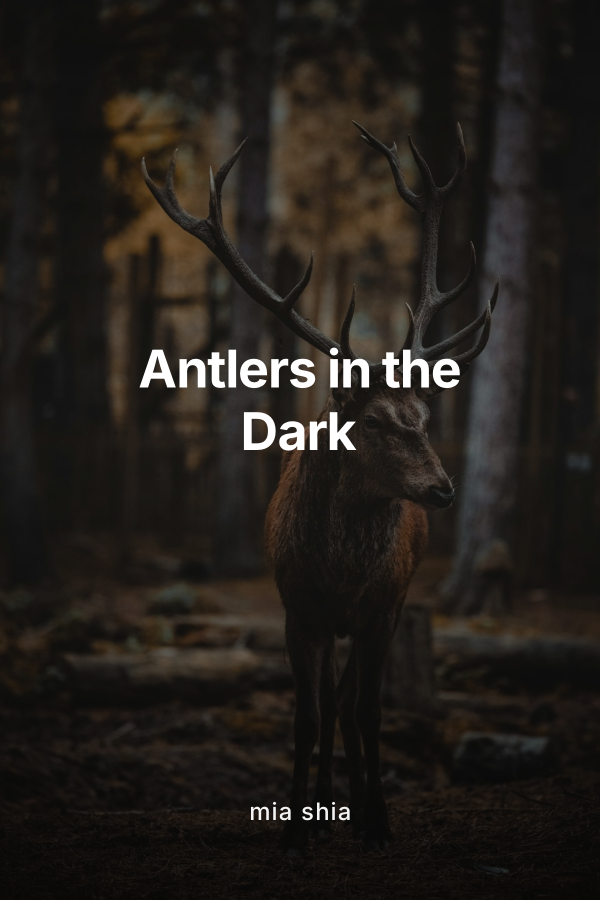
This book is a dark, character driven post‑war fantasy that reimagines one wizard as something half man, half predator, and asks how a family of war heroes learns to live with the brother they helped condemn. Inspired by the tone and structure of long, emotionally intricate fanfiction, it combines psychological horror, slow burn hurt/comfort, and razor edged family drama into a single, intimate narrative centered on survival rather than grand external plots.
At its core stands Percy, a former collaborator on paper and a cursed monster in truth. Marked with deerlike instincts and a predatory hunger that fixes on human flesh, Percy spends his post‑war years as an underpaid, overqualified Ministry functionary, clinging to routine and bureaucracy because structure is the only fence he trusts to hold his new nature. He hides antlers, hooves, teeth, and the writhing, semi autonomous shadow that trails him. He files reports in immaculate ink while fighting the urge to tear his colleagues apart when they belittle him, steal his work, or use their own trauma as a license for cruelty. His shadow, constantly reined in, is a silent commentary of strangling hands, clinging hugs, and petty acts of sabotage that Percy refuses to allow.
Cursed and condemned, Percy is not trusted by the wider wizarding world. The war left him stained by association with power, and the Weasley name, once a shield, now functions as a complicated mirror. His parents and siblings are wounded, disillusioned survivors who remember a son who chose the Ministry over family and then returned at the very end, too late to avoid suspicion. Percy believes they are better off without him and keeps his distance, but their anger and absence are a constant ache. The book treats the Weasleys not as a wholesome ideal but as a fractured clan whose love curdled under fear, grief, and bitterness. Reconciliation, when it comes, is slow, messy, and never idyllic.
The narrative instead begins and largely unfolds in the cramped flat above a joke shop still glowing with the afterimage of war. Percy forces his way into George’s life, negotiating himself into the spare room with relentless practicality and a quiet, infuriating insistence that he will not let his younger brother die. George, maimed by grief and hollowed out by the loss of who he used to be, does not want Percy there. He does not trust Percy’s motives, does not forgive his choices, and does not believe in easy redemption. Yet Percy cooks, keeps the books, and calmly interferes with George’s spiral into self destruction, refusing to accept “I am fine” from a brother who is clearly not.
Fred is alive but physically disabled, his mind sharp and ferocious while his body betrays him. He occupies an uneasy middle ground in Percy’s return. Too observant to miss what is wrong, too furious to grant easy absolution, Fred wields his wit like a knife. Together, the twins snipe, mock, and occasionally outright attack Percy where it hurts, weaponizing old memories and public narratives about his collaboration. The narrative makes no effort to soften their cruelty. It instead lets their anger stand as a valid response to trauma and betrayal while slowly, almost reluctantly, drawing out the instinctive ways they begin to care for Percy again without realizing it. They defend him in public even as they tear into him in private. They adjust the flat for his sensory triggers and shadow driven quirks without naming it kindness. They worry when he is late.
The book alternates primarily between Percy and George’s perspectives, with Fred and a handful of side characters stepping in at precisely chosen moments to show how differently the same events can be read. Bias and incomplete information are central tools. A cutting remark seen from George’s point of view, for example, is revealed in Percy’s narration as a deliberate attempt to stop his own hunger from focusing on his brother. A seemingly casual act of assistance from Fred hides an unspoken calculation about safety, resentment, and dignity. The result is a narrative that feels like an intricate argument among unreliable witnesses, all of them trying to survive themselves as much as each other.
Beyond the flat, the Ministry becomes a second crucible. Percy’s probationary position is secure enough that he will not be fired easily, yet he is systematically underpaid and fenced in by tasks beneath his ability. Colleagues rely on his competence while muttering about his past. Some steal credit for his work. Others perform a brittle courtesy that never quite hides the suspicion in their eyes. Ministry culture is steeped in hypocrisy and quiet bigotry, and Percy moves through it in a shell of cold professionalism that barely contains his bottled fury. His deer instincts mark out his office and files as territory, and his shadow reacts violently to perceived encroachment, forcing him to clamp down harder on his control each day.
A crucial thread in the book is the curse itself. Percy did not ask to become a creature with Alastor like abilities and a hunger for human flesh, and he refuses to kill for food. Instead he constructs a private, ethically fraught system of “sources” that lets him feed without fresh murder. These choices are not sanitized. The narrative acknowledges the horror of cannibalism and the moral grey of harvesting remains, even as it depicts Percy’s rigid refusal to cross certain lines. His hunger is ever present and often focuses on those he wants to protect. The book leans into the dissonance of loving someone and wanting, in the same breath, to tear them open. That internal war is rendered with visceral, graphic clarity, always with an eye toward psychological realism rather than cheap shock.
Percy’s deer traits are not simple cosmetic markers but a complex sensory and behavioral system that shapes his daily life. He is hypervigilant, prone to startle, and governed by cycles that resemble a non sexual rut, periods where territorial aggression, hunger, and emotional volatility surge. In these phases he becomes clingier with “his” people, more defensive of the flat and shop, more likely to snap. The concealment he maintains in public feels like wearing a too tight skin. It causes headaches, nosebleeds, and an almost static tension in his shadow, which strains toward visibility. These stresses lead to dramatic, high stakes slips, both at work and at home, that provide key beats in the slow reveal of his condition to others.
The shadow itself functions as a central secondary character. It is a semi separate extension of Percy’s subconscious, mischievous, disobedient, and often at odds with his self loathing. It hugs people Percy wants to avoid, chokes those he only fantasizes about hurting, and clings to Fred’s wheelchair or George’s sleeve when danger approaches. It mocks Percy, comforts him, and at times betrays emotions he would do anything to hide. The interplay between Percy and his shadow introduces flashes of dark humor that prevent the narrative from drowning in its own grief, while also intensifying the horror when the shadow’s desire for violence diverges sharply from Percy’s conscious ethics.
Around this core trio of brothers, the book weaves a rich web of side characters and post‑war society. Angelina, fiercely pragmatic and protective of George, initially views Percy as a problem, a risk to her already fragile friend and to the shop that represents their shared future. Lee, hyper observant and quietly ruthless in his own right, is one of the first to notice that Percy’s story does not add up. He collects data, notes patterns in Percy’s schedule, and recognizes the gaps. Their evolving relationships with Percy are never romanticized. They involve distrust, harsh words, reluctant cooperation, and, eventually, a complicated loyalty shaped by the moment each of them witnesses a fragment of Percy’s monstrosity and the lengths he goes to in order to control it.
Further out still, the rest of the Weasley family appears late and sparingly at first. The book honors the user’s wish that the broader clan not sweep in early to absorb Percy back into a warm embrace. Instead, their re entry comes after the brothers and close friends have already built a tense, fragile equilibrium. Early encounters with Molly, Arthur, Bill, Charlie, Ginny, and Ron are razor thin on the surface and brutal underneath. Some scenes are wrapped in brittle politeness, every word chosen too carefully, every silence charged. Others explode into shouting matches where decades of resentment and misunderstanding pour out. Still others perform a play of family harmony that fools no one, least of all Percy, who feels like a guest in his own childhood kitchen.
Bill and Charlie, in particular, bring a honed competence and a terrifying protectiveness. They are used to identifying and neutralizing threats, and they approach Percy as both potential asset and potential danger. They notice inconsistencies. They run quiet background checks. One of them eventually confronts Percy privately, making it clear that brotherhood does not negate the obligation to protect the younger siblings. Their stance is not simple hostility, however. It combines genuine concern with ruthless contingency planning, and their slow shift toward a more nuanced understanding of Percy’s curse and choices becomes one of the most compelling sub arcs in the later chapters.
Another late arriving but emotionally potent thread involves Penelope and Oliver, figures from Percy’s pre war life who represent a version of him that once existed. Penelope is a former girlfriend turned friend by mutual recognition that their bond was misnamed. Oliver is a friend whose loyalty never wavered as much as Percy believes it did. Their reappearance much later in the narrative gives Percy a chance to confront the cost of his self isolation, the friendships he assumed he had forfeited. The reconnection is not easy. They are angry with him for disappearing, for assuming he knew what was best for them, for not trusting them with the truth. Yet beneath the reproach is a steady, stubborn care that shatters Percy’s belief that he is universally despised. Their mix of fierce verbal slapdowns, practical support, and refusal to accept his martyr complex creates space for some of his rawest breakdowns and most honest growth.
Throughout, the book refuses to treat trauma as an aesthetic. It draws on realistic depictions of grief, intrusive thoughts, hypervigilance, and self destructive coping without glamorizing them. George’s recklessness with his own safety, Fred’s oscillation between bitter humor and the crushing reality of his body’s limits, Percy’s cannibalistic urges and self hatred all coexist with small, stubborn acts of survival. People worry about rent, about Ministry policy, about access ramps and potion supplies and the politics of public memory. There is no grand external conspiracy. The world is dangerous and unjust enough without one. The stakes are instead rooted in everyday survival, in the quiet heroism of not giving up on yourself or on the people who have hurt you when every instinct screams to run or to tear them apart.
The structure of the book, written for an audience accustomed to long, layered online fiction, leans into slow burn pacing. The first chapters focus on Percy moving into George’s flat, the prickling tension of cohabitation, tiny domestic battles over territory, food, and silence, and the early near misses where shadows behave oddly in candlelight or where the sound of hooves echoes in the hallway at night. Middle chapters widen the scope to include the Ministry, the shop’s troubles, Fred’s medical and access challenges, and the gradual pattern of people noticing that Percy is not simply “strange.” Each discovery is partial and colored by the discoverer’s fears and desires. No one, not even George or Fred, ever holds the full truth.
As the narrative moves into its later chapters, emotional stakes rise. A crisis involving Fred forces Percy into a fully feral state, revealing far more of his curse than he ever intended. Trust fractures, then reforms along new lines, with George and Fred grappling with the horror of what Percy is and the evidence of how hard he has worked not to harm them. Family involvement increases in fits and starts, pulled by practical necessity as much as by longing. Scenes at the Burrow, at St Mungo’s, at the Ministry, and in Diagon Alley offer snapshots of a society trying and often failing to rebuild after catastrophe. Percy’s presence in each space is both catalyst and mirror, showing what people are willing to forgive and what they are not.
The ending does not offer neat absolution. Instead it lands on a cautiously hopeful but scarred note. Percy and George build something like a partnership, raw and sometimes unhealthy, yet honest in a way they never managed before. Fred, still furious and still loving, occupies a position as both sharpest critic and unexpected ally. The Weasleys as a whole reach an uneven reconciliation where certain relationships remain cool or fraught, and others regain real warmth. Percy finds himself closer to some siblings than he ever was in childhood and permanently at arm’s length from others. Penelope and Oliver stand as reminders that he is allowed to be loved even when he cannot fix what he has done or what he has become.
By the final pages, Percy has not been redeemed in any easy sense. He has not been cured. His hunger remains. His deer instincts will continue to shape his world. His shadow will always be a little too eager to wrap itself around someone’s throat. What changes instead is the network of people around him and his own willingness to accept that he is not solely a monster or solely a martyr. He is something in between, a survivor among other survivors, trying to thread a path between the antlers and the dark.
Antlers in the Dark is written for readers who crave complex, morally tangled character studies more than plot twists, who are comfortable dwelling in discomfort, and who recognize that sometimes the bravest thing a monster can do is stay.