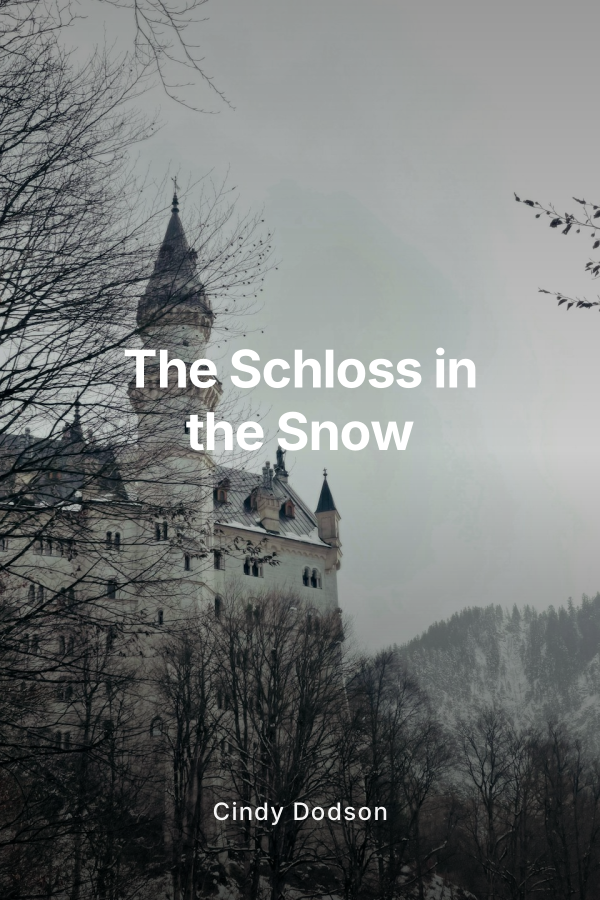
The Schloss in the Snow is an 18+ gothic horror novel with strong psychological and erotic currents, set in 1946 in the coastal mountains of Hungary, in the uneasy quiet just after the Second World War. A blizzard, roaming wolves, and scattered Romany camps frame a seemingly prestigious boarding school housed in an ancient castle that has survived Vikings, Ottoman wars, revolutions, and two world wars.
At the center of the story is Jessie, physically eighteen but mentally closer to a wary, foul‑mouthed sixteen or seventeen, on her way to what her parents insist is “the best education in all of Europe.” She arrives through a storm that feels less like weather and more like a hungry presence, the mountains looming like witnesses as her family car crawls toward the castle gate. Her parents’ nervous reassurances fail to quiet the growing dread that the school is not what they have been promised.
From the first moments, the book anchors itself in Jessie’s relentless internal voice. She swears far more in her head than aloud, reacting to every odd detail, every suspicious adult, every strange rule with sarcasm, fear, and flashes of defiance. Her thoughts and spoken words run almost nonstop, creating an intimate, high‑pressure tunnel through which the reader experiences every second of her first forty‑eight hours at the Schloss.
Those first two days are stretched into two long, “episode‑length” chapters, each scene treated as an event in itself rather than a quick step in a plot outline. Chapter One covers everything from the car ride to the end of the teachers’ speeches in the gymnasium. Chapter Two runs from Jessie’s brutal pre‑dawn breakfast through classes, the first brushes with the school’s extreme physical training program, and finally to the co‑ed dormitory where nudity is permitted and the carefully staged routines of the day collapse into something more chaotic, sensual, and quietly terrifying.
What makes the Schloss stand out, and what defines the book’s identity, is the blend of grounded, period‑accurate postwar tension and creeping Lovecraftian unease. Jessie is processed on arrival by Dr. Razor, a tall, polite yet menacing German “head nurse” whose nationality alone already raises questions about his past in a world that has just “ended” a war. His examination of her is intimate, clinical, and deeply invasive. He measures every part of her body, draws blood, inspects her genitals, and takes samples. The scene is not presented as assault but as a horrifyingly normalized procedure in this place, a medical ritual that treats Jessie as material rather than as a person.
After the exam, Razor assigns her a uniform that is both elegant and profoundly objectifying: thigh‑high white stockings, black panties, a tight blue mini pencil skirt, a sheer, bra‑less blouse that clings like wet fabric, an ascot, gloves, and outerwear she is only allowed to wear outside. Later, she will receive sports gear that is even more exposing, including a wrestling singlet whose “one size fits all” design leaves her backside bare under a G‑string strip.
The school’s daily routine is draconian and intensely physical. Breakfast runs from 4:30 to 5:00 in the morning, followed by tightly scheduled academic classes and then block after block of demanding training: hours of wrestling, boxing, conditioning, and weightlifting under the supervision of Coach Patty, a woman whose attire is described as the most revealing anyone has ever seen. Each physical discipline begins with its own specific drills and conditioning, turning the gym into a temple of the body where students are reshaped, honed, and secretly assessed. Jessie’s body becomes a battleground where shame, pride, erotic awareness, and a strange, looming sense of purpose clash.
Yet this is not simply a story about fetishized uniforms or disciplinary routines. All of this physical rigor hides a larger, more disturbing function. The castle’s hallways are lined with Roman statues and portraits of past headmasters, mistresses, and ancient nobles whose features subtly echo something inhuman. Their pale yellow skin, huge glassy eyes, and oddly gilled cheeks hint at a bloodline that is not entirely human, a lineage that has persisted through centuries of war and upheaval. Carvings in the stone show pirates with squid heads, sailors with lobster claws, half‑human fish people, multi‑headed dragons, a giant fish man, and a winged figure with a squid head and bat‑like wings. The iconography is not explained outright. Instead, it presses in on Jessie’s perception, one more layer of wrongness in a place that keeps insisting it is about “holistic education.”
The faculty lineup at the opening assembly shows how carefully the Schloss balances the veneer of a modern institution with the deeper agenda at work. In the vast gymnasium, before rows of girls in skimpy uniforms and boys in everything from tuxedos to working‑class suits, Madame Barcavic, the headmistress, outlines a schedule that sounds rigorous but rational: English with Miss Flanagan, history with Mr. Lee, Romany folklore with Mr. Shelby, science with Dr. Zolar, then hours of physical training, chores in the gardens and animal pens, and finally co‑ed dorm life where nudity is permitted only within the dorm walls.
Each teacher steps forward and delivers a distinctive speech that both defines their role and hints at their deeper allegiance. Miss Flanagan, severe in tweed and spectacles, is a perfectionist of the English language who promises “appropriate corrective measures” for failure. Mr. Lee, small and sharp‑eyed, frames history as a story of failures and uncomfortable truths that must be confronted. Mr. Shelby, the Romany folklore instructor, speaks with warmth and ancestral pride, presenting Romany tales as a living lens for understanding the world rather than mere superstition. Then Dr. Zolar shambles in, a gaunt, scorch‑marked figure in a stained lab coat, clutching a bubbling beaker and preaching a wild gospel of science as interrogation, transmutation, and explosive revelation.
Their speeches create a deliberate tonal swing: from stern discipline, to rational inquiry, to deep cultural mysticism, to manic experimentation. Barcavic stitches all this together as a proud, “holistic” program. But for Jessie, sitting in her revealing uniform among strangers, the effect is not reassuring. It is a theatrical display of power, intellect, and ritual, performed in a hall whose walls are rich with images of fish‑men and squid‑headed giants. The contrast between refined language and grotesque decor primes both Jessie and the reader for the eventual revelation that the Schloss is not simply a school at all.
Beyond the gym and classrooms, the world of the castle is bracketed by Romany folklore and the fresh wounds of the war. History lessons allude constantly to the recent conflict, its atrocities, and its shifting borders. Folklore class, by contrast, presents tales of forests that think, rivers that remember, and spirits that punish arrogance, many of which map disturbingly well onto the carved monsters and painted ancestors in the castle halls. German “scientists” and “doctors” have found a home here, their war roles politely unnamed, their expertise repurposed into the school’s strange medical and physical regimes. Jessie’s suspicions that Razor might be a Nazi doctor are never outright confirmed, but the question hangs over everything he does.
The towns beyond the castle are described as “vibrant” yet dangerous. Students will be sent there for provisions, mingling with locals described in broad, almost theatrical labels: cockneys, gypsies, Fenians, scousers. These excursions promise to widen the stage, introducing Romany communities whose stories may be the only honest commentary on the castle’s true nature, and working‑class survivors of the war whose own traumas intersect with the experiments and cultish agendas simmering within the Schloss.
Sexuality in The Schloss in the Snow is explicit, consensual among students, and tied closely to Jessie’s evolving understanding of herself and the institution that is trying to reshape her. The most graphic content centers on workouts, dorm interactions, and the medical environment. The training floor becomes a space where physical humiliation slowly, chaotically, shifts into shared exertion, camaraderie, and erotic tension. The dorms evolve from a space of embarrassment and exposure into a setting of bonding, desire, and uneasy intimacy, all under the gaze of rules that treat nudity as both normal and strangely ritualized. The doctor’s office, meanwhile, remains clinical and sinister rather than romantic, a site where bodies are cataloged and tested for reasons that never quite add up.
Underneath the sex and training lies a steady, Lovecraft‑inspired escalation of dread. The castle is tied to an ancient noble bloodline that appears to share features with the fish‑like figures in the portraits and carvings. The Romany stories whisper about old beings connected to forest, mountain, and sea, forces awakened or disturbed by human violence and ambition. The presence of German doctors and the school’s obsessive focus on measuring, training, and “optimizing” bodies suggest that the Nazis, or men like them, blundered into something older than history and are now trying to harness or appease it behind the civilized mask of a boarding school.
Jessie, as both observer and participant, is gradually drawn into this convergence of cult, science, and folklore. She is weighed, examined, conditioned, and placed under constant intellectual and physical pressure. Her role in the larger plot is intentionally kept ambiguous early on, but the framework positions her as someone who might be a destined vessel for an ancient entity, a disruptive force who could expose and shatter the cult, or a survivor who escapes with her sanity deeply scarred and her perceptions permanently altered. The book leans into uncertainty: is she meant to join the inhuman lineage, to feed the thing the castle serves, or to carry its influence out into the world after a superficially “triumphant” escape?
Tone‑wise, the novel draws on tragic, beautiful gothic sensibility where monsters are both terrifying and pitiable. The fish‑leaning nobles and carved creatures are not simply ravenous beasts but emblems of a long, secret bargain between human elites, Romany guardians or traitors, and something vast that lives in sea or forest. Jessie’s growing fear is matched by a creeping empathy, a recognition that the real horror might lie not only in the inhuman figures but in the human willingness to serve them or become them.
Formally, the story lives in intimate, tight first person. The language alternates between lush, sensory descriptions of the winter mountains, the ancient stonework, and the rituals of the school, and Jessie’s foul‑mouthed, sardonic inner commentary that slices through any pretense. External dialogue is quick, overlapping, and often tense, especially when students push back against rules or bond over shared discomfort. Teachers speak with controlled, sometimes theatrical rhetoric, while students talk in sharper, more chaotic back‑and‑forths that give the sense of a TV episode rendered in prose.
Across its eventual two chapters totaling around four thousand words, the book functions like a long, unsettling pilot episode for a much larger narrative. Chapter One’s focus on arrival, processing, and the opening assembly builds the framework of the school and hints at the mythos in its architecture and staff. Chapter Two’s unwavering, moment‑to‑moment tracking of Jessie’s first full day plunges her into the lived reality of that framework: the exhaustion of the schedule, the intensity of the training, the shocks of co‑ed dorm life, and the small, telling details that suggest nothing here is accidental. Everything from the exact weight of her body on the scale to the style of her classmates’ suits, from the carvings on a hallway pillar to an offhand remark in folklore class, is treated as a potential clue.
The Schloss in the Snow is built for readers who want an 18+ story that does not shy away from explicit sex and raw language but anchors both in a dense, atmospheric tale of postwar guilt, ancient cults, and the slow erosion of a young woman’s certainty about who she is and what her body is for. It is for readers drawn to slow‑burn horror, to long chapters where every scene is allowed to breathe and unravel, and to narratives where the central mystery, “Why is this place like this?” is answered only in part, leaving a margin of cosmic uncertainty that lingers long after Jessie’s first day ends.