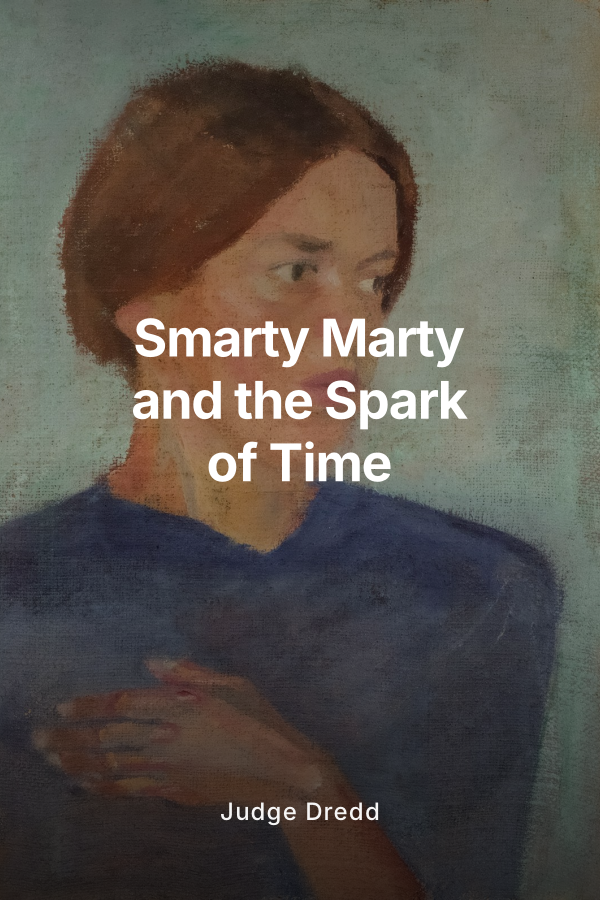
Smarty Marty and the Spark of Time is a richly illustrated time travel adventure for readers aged 8 to 12, following a quick‑thinking, puzzle‑loving inventor who secretly safeguards the turning points of history. In this first story of the series, Marty and his loyal dog Bolt are sent on an urgent mission to help Thomas Edison at the very moment he is ready to give up on creating a long‑lasting light bulb.
Deep beneath his ordinary house, Marty’s hidden lab hums with screens, gears, and strange machines. It is his private world, a place where curiosity rules and experiments never truly fail. When his time‑watch starts blaring a red alert, Marty learns that somewhere in the past a “historical figure in trouble” is about to abandon a crucial idea. The watch reveals a name and a date: Thomas Alva Edison, 1879, on the brink of quitting his work on electric light. If Edison stops now, the future may stay dim in more ways than one.
Answering the call, Marty activates a swirling red and gold time vortex. With Bolt tucked under his arm, he steps into a corridor of roaring wind and streaking colours, flipping through years in seconds. Their destination is a cramped, oil‑lit workshop crowded with wires, tools, and fragile glass bulbs, most of them cracked or blackened from repeated failures. There they meet a weary Edison studying yet another burnt filament, convinced that he has reached the end of the road.
At first, Edison demands to know who this strange boy is and why he has appeared in his lab. Marty does not claim to be a genius, a rival inventor, or a magic solution. Instead, the teen traveller offers something Edison has nearly exhausted: encouragement, fresh perspective, and an honest belief that the work is not wasted. When Edison complains that he has “failed hundreds of times,” Marty gently reframes those attempts as hundreds of discoveries about what does not work, evidence that the right answer must be close.
Bolt’s playful chaos lightens the mood. Knocking over a tool, sniffing at wires, and wagging through the workshop, he coaxes a reluctant laugh out of Edison that breaks the tension in the room. That laughter cracks open a small space where doubt loosens its grip. In that space, Edison finds just enough courage to try again. Marty’s watch is still glowing a warning red, reminding them that the future is not yet safe. Time itself is holding its breath.
Together, Marty and Edison review sketches and half‑tested ideas. Marty never tells Edison what to do, never hands him a finished blueprint, because part of his mission is to protect the integrity of history. Edison must remain the inventor of his own breakthroughs. Marty can only ask questions and offer hints that nudge Edison to look again at materials he has tested before. Sometimes, the book suggests, the difference between failure and success is not a grand new idea but a small change made with renewed determination.
The turning point arrives when Edison decides on one more experiment. He carefully fits a new filament into a bulb and names the material aloud. The moment stretches. The bulb glows, wavers, then shines more steadily. Seconds lengthen into minutes. The light holds. In that soft golden glow, the entire mood of the workshop changes. Marty’s watch fades from urgent red to a calm green, silently confirming that the time stream has stabilised and the future has been restored.
Edison’s joy is loud and contagious. He laughs with the full relief of someone who has pushed past his own limits and discovered what lay beyond quitting. Marty does not claim credit. Instead, he honours Edison’s perseverance and reminds him that his refusal to give up is exactly the quality that will light the way for others. In turn, Edison offers a simple truth that anchors the book’s core message: no one should give up when they are close to something important.
With history set back on track, the vortex opens again. Marty and Bolt leap through the spinning colours and land with a gentle thump back in their underground lab. The machines hum, the screens blink quietly, and the world above remains unaware of how narrowly it escaped a darker path. Bolt curls up and falls asleep, while Marty studies his watch and reflects on what they have just seen. Sometimes, he realises, the biggest changes come from trying one more time.
The book closes by drawing a clear, empowering moral for its young readers. Progress belongs to those who keep going, even when the task feels impossible and every attempt seems to fail. Set against vibrant illustrations on facing pages, the story uses action, humour, and heart to make an abstract life lesson concrete and memorable. It introduces children to a famous inventor at his most human and unsure, then shows that the same courage to keep trying is available to them in their own challenges.
Yet the ending is not entirely tidy or final. Just as the lab settles into silence, Marty’s watch blares another urgent signal. Red light pulses again. Somewhere in history, another figure is struggling with a crucial decision, and another turning point is coming under threat. The book hints that future volumes will invite readers back into the lab and out across time, perhaps even imagining themselves stepping beside Smarty Marty and Bolt on their next mission.
Designed as an 8×10 full colour, illustration‑rich paperback with text on the left pages and art on the right, Smarty Marty and the Spark of Time combines cinematic time travel scenes with clear, accessible language for middle‑grade readers. It offers parents and educators a story they can enjoy reading aloud while opening discussions about resilience, curiosity, scientific experimentation, and the idea that many discoveries are built on long chains of “failed” attempts.
At its heart, this book is not only about Edison’s light bulb. It is about the inner spark that keeps children moving forward when they are tempted to give up on a project, a hobby, or a dream. Through Marty’s quiet bravery and Bolt’s loyal energy, readers see that even small acts of encouragement can change the course of someone’s story. Smarty Marty and the Spark of Time invites young minds to imagine time itself as something fragile and precious, shaped by the choices of people who refuse to stop at almost.