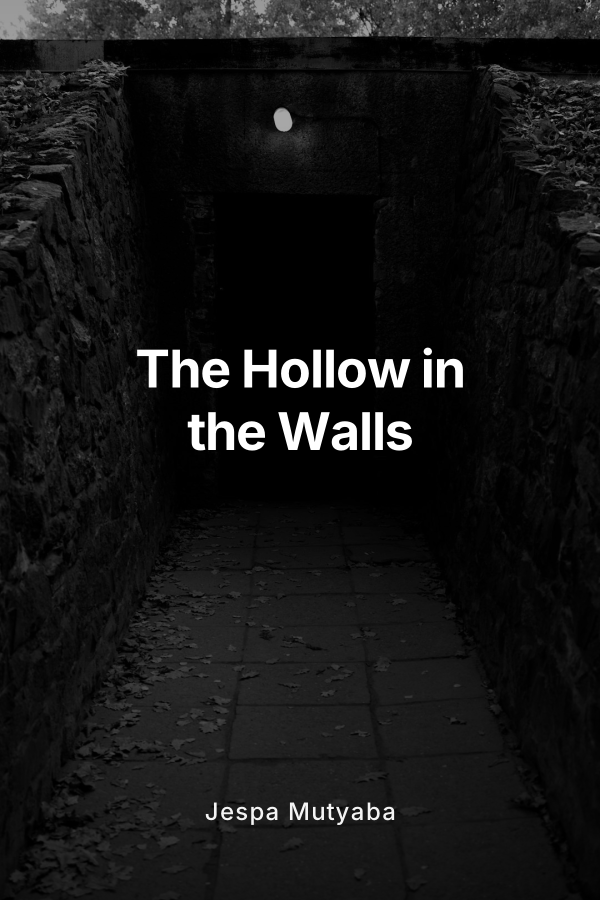
The book follows a slow, claustrophobic slide from ordinary curiosity into intimate terror, set almost entirely inside one aging structure that seems to listen more than it creaks. Across five chapters, the narrative traces how an apparently rational investigation of a place’s history becomes a confrontation with something that does not want to be understood, only obeyed.
At the center is a single protagonist whose need to make sense of the world has always been stronger than their fear. They come to the house believing they are here to observe, record, and leave with answers. Instead, the house teaches them that attention is not neutral. Every moment they spend watching it is also a moment it spends watching them.
The story is built less on sudden shocks and more on an accumulating weight of details: sounds that are almost words, drafts of air that feel like intent, quiet shifts in the architecture that cannot be blamed on memory alone. Isolation, sleeplessness, and self doubt become as frightening as any external threat. By the end, it is unclear whether the house has changed, or the protagonist has simply been hollowed out until their own mind serves the house’s purpose.
Below is how the five chapters unfold.
Chapter 1: The Key and the Echo
The book opens with the protagonist arriving at the house on the outskirts of a nearly abandoned town. They are here on a personal project to document forgotten buildings and the stories attached to them. The house is three stories high, with boarded windows and a sagging porch, but it is not ruined. It feels stalled, as if someone stepped away mid sentence and never came back to finish it.
The arrival is practical and detailed. We see the drive in on a narrow road lined with trees too close together, the way cell reception drops gradually instead of all at once, the brittle smell of leaves crushed under tires. The protagonist is drawn here by an old photograph and a brief mention in a regional archive about “an incident the town prefers not to discuss.” This sets up a mystery that seems, at first, purely historical.
Inside, the house looks like it has been cleaned but never lived in. There is a thin film of dust, but no true decay. Furniture is sparse and oddly placed, as if arranged for an audience that sits just out of sight. The protagonist takes notes, photographs the rooms, and records the first faint, unplaceable noise: a short, dry sound behind the walls, too deliberate for rodents, too close to be the wind.
That first night, the house introduces its primary motif. After the protagonist turns off the lights, the structure begins to settle in long, drawn out groans that feel almost like breathing. They wake from a shallow sleep convinced someone whispered their name, although no one knows they are here. Their mind, still firmly rational, labels it stress, the brain trying to make patterns from unfamiliar darkness.
The chapter ends with the protagonist discovering a small, hand carved wooden key hidden inside a wall cavity behind a loose board in the hallway. There is no corresponding lock in the house that they can find. They keep it in their pocket anyway, feeling the teeth of the key press against their leg with each step, a tiny reminder that the house is already giving them something, though its price has not yet been named.
Chapter 2: Rooms That Remember
The second chapter deepens the protagonist’s relationship with the house as an object of study. Days are spent methodically exploring each room, sketching floorplans, cataloging strange details. The attic floor is subtly slanted toward the center, as if everything in the room has been invited to roll inward. A bedroom closet is deeper on the inside than its dimensions should allow from the hallway outside. There is a patch of wallpaper that has been carefully replaced, pattern aligning perfectly, yet the plaster behind it feels swollen and soft.
The protagonist begins to uncover fragments of the house’s past. Faded photographs of a family whose eyes never quite look at the camera. A stack of unsent letters in a desk drawer, all addressed to the same person, each stopping halfway through a sentence. A child’s drawing shoved behind a baseboard, showing the house with small, dark shapes drawn inside the walls instead of furniture.
Each discovery is rationalized as evidence of private tragedies, the kind every old building holds. But the more the protagonist learns, the more they sense a common thread. Every written account suggests that the people who lived here withdrew from the outside world little by little, circling tighter around the house, until contact with them simply ceased.
At night, the noises in the walls become more insistent. Sometimes they sound like someone running a finger along the inside of the wooden beams. Sometimes like a heartbeat pressing against plaster. Once, while playing back an audio recording taken in the dining room, the protagonist hears a clear, soft voice between their own remarks. It is not a word, exactly more like the start of one, cut off as if the speaker realized they were overheard.
The protagonist spends an evening testing the house. They speak aloud in empty rooms, asking harmless questions: “Who lived here?” “What happened to you?” The silence that follows is heavier than any response. It has a quality that feels chosen, not accidental.
The chapter ends with an architectural anomaly. Comparing the floorplan sketches with the physical space, the protagonist realizes that there is a gap along the interior of the house that no accessible room occupies. A long, narrow hollow running behind multiple walls, from the ground floor up to the second story. There should be a room there. Instead, there is only the persistent sense that something is listening from inside that missing space.
Chapter 3: The Shape Behind the Walls
By the third chapter the line between documentarian and participant begins to blur. The protagonist’s sleep is shallow and splintered, broken by indistinct sounds and the strange conviction that someone is standing on the other side of whatever wall they face, mirroring their posture. They start leaving lights on in certain rooms. Their journal entries shift from clear observation to frantic, second person warnings written as if to a future version of themselves who might forget what the house does.
The search for the missing interior space consumes them. They measure and remeasure distances, tap along baseboards, mark where sound changes pitch when they knock. Eventually they find it a nearly invisible seam in the upstairs hallway, where the wallpaper pattern shows the slightest misalignment. Behind it is a concealed door frame, flush with the wall, with no visible handle. The wooden key in their pocket grows heavier by association.
The protagonist resists the urge to open it, telling themselves that the house’s secrets are not worth indulging superstition. Instead, they turn outward, visiting the dwindling town nearby. Locals are reluctant to talk. An old clerk at a gas station pretends not to recognize the house’s address, then slips and refers to it as “the place that learns you.” Another resident mentions a family that used to live there, then abruptly changes the subject, eyes tracking some memory they refuse to share.
These conversations introduce the idea that the house is not simply haunted by a past event. It is described, in hushed fragments, as something that alters people not through overt violence, but through a slow erosion of will. People who move in stop leaving. They stop answering letters. Eventually, they stop being themselves, becoming “hard to recognize in the smallest ways” if they are seen at all.
Back at the house, the protagonist finds subtle changes. Objects are not where they left them, but always moved only slightly, in directions that guide them closer to the concealed door. A photograph that was face down is now propped upright, angled so that the missing interior space occupies the background. The wooden key, left on the nightstand, is discovered one morning on the floor directly beside the hidden seam in the hallway, as if someone has gently placed it there while the protagonist slept.
Psychological tension spikes when they begin to catch glimpses of something just beyond their field of vision. A hand withdrawing behind a doorframe, the suggestion of a figure standing inside the reflection of a window where no one is present. Each time they turn their head, there is nothing. But a faint warmth lingers in the air, as though someone recently stood too close.
The chapter closes with a moment of capitulation. Driven by a mix of terror and need for understanding, the protagonist aligns the wooden key with a barely visible keyhole along the hidden seam. As the key turns, both the house and their own body respond. The air pressure shifts. Their skin prickles with a sensation that feels like a held breath, shared between them and the walls around them. The concealed door unlocks, though it does not yet open, as if waiting for explicit permission.
Chapter 4: The Hollow Room
The fourth chapter is the most claustrophobic. The protagonist steps into the space behind the walls, discovering that the “room” is not quite a room, not quite a corridor. It is a narrow, lightless hollow whose dimensions feel wrong, more felt than seen. The air inside is warmer than the rest of the house, with a sour, metallic taste. Surfaces are smooth from repeated contact, as if many hands have pressed against them over the years.
Using a weak flashlight, they see marks. Not graffiti, but impressions where the wood seems to have softened and held the outline of bodies leaning against it. Here a shoulder’s curve, there the shallow groove of fingers digging in. At intervals along the length of the hollow are faint shapes drawn in something dark and flaked. Each resembles a person standing upright, but the lines fade as they reach the head, blurring into smears, as if whatever rested there was absorbed.
The protagonist’s perception begins to fray. Time inside the hollow distorts. Minutes feel stretched, then compressed. When they check their wristwatch it seems to have advanced more than it should. Their thoughts run in loops. They hear sounds clearly now, not just in the walls but in this space itself a subtle rustle, almost like cloth, moving just ahead of their light.
Their earlier, rational explanations collapse. This is not a structural oddity or secret domestic passage. It feels like a throat that has been built into the house, a place designed to hold a presence between the visible rooms. The protagonist starts to sense that what lives here is not a ghost in the traditional sense, but an emptiness with a will, a hunger that understands people intimately enough to shape their fears and compulsions.
Encounters in the hollow are brief and devastating. A whisper brushes their ear, but instead of language it is an echo of their own thoughts, repeated back to them in a voice that is not quite theirs. Shadows overlap in unnatural ways, as if there is an extra body in the space that refuses to fully appear. When they retreat out of the hollow, they realize that dust has collected along their clothes in specific patterns, outlining hands at their back and throat where nothing visibly touched them.
Back in the main rooms, reality is subtly wrong. The house’s layout has shifted by inches that should not be possible. A doorway that once opened into the kitchen now looks into a different angle of the same room. Windows frame trees that seem a step closer to the glass each time they are seen. The photographs in the house now show the protagonist in the background of scenes they have never lived.
Psychological tension peaks as they understand that the house has been studying them since they arrived, mirroring their routines, rehearsing their gestures in that hidden hollow before reintroducing altered versions back into their life. Just as the previous occupants were drained of themselves, the protagonist feels their identity loosening, small traits eroding in ways only they can notice.
The chapter ends with a crisis of choice. The protagonist considers fleeing outright. They pack a bag, grip their car keys, step onto the porch. But the world outside feels thin and unreal, as if the house’s interior has become the more solid reality. The air beyond the property line is wrong in some indefinable way, soundless and flat. Standing at the threshold, they understand that leaving might not be as simple as walking away. Part of them is already lodged inside the hollow, and the house will not let go cleanly.
They step back inside, not entirely by their own will, and hear the concealed door click shut behind them without being touched. The hollow is no longer a secret. It is now an acknowledged room in the house, and the house has grown stronger for being seen.
Chapter 5: What the House Keeps
The final chapter traces the protagonist’s descent from shaky autonomy into a harrowing intimacy with the house. Days and nights blend. There are fewer journal entries, and the remaining ones are written in a different hand, more cramped, as if someone is guiding or restraining their movements. Food loses its taste. Sleep, when it comes, is accompanied by vivid tactile dreams of being pressed into the walls until their outline is just another soft impression in the wood.
In moments of clarity, the protagonist pieces together what the house truly offers. It feeds on the desire to belong somewhere completely, to be relieved of choice and uncertainty. Each previous occupant came here with a different wound loneliness, shame, curiosity, grief and the house gave them a place where those wounds could close around a single, total purpose. To stay. To be kept.
The horror, then, is not only that the house consumes people, but that part of them welcomes it. The protagonist recognizes this impulse in themselves. The outside world, with all its noise and demand for constant decision, now feels invasive compared to the heavy, enclosing silence of these rooms. The house has tuned itself to their specific fears and longings until it feels like the only place that truly understands them.
Physical manifestations reach their peak. The walls pulse almost imperceptibly, like a slow, massive heartbeat. The hollow behind the walls is audible even from the main rooms, a constant low murmur of shifting wood and breath. Sometimes, when the protagonist stands still, the world tilts, and they feel themselves sliding sideways, gravity gently nudging them toward the concealed space.
In the climax, they enter the hollow one last time, not in defiance but with the numb resignation of someone returning to a bed they know will never let them rise again. The space adapts. It is wider now, more accommodating. The impressions along the walls are distinctly human, layered on top of one another, forming a dense map of past occupants. A voice that is both many and singular speaks, not aloud but in the protagonist’s own thoughts, inviting them to let go of their remaining resistance.
The final confrontation is quiet. There is no chase, no violent struggle. Instead, there is bargaining. The protagonist offers a compromise: they will stay, but on their own terms, if the house will allow them to keep their mind intact. The house responds not with words but with a demonstration. It shows them flashes of other lives that chose differently lives that fought until the end and were erased more completely. In contrast, the protagonist’s current, partial surrender is rewarded with a semblance of continuity. They will stay themselves, but small, contained, folded neatly into the house’s memory.
The last pages shift perspective slightly, hinting that the narrator may no longer be entirely the protagonist, but a composite voice speaking from the house. The book closes on an image of a future visitor approaching the property, drawn by an obscure reference in an archive, much like the protagonist once was. Inside, in the hollow room, a new, very faint impression has appeared on the wall, still soft, still warm.
The house waits, patient and attentive, its quiet hunger sharpened by what it has learned. It knows exactly how to listen now, and exactly how to answer.