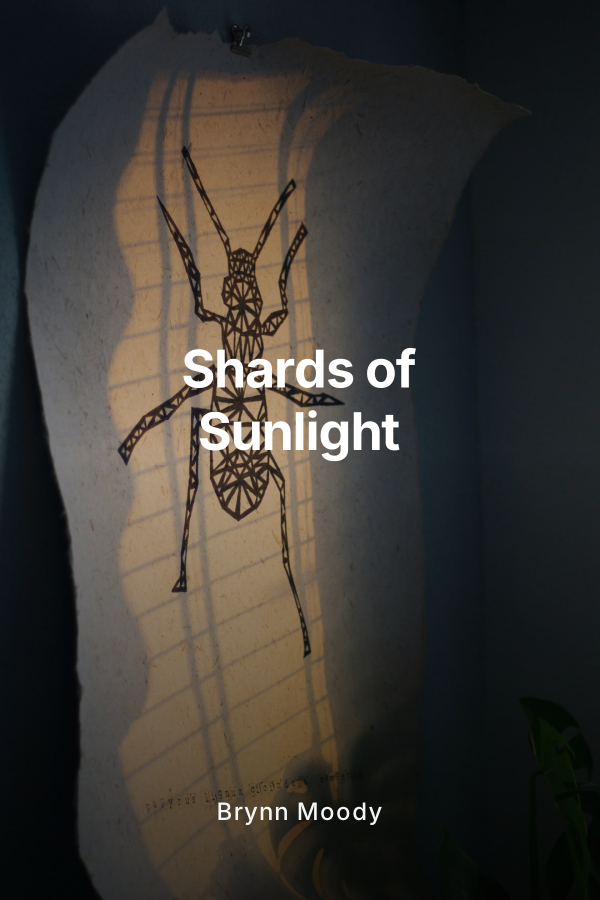
This book follows Evelyn, a daughter of Apollo who survived an ordeal so dehumanizing that the others quietly begin to measure time by it: there was life before the bottle and life after it. Once trapped and treated as a resource instead of a person, she emerges technically rescued yet still feeling the walls around her even beneath open skies. The story charts how a girl who was nearly lost becomes the quiet center of a shifting camp, and how the people who love her learn to fight for her healing with the same ferocity they use on monsters.
At Camp Half-Blood, no one officially acknowledges the invisible rules that form around Evelyn’s trauma. No one posts a schedule or gives a speech, yet routines rearrange themselves. Will tweaks infirmary rosters, patrols and meal times so she is never cornered in small rooms and never forced into crowds for longer than she can bear, subtly planning around the way she flinches from closed doors and freezes at unexpected touch . Annabeth quietly rewrites battle formations, ensuring Evelyn can always reach open air, an exit, a window. Percy stops questions before they form, backing Nico and Evelyn in conversations with an effortless kind of loyalty that tells everyone else how to behave.
The bottle still owns part of Evelyn’s nervous system. Even when she stands in sunlight, she feels glass against her skin. Tight spaces make her heartbeat surge. She sleeps with light visible somewhere nearby. She sits on the edges of groups, never in the center, where escape routes are blocked. The narrative stays close to her senses, tracing how mundane moments can echo captivity: a slammed door, a hand on her wrist, a well-meant surprise from a friend. Each becomes a test of whether she trusts the world not to close around her again.
Humor becomes one of her sharpest survival tools. Around the campfire, Leo sets up jokes like kindling, but Evelyn is the one who lights them. When he starts roasting Jason’s perfect hero image or Thalia’s terrifying glare, Evelyn delivers the final line that leaves even the most battle-hardened demigods doubled over, not because she is cruel but because she is precise. Her humor is dry, a little savage, and always honest, puncturing the myths her friends build about themselves so they can breathe inside their own legends . In those evenings, laughter becomes proof that they are more than the worst things that have happened to them.
The heart of the book is Evelyn’s emotional arc. At first she is soft in the way that raw skin is soft: exposed, painfully sensitive, refusing to grow callouses that would make her less herself. She is not naive. She has seen the way power can turn people into objects and how easily hope can be bottled, rationed and used. The narrative follows her through halting attempts to reclaim a sense of safety, to decide what kind of hero she wants to be, and to define herself beyond the labels of “Apollo’s daughter” or “the one they almost lost” .
Each chapter deepens a different layer of this transformation. Early on, the focus rests on immediate coping: the unglamorous work of getting through days when adrenaline has nowhere to go and nightmares have no clear source. The camp around her adapts without fanfare. People start leaving doors cracked, sitting beside her instead of in front of her, learning to announce themselves before entering small spaces. No one names it a strategy, but together they write a new etiquette of care.
Over time, Evelyn begins to open in small, uneven increments. She does not deliver a single confessional monologue that explains her past. Instead, fragments of the bottle years appear in offhand comments, in the way her gaze catches on glass objects, in the rare moments when someone asks exactly the right question and then does not rush to fill the silence that follows. The book honors how survivors often reveal their histories piece by piece, on their own terms, trusting others with slivers before offering anything whole.
As she heals, Evelyn starts to pivot from protected to protector. She notices younger campers who flinch the way she used to, kids who are too quiet about wounds that run deeper than monster claws. Her instinct, honed by her own captivity, is to ensure no one else ever feels that alone again. She volunteers for watch shifts near the newer bunks, not to hover but to be nearby, a lighthouse rather than a guard. She learns how to advocate for others, to push back on traditions that hurt more than they harden, and to redefine what strength looks like in a place built for warriors.
The other demigods evolve alongside her. Will’s quiet planning broadens into a philosophy of care that reshapes the infirmary and the way the camp treats injury and trauma. Annabeth’s reorganized battle plans become a case study in strategy that accounts for human vulnerability instead of ignoring it. Percy models a kind of loyalty that does not demand explanations, only presence. Together, they show that heroism is not only measured in quests completed or monsters slain, but in how effectively they protect each other’s right to feel safe, silly and fully human.
Tone wise, the book blends emotional intensity with levity. Moments of high tension are pierced by jokes, pranks and affectionate teasing, so the story never sinks into pure darkness. The language aims to be vivid yet clear, accessible to teens and young adults who recognize themselves in characters balancing trauma with sarcasm, grief with stubborn joy. While the world involves gods and monsters, the core conflicts are deeply human: how to live after surviving, how to trust that freedom will not be yanked away, how to believe that softness can coexist with strength.
Across five chapters, the narrative traces Evelyn’s journey from a girl who moves as if glass still confines her to a young woman who stands in sunlight without apologizing for how much space she takes up. Each chapter centers a distinct phase: the aftermath of rescue, the unspoken adjustments of the camp, the role of humor and friendship in survival, the gradual unveiling of her past, and finally her emergence as a protector and leader on her own terms.
Shards of Sunlight is ultimately a story about refusal. Evelyn refuses to become only a symbol of tragedy. Her friends refuse to pretend that what happened to her is normal. Together, they refuse the idea that healing must be solitary or stoic. By the end, the bottle is no longer the defining metaphor of her life. It is part of her history, not her horizon. What defines her instead is the way she chooses, again and again, to step toward open doors, open skies and open futures, carrying her past without letting it cage her.