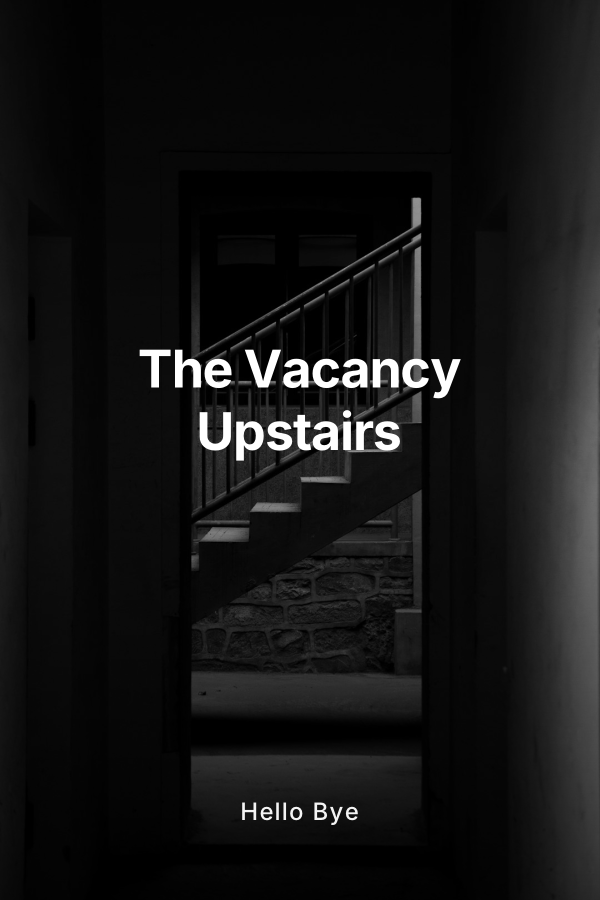
The Vacancy Upstairs is an erotic psychological horror novel that follows a young man who signs the wrong lease in the wrong building and slowly trades every shred of his ordinary life for a consuming, degrading pleasure that feels like the only truth he has ever known. Built from the seeds of the user’s concept, it combines haunted-house unease with escalating sexual surrender, blurring the line between addiction, consent, and the supernatural pull of a place designed for people like him.
At its heart is A, a drifting, overworked renter who wants nothing more than a quiet space to rest and disconnect. The building he chooses seems, at first glance, imperfect yet affordable. The hallway to his unit runs a little too long for the size of the floor; the mailboxes do not match the number of apartments; elderly tenants watch him with a look he cannot name, somewhere between pity and recognition. The landlord, distracted and oddly intimate, assures him he is exactly the kind of tenant the building is made for, then never explains what that means. During the lease signing, these peculiarities register as mild discomfort, red flags he tells himself are harmless. In truth they are the first signs that the building is not simply a place to live, but an organism that feeds.
The story unfolds as A settles into his new apartment and discovers how easily the routines of his old life begin to slip. The building is quiet, insulated from the outside world, yet alive with suggestive sounds at the edge of perception. Bedframes knock somewhere in the walls. Muffled voices rise and fall in the vents. Some evenings, A thinks he hears his own name whispered from the pipes as he drifts toward sleep. These hints of secret occupancy coexist with the mundane pressures of his job, his parents’ expectations, and the banal stream of notifications on his buzzing phone. Slowly, the outside obligations start to feel more unreal than the apartment’s atmosphere of warm, beckoning strangeness.
Four pivotal figures shape A’s descent, each embodying a different stage of his surrender. B is his first tender lover in the building, the one who meets him with apparent care, patience, and genuine erotic connection. B listens, learns his rhythms, and offers seemingly safe, nurturing intimacy within the apartment’s charged environment. With B, A learns to associate the space with reward, comfort, and a kind of attentive love he has never known. The sex is consuming yet gentle, tuned to his consent and framed as a sanctuary from the grind outside. B is the bridge between the world he knows and the hidden economy of pleasure the building runs.
C, the caretaker, enters as a more practical ally at first. C is the one who suggests that maybe A does not need to answer every email, that one missed shift will not end the world, that a day in bed is more honest than another day pretending to care. C brings him food, reminds him of nothing except the present moment, and praises him for listening to his body’s desires. Through C’s encouragement, irresponsibility begins to look like a radical form of self-acceptance. When A leaves his phone buzzing on the nightstand and lets it vibrate through an orgasm without checking who is calling, it is C who tells him this is a victory, proof that he is finally choosing himself. What feels like rebellion is in fact the building’s design slowly succeeding.
D and E arrive later as the ones who normalize giving up completely and who escalate the sexual games into rougher, more anonymous territory. They are experienced residents in the building’s unspoken rituals, blasé about jobs they once had, families they once answered to, names they no longer use outside these rooms. With D and E, group scenes become common, first with B joining in, then with faces and bodies blending into a collective intensity that matters more than individual identities. A discovers that he can be used while barely conscious, that he can pass out mid encounter and wake only to beg for more, and that no one around him views this as alarming. Within the building’s logic, this is simply how satisfaction looks when you are done pretending to want anything else.
As the chapters progress, the narrative structure mirrors A’s dissolution. Early on, scenes are clearly delineated. Encounters with B, C, D, and E happen one on one. The reader can keep track of who is who, how A feels with each, and where one night ends and another begins. Over time, those borders erode. Threesomes with B and C or B and D blur the edges of intimacy and complicity. In later sections, rooms fill with bodies whose faces A no longer fully registers, though a familiar scar, a particular laugh, or a habitual gesture signals B or C or D or E somewhere amid the tangle. The prose shifts from sharply observed detail to a more dreamlike, repetitive rhythm that mimics the cycle of climax, collapse, and reawakening in the same unmade bed. The building becomes less a setting and more an atmosphere, a pressure that compresses all experience into a single loop of arousal and release.
Parallel to A’s immersion runs the story of his parents, who exist outside the building yet are pulled by the vacuum he leaves behind. What begins as mild irritation at his missed calls and unreturned messages builds into confusion and then panic. The narrative intercuts their attempts to reach him with his deepening attachment to the apartment. While his phone buzzes unheard on the sheets, his mother leaves voicemails that move from scolding to pleading, while his father’s insistence that A is simply being irresponsible shifts inexorably toward fear. The sound design in these chapters is crucial. The vibration of the phone under A’s body is felt more than heard, transforming from an external demand into a physical component of his pleasure. Eventually, the parents travel to his address, armed with suspicion, worry, and a dawning awareness that something is wrong.
The climax of the book weaves two realities on a collision course. Inside, A participates in the ultimate scene, so engulfed by the building’s erotic machinery that his sense of self narrows to a single craving. He has not left the apartment in days. Food appears when he needs it. Sleep comes only in short, obliterated windows between uses of his body. Outside, his parents navigate the building’s impossible architecture. Hallways feel too long. Door numbers skip and repeat. They hear, just for a moment, the distant banging of a bedframe and muffled cries that sound familiar and impossible at once, as if their son’s voice is trapped a few floors away and yet nowhere at all. Then, as they finally reach his door, the noise cuts out entirely.
When the parents open the apartment, they find no one. The air is cold, the windows closed, yet the sheets on the bed are twisted and damp, carrying a faint musk that makes them both recoil and hesitate. On the mattress, there is a shallow indentation, still slightly warm, as if someone has just risen and stepped out of sight. The phone sits discarded on the floor, its battery long dead. To them, this is a disappearance, a mystery that veers toward the supernatural without offering proof. To the reader, who has lived inside A’s perception, it is the inevitable end of his trajectory. He has not been abducted so much as absorbed, fully integrated into the building’s unseen network of rooms and bodies and appetites. The vacancy upstairs has found its tenant.
Across its five chapters, The Vacancy Upstairs traces a coherent emotional arc. The first chapter focuses on the lease signing, the early oddities of the building, and A’s background as someone uniquely vulnerable to its promise of rest and escape. The second examines his initial encounters with B and the seductive safety of what appears to be ordinary romance in an uncanny place. The third expands the cast to include C, D, and E, charting his small acts of negligence and the normalization of staying inside. The fourth plunges into the hedonistic spiral, where group scenes, sleep deprivation, and near unconsciousness blur consent into compulsion. The final chapter braids A’s final surrender with his parents’ desperate search, culminating in the chilling tableau of the empty apartment and the lingering impression that the building itself is not just haunted but hungry.
Throughout, the book refuses simple moral judgments. It presents A’s submission as both ecstatic and terrifying, both chosen and engineered. The erotic content is explicit and central, yet always framed within a psychological horror lens that interrogates why someone might willingly drift into a life where being used while barely conscious feels preferable to facing their own unrealized potential and the banal disappointments of the world outside. The vacancy is not only in the apartment upstairs, but in A’s sense of meaning before he ever turned the key. The building senses that emptiness and offers to fill it, at the quiet cost of everything else.