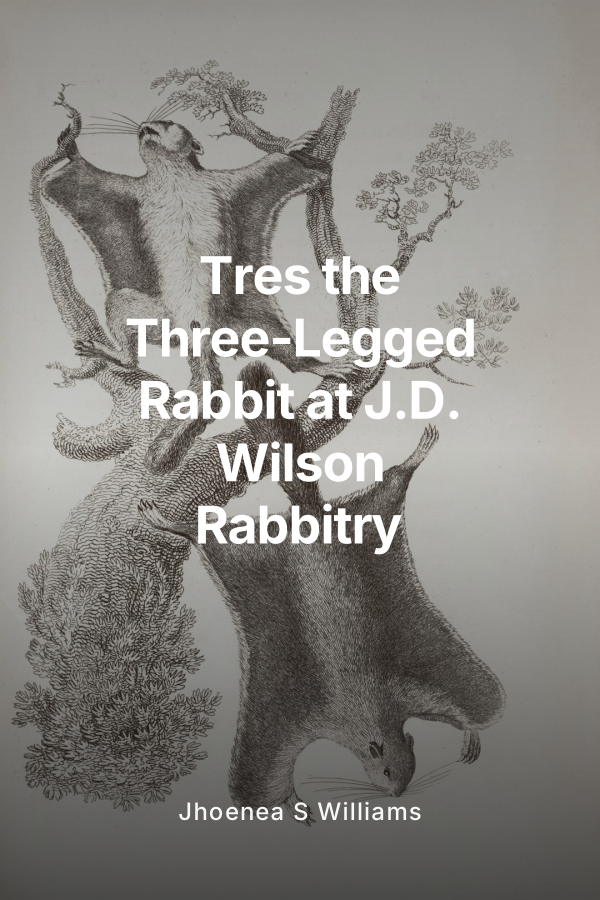
This children’s picture book for ages 6 to 8 tells a gentle, realistic story about Tres, a chocolate and white rabbit who hops on only three legs and believes that makes him “less” than everyone else. Set in the real-world farm setting of J.D. Wilson Rabbitry, the story blends everyday animal life with a simple mystery and a strong emotional arc to help children see that “being different is ok” and that every body can be special and useful.
The story opens with a warm, read-aloud friendly introduction to J.D. Wilson Rabbitry. Every morning is “busy and bright” as Mr. Wilson and his daughters, little Naje and Kadeea, feed hay, pellets, and sweet bananas to the animals. Amid the familiar routine, Tres explains in first person that his mornings feel “a little different” because he hops on only three legs. His fur is chocolate and white, “like a splash of milk in cocoa,” and although he is loved and well cared for, Tres already sees himself through his difference.
Early scenes show Tres moving around the barnyard among real, talking animals who behave like animals but speak in simple, childlike voices. Snow the cat is quietly supportive, rubbing against Tres when he feels low. Nan the hen is uncertain at first, watching from a little distance, but will grow kinder over time. Coco the other rabbit starts out as a teaser. In the play yard, with banana trees, hay, flowers, and pellets nearby, Coco points and laughs: “Look at Tres and his funny hop!” Other animals giggle and whisper. Tres feels a clear sting of shame and sadness.
Trying to stay brave, Tres keeps hopping, but the teasing returns a second time just as he begins to feel a tiny bit better. “For a moment, I felt a little better” gives way to Coco repeating “Look at Tres and his funny hop!” The repeated phrase becomes an easy point for children to anticipate and recognize, while also showing how words can hurt when they are said again and again. This second tease pushes Tres to retreat.
Tres hides in his hutch, and the inside feels dark and lonely. Speaking in simple, honest sentences, he tells Naje and Kadeea: “I don’t like my hop. I feel sad when they laugh. I wish I had four legs like the others. I wish I was normal like everyone else.” These lines capture the feelings many children have when they feel different, in direct, accessible language. Kadeea gently pets Tres and answers with kindness: “You are special to me, Tres.” This important reassurance plants the first small seed that being different does not erase love or belonging. Snow’s quiet presence and Nan’s growing concern start to wrap Tres in a soft circle of care, even though he cannot feel it fully yet.
Not long after, the calm routine of the rabbitry is disturbed. One morning, everyone discovers that the gate near the banana trees is standing wide open and the bananas have been badly nibbled. Hay rustles, feathers ruffle, and the animals murmur in worry. Mr. Wilson notices the open gate and the damaged banana trees, but he does not shout or punish anyone. Instead, there is a quiet alarm and a sense that something needs to be understood and fixed so all the animals can stay safe. This sets up a simple, child-scale mystery: Who or what opened the gate, and how can they stop it from happening again?
Two-year-old Naje becomes the bridge between Tres’s hurt feelings and the barnyard’s real need. She goes to his hutch, gently picks him up, and carries him to the open gate. At the fence, she sets him down with care. In a short, powerful line that will repeat later in Tres’s mind, she says, “I know you can, Tres.” That one sentence becomes the emotional spark that lets Tres believe he might be more than his sadness and self-doubt. From a read-aloud perspective, this line is simple, rhythmic, and memorable, easy for young listeners to latch onto.
Tres answers without hesitation: “I’ll try.” This is one of the story’s quiet turning points. He does not suddenly feel strong or confident, but he chooses to help. The story deliberately avoids showing Tres as “broken” or needing to be “fixed.” Instead, it lets his difference remain, and shows his courage growing around it.
Guided by Naje’s belief in him, Tres climbs onto the fence and begins to walk along the top rail. His three legs give him a special kind of balance that other rabbits do not have. Snow, Nan, and even Coco stand below, looking up and cheering: “Go Tres, go Tres!” The chant appears like a little chorus, encouraging children to join in when they listen. This moment works on several levels: Tres is using his body in a way that works for him, his community is finally supporting him, and the scene is fun, not heavy.
From this higher perch, Tres notices two important things at once. First, he spots the gate latch hanging loose in a way only someone at his height and angle could see. Second, he sees the pattern of tracks in the dirt leading to and from the gate. With his unique hopping pattern and vantage point, Tres can match the marks on the ground to the animals in the yard. Quietly, the narration guides children through his simple reasoning, without turning it into a complex detective story. Tres realizes that no animal is being bad on purpose. Instead, he discovers that Kadeea accidentally left the gate not fully closed and that curious animals pushed it open while searching for treats.
When Tres explains what he has seen, the barnyard listens. Mr. Wilson gently confirms the loose latch and Kadeea’s forgetful moment. Kadeea feels worried and says she is sorry, but Mr. Wilson replies with calm reassurance: “We all make mistakes, we’ll just be more careful next time.” No one is shamed or punished. The focus stays on learning and caring for one another. Tres’s role in solving the problem becomes clear: without his special hop and his three-legged balance on the fence, the mystery might have stayed unsolved.
In that moment, Tres whispers to himself the line that Naje had said earlier: “I know you can, Tres.” Remembering her belief helps him stand a little taller. He thinks, “I felt special inside.” This simple thought marks the first time Tres connects his difference with a positive feeling. For young listeners, “special” is a familiar, gentle word that signals self-worth without sounding heavy or technical.
Mr. Wilson then touches Tres with a gentle pat and says, “Tres, you saved the bananas today.” The animals around them clap and cheer. The story later revisits the bananas at evening feeding, when Mr. Wilson brings “hay, pellets, and sweet bananas” and everyone feels safe, happy, and full. This repetition ties the mystery to an everyday joy, showing children that Tres’s actions protect something all the animals love.
As the barnyard settles into safety again, Tres smiles and thinks, “Lots of animals are different, like me.” The line stays general, without naming specific differences, so it can easily connect with many kinds of children and families. It invites kids to see variety as normal, not as a problem to be hidden.
The emotional climax of the story arrives not with loud drama, but with a quiet, heart-level shift. Tres smiles and thinks, “Being different is ok.” Just after he has this thought, Coco walks up to him. Her earlier teasing has weighed on her. In a simple, clear apology, she says, “I’m sorry for laughing at your hop, Tres. Your hop helped us today.” Tres answers, “It’s ok, Coco. Come hop with us.” His forgiveness is quick and uncomplicated, modeled in a way that young children can understand and copy.
To show real change, Coco decides to hop like Tres. She tries to move on three legs. It is clumsy and difficult. Coco puffs and says, “Hopping on three is hard!” The line is both funny and honest, perfect for a light moment after the heavier feelings. Tres answers playfully, “It’s just practice...” and the pictures will carry the rest, with Coco wobbling and giggling, Snow getting surprised by flying hay, and all the animals joining in a new hopping game.
In the happy ending game, everyone copies Tres’s three-leg rhythm. Naje and Kadeea clap their hands. The animals chant “Go Tres, go Tres!” in a joyful loop. Tres’s once “funny” hop has become the center of a shared, happy activity. What made him feel ashamed earlier now draws his friends closer.
As the story moves into its final emotional notes, Tres reflects again. “Now I like my hop.” After everything that happened, this simple reversal from his earlier “I don’t like my hop” gives children a clear sense of growth. “Now I felt special inside.” He no longer wishes to be “normal like everyone else.” Instead, he sees that his exact body and way of moving have value.
Then come three final, memorable lines. First, Tres says, “My three legs saved the bananas today.” This connects his difference directly to his success. Next, he declares, “I’m Tres, and I like my hop just the way it is here at J.D. Wilson Rabbitry.” He speaks his full sense of self out loud, grounding it in his home and community. Finally, he gives the book’s core lesson in one child-friendly sentence: “At J.D. Wilson Rabbitry, different doesn’t mean less, we all have our place in life.” Spoken entirely by Tres, this line offers a complete message that adults can easily revisit with children after the story ends.
The book includes a short dedication page: “For every child who feels a little different, with love from J.D. Wilson Rabbitry.” Its language is intentionally soft and open, inviting any child who does not fit in perfectly to feel seen and welcomed.
Because this story is designed for reading aloud, the sentences are short and rhythmic, with gentle repetition of key phrases such as “I know you can, Tres,” “Look at Tres and his funny hop,” “Go Tres, go Tres,” and the shift from “I don’t like my hop” to “Now I like my hop.” Picture notes guide illustrations that show real-looking animals and a realistic barnyard environment, with slightly darker tones when Tres is sad and brighter, sunny yellows near the banana trees and happy scenes.
At the end of the book, simple discussion questions and one drawing activity idea can help parents, teachers, and caregivers deepen the lesson:
- Feelings questions: “How did Tres feel?” and “How do you feel when you do something special?”
- Lesson questions: “How was Tres different?” and “What can you do if you feel left out, like Tres did?”
- Drawing activity: “Draw a picture of yourself and write one word that shows what makes you special.”
Altogether, “Tres the Three-Legged Rabbit at J.D. Wilson Rabbitry” offers a warm, engaging story that is easy for children to follow and rich enough for adults to revisit many times. Through a barnyard mystery, a three-legged hop, and a circle of gentle characters, it shows young readers that bodies can be different, feelings can be hard, and still, with kindness and courage, everyone can find a safe, valued place in the world.