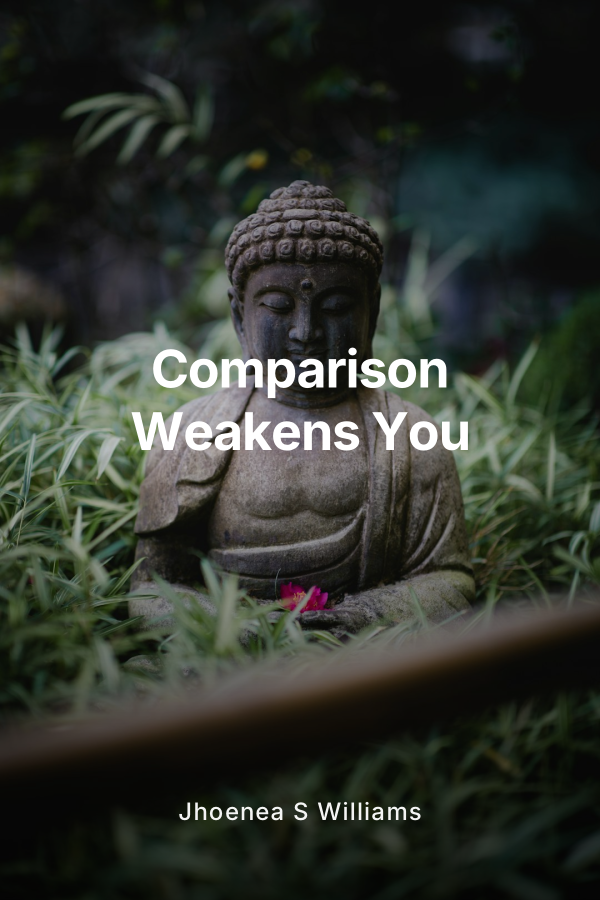
This book is a small, sharp companion for people who feel like failures, who scroll through other people’s lives and quietly decide they are losing at their own. It was shaped as a set of short, simple pages built around three parts on each page: the painful thought, the honest validation, and a hopeful action step in plain language. The voice is blunt, kind, and gender neutral, written for readers from about sixteen upward who feel exhausted by comparison, self hate, and the pressure to always be “doing better” in life.
The core idea is simple. Comparison is the enemy. Not you. Not your pace. Not your tired brain. The book attacks the lies, the fake standards, and the invisible rules that tell you you are behind, not good enough, or already ruined. It never attacks the reader. It calls social media standards fake and cruel, and it speaks in a general “you / we” voice so no one feels singled out or shamed.
Across fifteen pages, the book walks through a gentle journey from the darkest comparison and self hate into a quieter, steadier kind of hope. The pages are arranged to start with heavy comparison thoughts, move into numbness, burnout, and self hate, and then end with more hopeful pages focused on moving at your own pace and building a small, real life that actually fits you. The language is very simple with no complex words, because the imagined reader is tired, overwhelmed, and struggling to focus.
At the heart of every page sits a raw, specific thought that many people keep buried. Thoughts like “Everyone is moving forward except me,” “Their life looks perfect and I wish it was mine,” “I hate who I am,” or “I am so tired I do not want to be here anymore.” Each thought becomes the title and first punch of the page. The book opens hard, on purpose. It refuses to water down what people actually think in their worst moments. It names comparison around success, looks, relationships, and lifestyle, especially through social media scrolling and “highlight reels.”
After the hard first line, each page softens into validation. Instead of arguing with the reader or telling them to “think positive,” the pages admit how painful this really is. For example, after a comparison thought like “Everyone is moving forward except me,” the validation might say that anyone would feel crushed seeing everyone else’s wins every day, and that feeling stuck, invisible, or like you are disappearing is not dramatic, it is human. On self hate pages, the validation is short and blunt, lines like “Waking up like this hurts” that acknowledge the weight of hating your own reflection or your own thoughts. The validation never says “you are overreacting.” It keeps repeating that wanting to vanish, or feeling useless, is still only a feeling, not a fact about who you are.
Then, every page turns toward action. The actions are tiny, physical, and realistic. They focus on body, nature, and creativity rather than on huge life overhauls. There is no demand to “change your mindset” instantly. The main signature action is always the same and always simple: step outside for a minute and feel the air on your face. This is the one thing that almost anyone, anywhere, can do. It restores a link between you and the real world beyond a screen.
The book carries a repeated closing pattern that becomes a kind of anchor. At the end of most pages, in the final two lines, the same idea returns: “Comparison is lying to you. Step outside for a minute and feel the air on your face.” This double line is the heartbeat of the whole project. It names comparison directly as the liar and then offers one concrete move back into your own body and your own life. The tone is firm but not shouting. There are no exclamation marks, no dramatic speeches, just a simple command that can be obeyed even on a very bad day.
Some of the pages are crisis level. These are reserved for the heaviest thoughts, like wanting to disappear completely or feeling too tired to stay alive. On these pages, the closing shifts slightly, adding “right now” for urgency, as in “Step outside for a minute and feel the air on your face right now.” The book uses that more urgent command only on a few of the darkest pages, so that it does not lose its force. The crisis pages still keep language free from swear words and avoid graphic detail, but they do not pretend the feelings are mild. They are honest about exhaustion and the desire to vanish, while clearly separating those feelings from the reader’s worth.
The middle set of pages focuses more on numbness and burnout. Thoughts like “I do not feel anything anymore” or “I am so tired of trying” sit at the top. The validation here centers on how exhausting it is to wake up feeling empty or to push yourself through days that feel pointless. The book points out that this kind of deadness is a response to overload, not proof that you are broken beyond repair. The action steps on these pages stay very small, like moving your body for one minute, noticing one real object in your room, or just getting yourself to daylight. These middle pages slowly begin to introduce the idea that your worth is not tied to constant productivity.
Later in the journey, more pages turn toward acceptance and hope. They start to repeat a few key truths in different simple sentences. For example: you are not late to your own life. You can move at your own pace. Small days still count. You can build a small life at your pace that is still real and good. These hopeful lines are not painted as slogans, but as possibilities the reader can test in tiny ways. The book gives small pictures of what a “small, real life” can look like: quiet routines, a few real friendships, simple hobbies, and ordinary days that are still meaningful even if they never show up on anyone’s feed.
One of the strongest comparison thoughts in the book is “Their life looks perfect and I wish it was mine.” That page takes place in a very specific scene. The reader is scrolling social media and sees a perfect lifestyle image, often a styled room or an “aesthetic” daily routine. Everything in the picture looks brighter, cleaner, better. In contrast, the reader’s own room feels messy or dull, their life colorless. The page names the quiet envy and the sense of being invisible or like “nothing in the background” while other people seem to actually be living. It then calls out the cruelty and fakery of these standards, attacking the fake online life rather than the reader’s reaction to it.
Another crucial page centers on the line “Everyone is moving forward except me.” This page describes the feeling that others are sprinting while you are stuck at the same spot, scrolling through their milestones, promotions, moves, and big announcements. It begins with a hard punch of a line, then moves into validation that “anyone would feel crushed seeing this every day,” especially when they are already tired, ashamed, or worn down. The final command on that page instructs the reader to put the phone down for today, pairing that with a small bodily or nature based action so they can touch something real instead of feeding the lie again and again.
Self hate has its own pages, some of the heaviest in the book. Thoughts like “I hate who I am” sit in bold at the top, followed immediately by a short admission such as “Waking up like this hurts.” The book lets that statement stand without rushing past it. It names how loud and heavy that hate can feel. Then it quietly separates identity from emotion by reminding the reader that even this level of self disgust is still a feeling, not a final verdict on their value. On these pages, the closing line stays the same, repeating that comparison and fake rules about worth and success are the liars, not the reader’s heart.
Throughout all the pages, the style remains harsh toward lies and systems, but gentle toward the person. The book repeatedly attacks comparison itself, calling it a trap and a poison, while insisting that the reader is not the problem. It sometimes names “social media standards” or “invisible rules about success” as fake and cruel, drawing a clear line between the human being who hurts and the structures that make that hurt worse.
The final page of the book holds its main promise. In the hopeful section, it says, in simple words, that you can build a small life at your own pace that is still real and good. This line is not sold as a quick fix, but as a deep alternative to the endless race of comparison. The page gives quiet examples of that kind of life: one slow morning, one honest friend, one creative thing you do for yourself, one walk outside where no one is watching. It then pauses, and the signature closing returns in its clearest form. Comparison is lying to you. Step outside for a minute and feel the air on your face.
In the end, Comparison Weakens You is not about becoming the strongest, happiest, or most successful version of yourself. It is about surviving the weight of fake standards, telling the truth about how badly comparison can hurt, and then choosing, one tiny action at a time, to come back to your own body, your own day, and your own pace. It is a book meant to be opened on the worst mornings, flipped through anywhere, and closed after one page with one small step the reader can actually take.