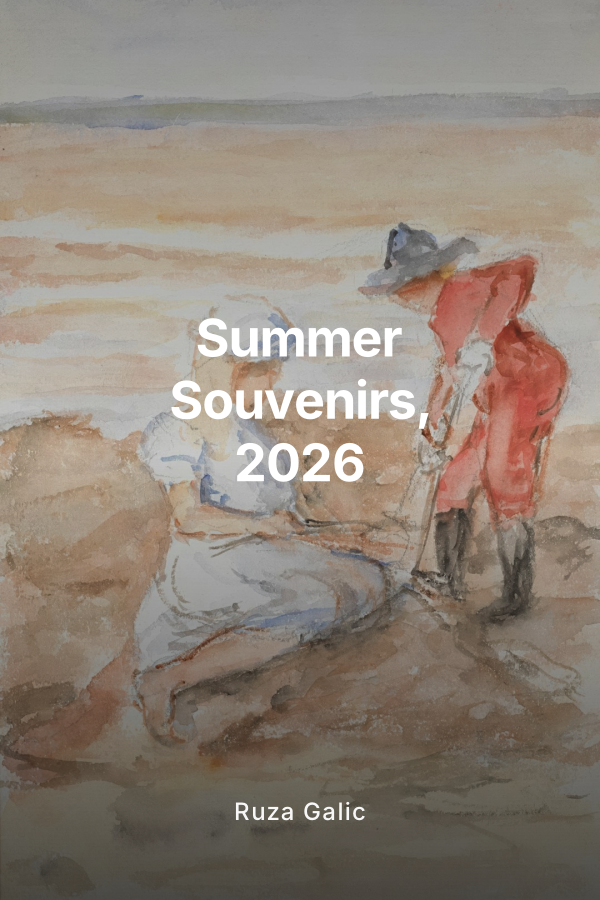
“Summer Souvenirs, 2026” is a colourful student anthology that gathers the brightest memories, reflections, and daydreams of a Grade 8 class as they look back on one unforgettable season. Drawn from a shared collection of summer-themed texts, the book becomes both a yearbook of experiences and a literary keepsake, designed as a physical A4 volume where each student’s voice holds its own page, framed by light, sunny colours and playful clipart.
At its heart, the anthology celebrates how differently young people live and interpret the same season. Some stories are intimate travel diaries that follow ferries across the Adriatic to islands like Brač or coastal towns such as Vodice and Bol, where students discover clear seas, iconic beaches, and the joy of reuniting with family working far from home. They write about days spent on Zlatni Rat beach, fishermen’s nights full of music and traditional food, and sunsets that paint the sea in gold so powerfully that one evening can feel like a life lesson in gratitude and beauty.
Other pieces turn inward, using summer as a metaphor for life. In reflective essays such as “Life´s a picnic” and “Life´s a beach”, pupils compare preparation for a picnic with preparing for the future, or shifting tides with the inevitability of change. They discover that footprints washed away by the sea can symbolise letting go of the past, and that storms, like difficult moments, eventually pass to make room for calm again. These texts show a surprising philosophical depth, revealing how Grade 8 students have begun to see everyday moments as sources of wisdom.
Water runs like a thread through the book. In “Aquaholic” and similar pieces, students confess that once they enter the sea, pool, or lake, they never want to leave. They recount fearless (and sometimes risky) jumps from rocks and ropes, icy lakes in Bosnia and Herzegovina, and the simple happiness of staying in the water until the last sunlight disappears. These aquatic adventures are not just action scenes; they mark growing courage, small brushes with danger, and the thrill of discovering what they can do with their own bodies.
Food and family form another strong strand of the collection. In “Chill out with your grill out”, for example, barbecues at lakes like Buško Blato are described in rich sensory detail: the divine smell of grilled meat, the sight of blue water and green trees, the feeling that everything tastes better in nature and in good company. Similar warmth appears in narratives of grandparents’ villages, picnics under trees near waterfalls and old stonemills, and quiet evenings spent baking cakes and watching films with family members. Across these pages, students show that their most valued souvenirs of summer are not objects but shared meals, laughter, and stories.
Cities and travel broaden the horizon of the anthology. “Summer nights and city lights” explores the excitement and risks of lively urban streets after dark, recognising both the fun of street performers and the unseen work of police, cleaners, and emergency workers who keep the city safe. “The ultimate getaway” switches into a guidebook style, recommending places as diverse as Pag, Berlin, Italy, Japan, South America, and Australia, portraying the world as something both reachable and endlessly fascinating. This variety of settings shows how far the students’ imaginations and experiences extend beyond their own town.
Not every summer in the book is about travel. “Staycation” proves that staying home in the village of Vir in Herzegovina can be just as memorable as any trip abroad, with football tournaments, birthday parties, bike rides through fields and forests, and even a local bullfight that ends in victory. Here, the excitement comes from community, competition, and first relationships, revealing how much can happen without ever crossing a border.
Structurally, the anthology gives each piece equal dignity: one story per page, the title at the top, the author’s name discreetly placed at the bottom, and a summer-themed illustration under the text. Between stories, a light, decorative divider line with a sunny motif keeps the rhythm of the book relaxed and spacious. The design mirrors the content: airy, bright, and open, like a long July afternoon. On the title page, the book proudly states “Summer Souvenirs, 2026 – Grade 8 – R. K. Galic”, and at the end, a signature page with a faint beach decoration invites students to sign their names, turning the printed volume into a shared artefact of their final year together.
Throughout, the intended readers are the students themselves, their families, and the school community. For them, “Summer Souvenirs, 2026” functions as both a reading experience and a time capsule. It captures the last school summer before high school, the mix of freedom and responsibility, the discovery of new places, and the deeper understanding of home. The voices are authentic and imperfect by design: the language remains exactly as the students wrote it, preserving their individual rhythms, errors, humour, and sincerity.
Taken together, these texts show a generation standing at the edge of adolescence, using English not just to complete an assignment but to claim their memories. Whether they are describing a perfect “slice of summer” on a beach, a quiet moment watching the sunrise, the nervous pride of learning to swim, or the realisation that life, like a picnic, must one day be packed away, they are learning to name what matters to them.
“Summer Souvenirs, 2026” is therefore more than a collection of holiday stories. It is a mosaic of early identity, stitched together from sunlit days, starry nights, and the courage it takes to put personal experience on the page. Years from now, when these students open the book again and see their own words beside their classmates’ signatures, they will hold not just a school project in their hands, but a vivid souvenir of who they once were and the summers that helped shape them.