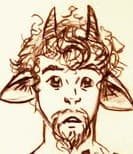
This book follows Tigres, a disciplined young scholar of monsters whose tidy worldview collapses when theory becomes flesh and blood. Sent to catalog the creatures of an ancient forest, he expects distant observation and neat field notes, not seduction, jealousy, or the kind of pain that lingers long after bruises fade. Instead, he meets a satyr whose laughter hides a history of exploitation, and whose body has been treated as a communal playground by the strongest beings in the woods, especially the brutal minotaurs that still haunt his memory .
Across five chapters, the story braids erotic tension with emotional excavation. At first, Tigres treats intimacy as just another aspect of his research, something to be observed and endured in small doses so he can keep writing. The satyr, amused by Tigres’ stiffness, teases him relentlessly, poking at his boundaries, stretching what Tigres can tolerate in bed as long as the scholar does not interrupt his work with resistance or questions. What begins as lighthearted provocation gradually reveals itself as a coping pattern shaped by years of being “everyone’s slut” in the forest, a role the satyr embraced to survive rather than to thrive.
The book’s heart lies in the slow, uneasy awakening of both characters. Tigres starts by compartmentalizing, scribbling observations while pretending that the sex is merely data, an odd price for access to rare knowledge. But as he notices the satyr’s practiced willingness, the quick way he placates, distracts, or offers more pleasure whenever discomfort surfaces, Tigres cannot ignore the fracture between the satyr’s jokes and his eyes. Curiosity shifts into concern. Field notes become confessions. He begins to question whether he is documenting monsters or participating in the quiet brutality that makes them.
A turning point arrives during a postcoital conversation, when Tigres lists the creatures he studies and casually mentions minotaurs. The word lands like a trap closing. The satyr’s mask slips. Panic flares where charm used to be, and for the first time Tigres sees the depth of the satyr’s past: not a series of fun, wild encounters, but a pattern of stronger creatures taking what they want, using a pretty, pliant body until he became more reputation than person . The satyr tries to brush it off, seducing harder, turning the focus back to Tigres’ pleasure, but the fissure has opened. From that point on, desire and trauma sit side by side, impossible to untangle.
Outside the forest, Tigres’ father feels the tremors without knowing their source. Tigres returns home later and later, clothes rumpled, mind elsewhere, ink smeared from frantic writing sessions in the dark. His father’s worry grows from restless pacing to pointed questions. What could his son be doing out there, night after night? Is he in danger, or is he becoming something his father cannot recognize? The book uses this tension to challenge Tigres’ loyalties: between scholarly duty and human decency, between the need to protect his father’s peace and the ethical obligation to confront the exploitation he has stumbled into. The father’s concern is not simply a background detail, but a pressure that forces Tigres to decide what kind of man, and what kind of witness, he is willing to be .
Each chapter expands the emotional stakes rather than repeating them. Early sections center on the initial encounters: Tigres’ awkward submission to teasing, the satyr’s calculated charm, and the strange agreement that allows Tigres to observe life in the grove as long as he pays in compliance and silence. Midway through the book, the narrative pivots into the satyr’s fragmented history, revealed not through long monologues but through slips in his behavior: flinches when certain beasts are mentioned, sudden shifts into dirty talk when conversations get too honest, and obsessive efforts to “make Tigres proud” for reasons neither of them fully understands at first.
As Tigres and the satyr grow closer, affection complicates everything. Tigres is no longer just a client or a scholar; he becomes the one person whose opinion seems to matter to the satyr. That hunger to be valued, to be more than a convenient body, drives the satyr to push boundaries in the opposite direction, trying to be good, obedient, even wholesome, although his instincts were forged in a world where love and use look frighteningly similar. Tigres, in turn, must confront his own selfishness: was he ever truly separate from the minotaurs in the satyr’s mind, or has his research been another form of taking without fully giving back?
The looming question of whether to involve Tigres’ father weaves through the later chapters. Tigres could confess everything, risking his reputation and his work to seek help for the satyr, or he could shield his family from the ugliness of the grove and its predators. The possibility that the father might try to “fix” things through control, surveillance, or violence adds another layer of risk. If Tigres introduces the satyr, he exposes him to a new authority that might not understand the complexities of consent twisted by years of coercion. If he keeps the satyr secret, he continues a pattern of silence that has always favored abusers.
By the end of the book, every relationship has been tested. Tigres’ field journal, once a neutral container for facts, becomes the moral record of his choices. The satyr must decide whether to keep playing the role of the eternally willing creature or to claim the right to fear, refusal, and anger. Tigres’ father faces the painful truth that protecting his son can mean trusting him to step into dangerous, messy realities instead of sheltering him from them.
Thorns in the Grove is written for mature readers who want erotic storytelling that does not flinch from the psychological cost of survival. It is not a tale of pure victimhood or pure rescue. Instead, it explores how humor, seduction, and even pride can grow over old wounds, beautiful and sharp at once. By threading intimate scenes with honest conversations about power and healing, the book invites readers to question where pleasure ends and exploitation begins, and what it really means to make someone proud when both of you are still learning how to be free.