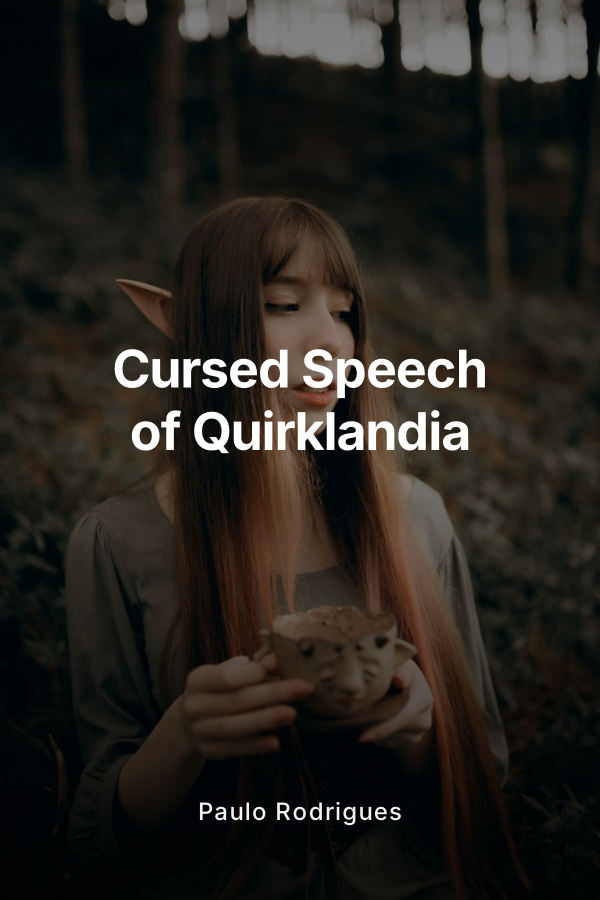
Only the first page of this book is left. We lost the rest in October 2026.
We lost access to the service that stored them, and no other copy exists. We're sorry.
In Quirklandia, power is born into every child, yet the world is still divided into rigid labels of hero, villain, and helpless civilian. At the top of this fragile order stand two rival academies: a shining Hero University that claims to train protectors, and a ruthless Villain University that openly forges criminals. Both institutions worship rankings and prestige. Both are quietly rotting from within.
Within this world, Paulo Rodrigues seems destined for greatness. Ranked number two in the Hero University, housed in the privileged VIP dorm, he possesses two formidable quirks. The first enhances his speed, strength, and hearing to superhuman levels. The second is feared even among elites: cursed speech, a power that brings immediate reality to whatever he shouts. His voice can save cities or crush a life in a single word.
Paulo is not alone. He has three brothers whose very existence defies the hero versus villain divide that Quirklandia treats as sacred. Harold, ranked ninth at the Hero University, manipulates reality itself and shares Paulo’s dorm, classroom, and dreams. They are each other’s anchor, best friends who trust one another without question. On the opposite side of the world, at the Villain University, their older brothers Theo and Aaron have built reputations as rising monsters. Theo sits unchallenged as rank one, wielding gravity and cosmic manipulation. Aaron, ranked sixth, commands elemental forces.
On paper, the family is split cleanly in two. In truth, the lines are tangled. Aaron and Theo carry a deep, festering jealousy of Paulo and Harold, born from the attention their younger brothers received from their parents. They hide that hurt behind open hostility and violent rivalry. Yet beneath all the resentment, all four brothers still love one another. That buried love is the one thing the corrupt powers of Quirklandia cannot predict.
Both universities are structured around a brutal, color coded dorm hierarchy. VIP students gain special privileges, training, and safety. Blue dorm students enjoy high status and moderate perks. Yellow dorm students receive only what they earn. At the bottom sit the red dorms, stripped of dignity, resources, and even basic respect. Teachers, staff, and fellow students treat the red dorms as garbage. Exams are rigged to humiliate them, punishment shows are broadcast as entertainment, and media interviews twist their failures into proof that they are worthless. Heroes and villains alike join in the bullying, making the label of the red dorm a public curse that seems impossible to escape.
The story ignites when Paulo stumbles onto a secret that the world has chosen not to see. One night, using his enhanced hearing, he overhears a clandestine meeting between red dorm students from his own Hero University and powerful outside villains. They are not just trading secrets or venting rage. They are planning a joint campaign with the red dorm of the Villain University, recruiting deadly villains from across the globe to destroy both schools and then seize the world. This is not mindless destruction. It is revenge for years of mockery and abuse, a demand that the world pay for calling them useless.
Paulo races to warn the number one hero student, the symbol of his academy’s strength. Before she can act, she is kidnapped, removed like a piece from a rigged board. With the top student gone, fear floods the Hero University and panic threatens to tip into full scale collapse. Forced out of the shadows, Paulo steps into a role he never asked for. He must expose the conspiracy, defend his classmates, and accept that the enemy is not only across the sea in the Villain University. It is already inside his own halls, within his own dorm system, and possibly closer than he imagines.
As Paulo digs deeper, a darker connection emerges. Red dorm students are not acting alone. A single powerful figure serves as the secret common enemy of heroes and villains. This corrupt official operates from the highest tiers of the Hero Association and uses the red dorms as disposable soldiers in a grander plan to shatter the academies and pave the way for world domination. The red dorms believe they are orchestrating their own revenge, but they are pawns in a strategy designed to seize control of every top ranked quirk user alive.
To stop this plot, Paulo must attempt the unthinkable. He approaches the Villain University and its student council, including Theo and Aaron, as potential allies. The villains hate the red dorm conspiracy for a simple reason. They may be villains by training, yet they refuse to be manipulated as puppets. They also recognize the same hidden enemy threatening their own power. A fragile alliance forms, built on grim necessity, wounded pride, and the quiet hope that perhaps the labels hero and villain are not the whole truth.
Within this alliance, the four brothers meet in open conflict for the first time since their paths split. Years of resentment boil over into furious clashes where each quirk is unleashed at full strength. Paulo and Harold fight Aaron and Theo not only as rivals but as four children trying to make sense of a broken family. No one holds back. They all take devastating injuries. During one brutal confrontation, while the world teeters at the edge of war, the act of nearly destroying each other rips away the last of their lies.
In the middle of the chaos, memories of training together as children surface. They remember their mother’s words to always protect each other, no matter what. They remember a simple move they invented as kids, a playful combo attack born from laughter, not ranking. That memory cuts through the hatred. One by one, they stop trying to win and instead choose to survive together. Tears and confessions erupt. Aaron admits he fueled Theo’s hatred of Paulo and Harold for no reason, that his jealousy had twisted the family for years. Theo confesses that beneath his fury, he always looked up to Paulo. The world may call two of them heroes and two of them villains, but in that moment they stand as brothers, united for the first time.
Their reconciliation sets the stage for the book’s true revelation. The corrupt mastermind orchestrating the red dorm’s uprising is exposed on live television as the world’s number one hero, the celebrated symbol of peace and justice, and the father of the four brothers. With cameras rolling, he mocks the very idea of heroism, reveals that he murdered their mother, and announces his intent to rule the world with the red dorms as his shock troops. In a single broadcast, he shatters the myth of the hero association and dares his sons to oppose him.
The final battle is fought on two fronts. In the physical world, the brothers combine their quirks into a new formation, transforming their childhood training move into a devastating combo attack guided by their mother’s message to protect one another. In the court of public opinion, they strike at the heart of their father’s power. Harold uses his reality manipulation to reveal secret recordings of the father’s crimes against students and red dorm members. Paulo then risks everything, speaking a single, lethal command with his cursed speech that forces their father to confess all his sins to the world. The backlash nearly tears Paulo’s body apart, leaving him coughing blood, but the confession is irreversible. The world sees its champion for what he truly is.
With the father defeated and taken into custody, the red dorm revolt collapses. Some of its members are imprisoned. Others are given a path to redemption when they publicly apologize and expose the abuse they suffered. The brothers refuse to let the story end with punishment alone. They demand a new system, one that destroys the dorm color stigma and strips power from the corrupt media that has fed on humiliation. Rankings are reset. Exams are redesigned to measure not only combat but teamwork, empathy, strategy, and the treatment of weaker allies. Scoring becomes public so that no journalist or official can twist results to fit a preferred narrative.
As the dust settles, each brother steps into a new role in the world they have reshaped. Paulo becomes headmaster of the Hero University, rejecting the old obsession with prestige in favor of transparency and protection for every student. Harold becomes a teacher there, changing how quirks are taught so that no student is treated like a tool. Aaron and Theo join the reformed Hero Association, working at the front lines of a new era where missions are based on need rather than reputation. Together, the four brothers create a joint hero and villain framework that judges people by actions instead of labels.
Yet victory does not bring peace. In the shadows, a new enemy watches the brothers rise. This figure has the terrifying ability to steal quirks and reshape public opinion. Unknown to the world, he was once the secret lover of the brothers’ father, a man whose life was shattered when that relationship was buried and whose heart filled with hatred when the father died. Now he intends to break the brothers emotionally and turn the world against them by twisting family photos, leaking distorted files from the father’s past, and painting the brothers as hidden accomplices to their father’s crimes.
Book one closes not with comfort but with a chilling promise. Somewhere in a darkened room, the new villain replays Paulo’s televised speech of reform and justice, mocking every word. On the wall beside him hangs a detailed map of the world, with the faces of Paulo, Harold, Theo, and Aaron marked with crosses. The brothers have just rebuilt Quirklandia’s foundations. They do not yet know that the next war will not be fought only on the battlefield, but inside the hearts of the people they swore to protect.