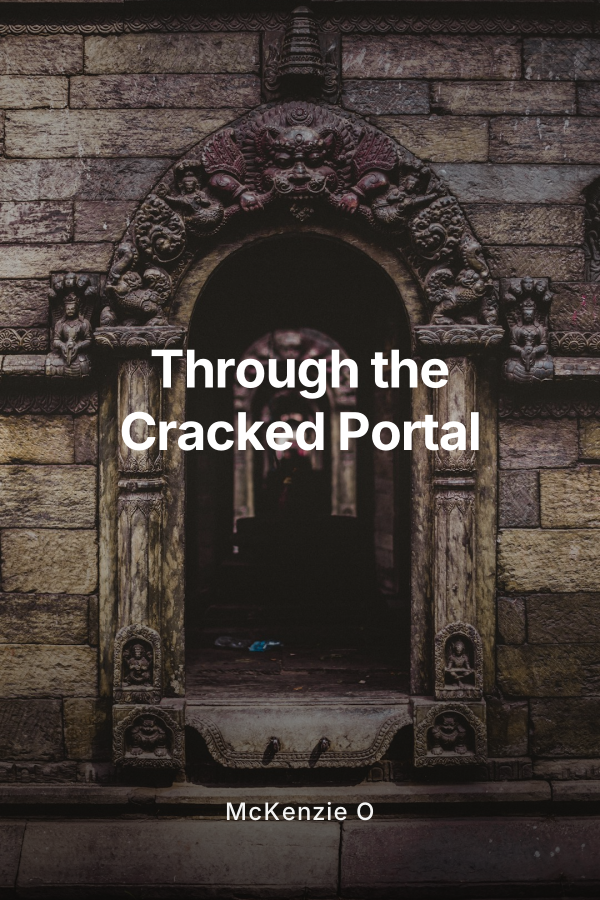
This book follows Alice, a perceptive but quietly anxious middle schooler whose vivid, unsettling dreams begin to mirror a terrifying reality at her school. When students start to disappear without explanation, Alice’s dreams become the only window into where they have gone and what hunts them there. Each of the eight chapters escalates the mystery, the danger, and the emotional stakes, guiding readers from ordinary hallways and homework into a twisted dream realm where memories bend, time breaks, and courage is the only way forward.
The story is structured to build suspense in layers. At first, Alice experiences a single disturbing dream that feels more real than imagination. She sees classmates trapped somewhere she cannot name, calling out in voices that half echo, half dissolve into static. She wakes with details that should not be possible: the color of a missing student’s shoes, a song that one of them hummed earlier that day, the way the school hallway looked at a time of night when she is never there. She tries to ignore it, but as rumors spread about a missing student, she realizes her dream was not just a nightmare. It was a clue.
Soon, more students vanish, and the patterns in Alice’s dreams sharpen into something like a map. Alongside a small circle of friends, she begins to connect fragments of information from these dreams to locations in their school. In the walls and floors that everyone else overlooks, the group notices odd, almost invisible flaws: hairline cracks where there should be solid paint, a strange cold spot in an otherwise warm corridor, the faint sound of whispering that no one else seems to hear. When Alice dreams again and sees, through a glowing slit in the air, where the missing kids are stranded, the friends understand that there is a portal hidden somewhere on campus, a threshold between their world and a darker one beyond. Yet the place she glimpses is impossible to recognize, even to her. She can see the children clearly, but the space around them defies names and directions. This uncertainty becomes both the clue and the threat.
As tensions rise at school, trust begins to fracture. Adults search in predictable places, form committees, and build theories, while Alice and her friends search for slivers of the impossible. They pore over floor plans, explore off-limits corners, and revisit the scenes from Alice’s dreams, looking for anything that does not belong. The pressure of carrying knowledge no one believes starts to wear on them. Arguments flare. Fear makes even simple conversations tremble. Yet when they finally find a small, jagged crack hanging in midair in a seldom used area, shimmering faintly like heat, they understand they have discovered the threshold to the place in Alice’s visions.
The portal is unstable, a fractured surface that looks almost like broken glass suspended without a frame. When they draw close, they feel their thoughts pull and stretch, as if the crack tugs at their memories. They hesitate, aware that crossing through might mean never returning. At the same time, the thought of their missing classmates suffering in that place hardens their resolve. Together, they widen the crack, prying it open with a combination of instinct, courage, and the strange logic Alice has begun to learn from her dreams. The moment they step through, the familiar world vanishes.
On the other side, the group finds a warped reflection of their school. Hallways extend in impossible directions, looping back on themselves yet never ending. Lockers float in shadowed, open space, doors lead to rooms that hold fragments of different times, and the building hums with echoes of every sound it has ever contained. The realm feels stitched together from scraps of memory, fear, and forgotten moments, and within it a supernatural creature moves with quiet, patient hunger. It uses illusions to manipulate the intruders, conjuring personal fears and painful memories to confuse and separate them. Each student faces scenes that feel tailored to their own private anxieties: the terror of being laughed at, the despair of being left behind, the humiliation of failure. The creature feeds on these emotions, becoming stronger as its victims grow weaker.
What elevates the story beyond a typical adventure is the role of Alice’s dreams as both threat and salvation. The same dreams that haunted her and revealed the portal hold the exact knowledge that can destroy the creature. Yet this knowledge is not simple information or a hidden object. It is a pattern hidden within images, a truth about how the creature formed and how the realm around it is held together. To defeat it, Alice must dare to look directly at what frightens her most, to consciously reuse the images and sensations that once paralyzed her in sleep. The group eventually discovers that by reenacting certain dream sequences, confronting rather than fleeing them, they can unravel the creature’s hold on the missing students and on the space itself.
This victory does not come without a cost. The group is shaken, exhausted, and deeply traumatized by the things they have seen and felt. Rescuing the missing children means guiding them back through a collapsing maze, pulling them away from illusions that feel kinder than reality, and forcing them to relive their fear in order to escape it. Even after they make it back through the portal, the darkness of that realm lingers inside them. They find themselves hyperaware of ordinary sounds and shadows, flinching at the sight of harmless flaws in the walls, second guessing every dream. Daylight no longer feels entirely safe.
In the aftermath, the students choose silence. Adults demand explanations, but the group knows that the full truth would be dismissed or misunderstood. Instead, the official story becomes incomplete and slightly false, assembled from what adults consider possible. The place where they found the portal is quietly avoided, turned into a spot everyone instinctively steers around. None of the rescued students will willingly return there, and even walking past it tightens their throats. Unspoken agreements form, and a shared fear seeps into the culture of the school. Everyone understands that something happened, yet almost no one understands what.
As the narrative moves toward its conclusion, the focus shifts from external monsters to internal scars. Alice must decide what to do with the knowledge that the boundary between reality and the other realm is thinner than anyone believes. She watches her friends cope in different ways: one buries themselves in schoolwork, another leans into humor, another grows distant and guarded. Their bond, forged in crisis, wavers under the weight of unspoken memories. At the same time, quiet hints appear that their ordeal is not entirely over. Strange notes surface in lockers, odd dreams visit more than one member of the group, and subtle anomalies in the school suggest that the portal was only one of many possible fractures.
The book leans into a tone that balances psychological tension with emotional depth, appealing especially to middle grade and early teen readers who enjoy eerie stories that respect their intelligence and emotions. While the supernatural creature and the warped realm deliver genuine scares, the core of the story remains grounded in friendship, responsibility, and the frightening power of knowledge. Alice’s journey charts the path from passive dreamer to active decoder of her own fears. Her evolution models the uncomfortable truth that sometimes the only way out of terror is through it, with eyes open.
Across its eight chapters, the book will explore: the slow buildup of inexplicable dreams and early disappearances; the strain of carrying secret knowledge; the discovery of the cracked portal and the ethical question of entering it; the disorienting traversal of the other realm; the psychological warfare waged by the creature; the revelation that dream knowledge can be used as a weapon; the high cost of rescue and return; and the complex, unresolved aftermath back in the ordinary world. The final pages will not tie every thread into a neat answer. Instead, they will leave readers with a lingering sense of both unease and possibility, hinting that Alice and her friends are only at the beginning of a longer, stranger path as quiet guardians against the fractures that connect their world to the dark.