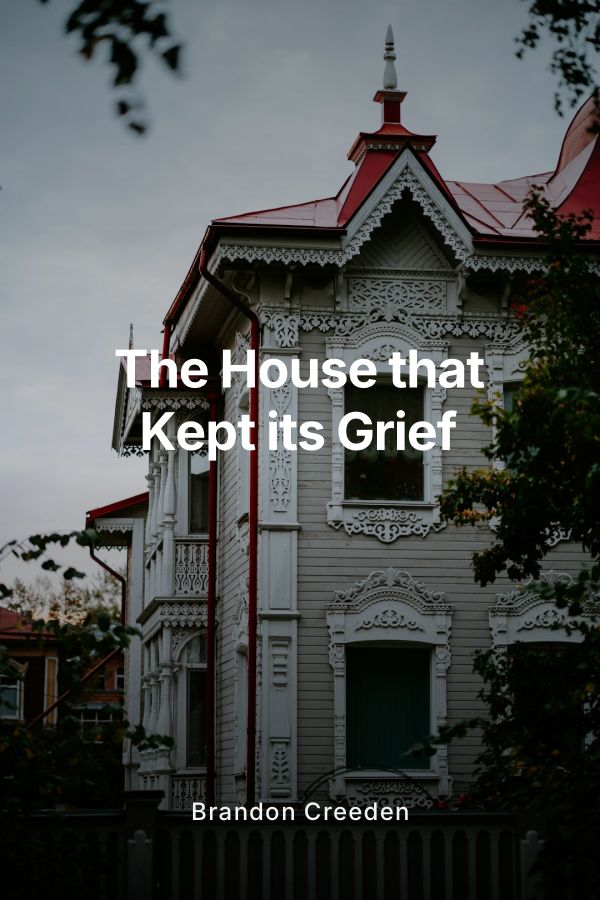
Only the first page of this book is left. We lost the rest in October 2026.
We lost access to the service that stored them, and no other copy exists. We're sorry.
In a country bruised by war and lean years, the Garrett family lives in a house that has learned the weight of silence. Petter returns from battle hollowed and wordless. Martha holds the home together with bread and needle and stubborn routine. Their children circle around absences they are too young to name, all of them living in the long shadow of the ones they have buried.
Into this house comes the box.
Carved by a reclusive carpenter who dies with it clutched to his chest, the box arrives without explanation, its wood etched with an iris for memory, a moth for passage, and a flame for love. It is placed on the Garrett hearth like a guest who never announces how long he intends to stay, and from that night forward, the house is never quite the same.
At first, the box is only a mystery. It hums at the edge of hearing. It slips into dreams. It sits motionless while grief moves restlessly around it. Petter keeps watch as if guarding a gate in the dark. William, fragile with fever, begins to see visions that feel less like fantasies and more like memories borrowed from another life. Martha, who has never trusted omens, finds herself unsettled by how right the box looks beneath their mantel, as though the room had been built around a space reserved for it all along.
As days stretch into seasons, the box becomes less an object and more a presence. It does not speak in words. It does not perform miracles. It simply reveals.
It reveals a lineage of love and loss carved into its grain. It reveals, through dreams and glimpses and quiet visitations, the woman it was made for and never reached, a figure in blue who walks the border between the living and the remembered. It reveals in Petter the boy he once was, in Martha the girl who still sings beneath her practical skin, and in William the strange, luminous inheritance of those who have looked directly at death and turned back with something burning in their hands.
The family begins to answer the box with their own creations. Petter returns to carving small, tender things instead of furniture for hire. William fills the house with figures that are more question than ornament: a child folded into a flower, a bird with no beak, a hand holding a ribbon. Martha, who has always mended what was torn, starts to write what cannot be sewn back together. She slips her bare, unpolished sentences into the box itself, as if it were a confidant that will not misplace what she is finally ready to say.
The box never heals them. It does not erase the graves they have stood beside or the nights they have sat through waiting for breath to steady. What it offers is quieter and stranger: it gives their grief shape. It turns sorrow from a formless fog into something that can be held, carved, arranged on a windowsill, read aloud, or left on a neighbor’s table where another pair of hands will recognize it.
When William’s carvings are taken into the village for a modest gathering, people who have never spoken of their losses find themselves lingering before a moth, a cradle, a faceless figure, and saying more in a few halting words than they have in years. The Garretts watch as their private ache becomes a kind of shared language. The box stays closed on the hearth, but its work travels outward through the objects and stories it has coaxed into existence.
Across twenty–five chapters, The House that Kept its Grief follows the Garretts as they learn to live beside a mystery that refuses either to explain itself or to leave. Each chapter traces the delicate movement from numbness toward a fuller, riskier kind of living: the tentative prayers of a father who no longer trusts words, the stubborn rituals of a mother who begins to suspect that survival is not the same as life, the awakening of a boy who must carry visions he did not ask for and cannot entirely refuse.
The box itself is never fully solved. Its origins are glimpsed in fragments: in the late work of the dead carpenter, in the counsel of an old woman who understands symbols better than doctrine, in rumors of other hands that have once lifted its lid. Yet the novel holds back just enough to keep the line between magic and metaphor blurred, inviting the reader to decide whether the box is a supernatural artifact, a vessel for memory, or the world’s way of paying particular attention to the broken-hearted.
Told in lyrical, luminous prose, the book inhabits kitchens and workshops, winter fields and fever dreams with equal intimacy. It treats ordinary gestures as sacraments: bread breaking on a rough-hewn table, a child’s palm tightening around a carved fox, a scrap of ribbon folded and refolded until its fibers remember every touch. Through these small details, the story suggests that the most enduring transformations do not arrive with thunder but with the quiet decision to stay open to what hurts.
The House that Kept its Grief is, at its heart, a meditation on how families live with what they have lost without losing one another. It is about the difference between being haunted and being accompanied, about the way beauty can arise not in spite of sorrow but hand in hand with it. For readers who have ever sat awake beside their own invisible box, wondering what to do with all that has been taken and all that remains, this novel offers a tender, unsettling hope.
Not the promise that wounds will close.
The promise that they can be carried, named, and sometimes, in the soft light of a hearth, shared.