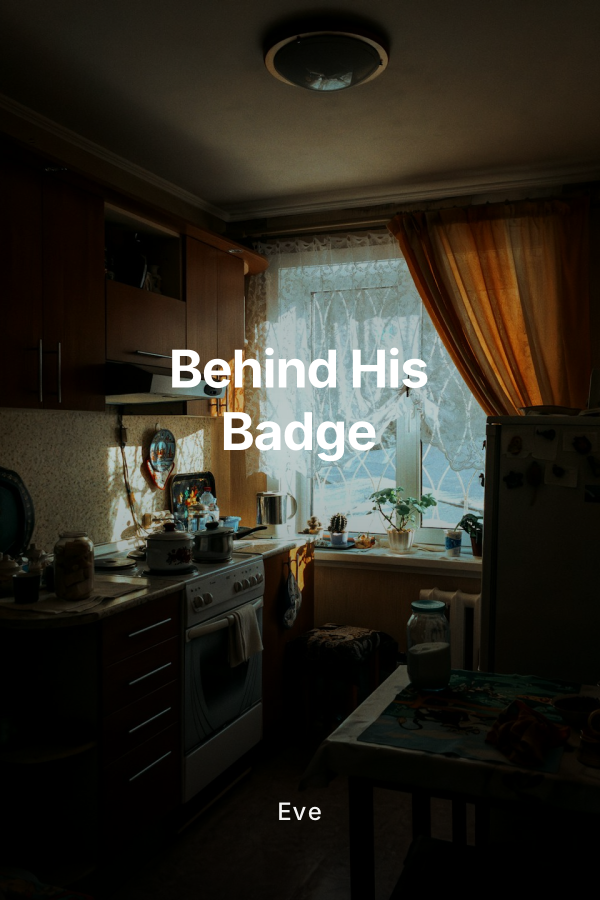
In a quiet English town where police sirens are rare and neighbours trust the uniform, Abigail Hartley is married to the man everyone calls a hero. Chief Superintendent Gary Hartley is the pillar of the force, the easygoing commander whose name inspires respect in briefing rooms and pub chatter alike. He is the man officers want to impress and the man the town believes would lay down his life for justice.
Inside the five bedroom showpiece of a house that his salary has bought, Abi knows the truth. Her life is not a partnership. It is a sentence.
Abi is thirty two and has no job, no money of her own, no friends allowed beyond carefully monitored pleasantries at the school gates. Her mobile is tracked, her clothes are chosen for her, every supermarket receipt examined line by line when Gary comes home. The Chief Superintendent does not tolerate secrets. He does not tolerate disobedience. He reminds her of this with his fists, his words, his control of her body, and the small dark cupboard she is locked in when she “forgets her place.”
From the outside, the Hartley children appear to live a dream. Twelve year old Oliver has the best boots on the football pitch. Ten year old William draws on an expensive tablet in his quiet corner. Nine year old Amelia pirouettes in brand new leotards, her medals lined up on pristine shelves. The house gleams, the tech glows, and Christmas always looks perfect in photographs.
Inside that house everything is fragile.
Oliver feels the weight of being the eldest son of the Chief. He is pushed to excel, to lead, to represent the family name. He knows that when the study door closes and voices rise, it is his mother who will carry the bruises. He is beginning to understand that his father can hurt people and walk away smiling.
William clings to his mother with a gentleness that Gary calls weakness. Sensitive, observant, and happiest at the edges of noise, Will notices the quiet flinches, the way Abi startles when a glass slips, the tremor in her voice when Gary’s car pulls up outside. He hears the apologies that follow muffled thuds. He learns early how to tiptoe through a minefield.
Amelia is Daddy’s angel. Gary softens for her, at least on the surface. He throws her in the air, cheers the loudest at her competitions, kisses her hair and tells her she is his heart. She loves her mother and hates the fear in the kitchen, but she is young enough to half believe the fairy tale her father performs. To her, the truth is a murky blur she cannot yet hold in full.
The town does not ask questions about the bruises that slip past Abi’s make up. The hospital staff know her name, and the officers on duty know better than to interfere with the Chief’s private life. Injuries become “falls down the stairs” and “clumsy accidents.” Reports are softened, photographs lost, questions cut short with a quiet word from a superior. A friendly detective escorts Gary out back for a cigarette while a doctor rewrites a chart under a nervous nurse’s gaze.
Behind His Badge follows Abi through a year in this house built on fear, told in her unflinching, exhausted voice. Each chapter strips away another layer of illusion. The story traces the routines of control that keep her trapped, from the morning inspections of packed lunches and cleaned floors to the night time assaults framed as wifely duties. It follows her through late night emergency department visits where she lies because the truth is more dangerous than the pain.
As pressure mounts in Gary’s professional world, his temper tightens at home. A high profile case puts his reputation in sharper focus. Officers crowd around him in admiration. Promotion whispers start to circulate. Any sign of imperfection in his domestic life becomes a threat. A misplaced receipt, a wrong purchase, a moment of visible fatigue turns into an excuse. The punishments escalate. The cupboard door closes more often. The bruises take longer to fade.
Abi’s only remaining act of rebellion arrives quietly. She starts to skim small amounts from the food budget. A few coins at first, later a few notes folded into a hidden slit in the lining of an old handbag at the back of her wardrobe. It is not a plan so much as a trembling instinct. A secret buffer, a hope that if one day everything tears open she might have enough for a taxi, a cheap hotel, some food for the children.
The book traces this tiny, fragile hope as it grows in the shadows of Gary’s control. Abi counts the money at night, heart pounding at every creak in the hall. She dreams of hostels and refuges she has read about on posters in waiting rooms. She scans faces at school gates, wondering which mother might believe her. She tells herself that if she can just reach a certain amount, she will run.
Because Gary is a Chief Superintendent, the world around them is inclined to trust him. A neighbour who hears shouting dismisses it after one friendly doorstep chat and a reminder of Gary’s long years of service. A teacher concerned about Will’s anxious drawings receives a charm filled assurance that Abi is “fragile” and the family is “handling things privately.” A junior officer who spots Abi’s fear in the ED corridor is quietly moved to a different station after asking one too many questions.
Every potential lifeline is thinned out by Gary’s reach.
The children drift closer to the edge of knowledge. Oliver overhears part of an assault and sees, through a crack in the door, the raw powerlessness of his mother on the floor. William finds a bloodstained towel stuffed deep in the laundry basket and starts having nightmares. Amelia notices that her mother sometimes winces when she hugs her too tightly, though she does not yet understand why.
When Gary eventually discovers the hidden money, the fragile bones of Abi’s resistance snap. The scene that follows is the brutal apex of years of abuse. It is not a sudden explosion out of character but an extension of a pattern the house has learned to endure. He reminds her of his position, of what he can do, of how fast help can be made to disappear. He reminds her of the reports that never see daylight, the colleagues who owe him favours, the doctors who look away. He beats her not just to punish the disobedience but to erase the thought that she could ever outmaneuver him.
The emergency department visit that follows is the worst yet. Concussion, fractures, deep bruising. A sympathetic junior doctor tries to probe, to ask more, but an older consultant steps in with a polite firmness. The notes are written in careful, neutral language. The narrative is shaped before Abi even finds the words. She leaves the hospital in a wheelchair under Gary’s guiding hand, the image of a devoted husband helping his accident prone wife.
By the end, Abi is still in that house. The town still praises the Chief. The officers still pat his back. The children still sleep in their separate rooms, hearts thudding at every raised voice, every footstep on the stairs. The money is gone. The hiding place is gone. The idea of escape has been beaten so far down that she can no longer look directly at it. On the surface she is calm, compliant, the perfect Chief’s wife again.
Inside, she is numb.
Behind His Badge refuses neat resolutions or sudden rescues. It shows how power can wrap itself in respectability, how institutions can be bent to shield an abuser, how a whole community can help hold one woman and her children in place without ever laying a hand on them. Abi’s journey is not toward liberation but toward a quiet, resigned understanding of the cage she is in.
Yet the book leaves a faint, unsettled trace rather than a tidy closure. Oliver’s eyes stay sharper, more watchful. William’s drawings grow darker, more detailed, revealing what words cannot. Amelia’s loyalty is slowly strained by things she will one day be old enough to name. The family remains trapped, but the narrative suggests that truth has begun to seep through the cracks, however slowly, however dangerously.
Behind His Badge is a gritty, intimate portrait of domestic abuse in the shadow of authority. It asks what happens when the man who enforces the law at work writes his own law at home, and what it costs a woman to keep breathing inside a life where even hope becomes a punishable crime.