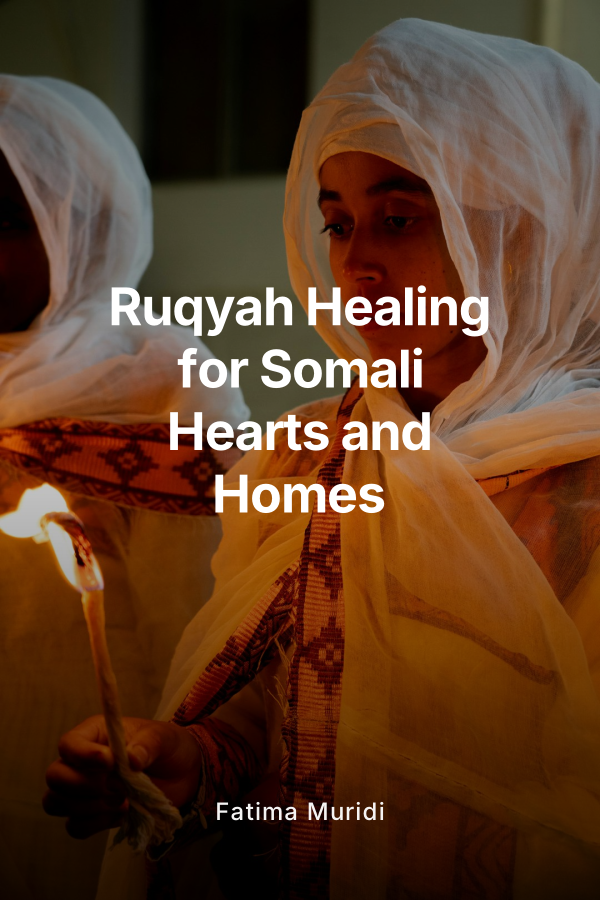
This book is a practical and spiritual manual for Somali families who carry both visible and hidden wounds. It guides them to use Ruqyah not as a desperate last resort, but as a consistent way of life that heals the heart, mind, body, and home by the permission of Allah.
Rooted in Qur’an, authentic supplications, and a clear separation from cultural superstition, the book shows Ruqyah as worship, tawakkul, and a return to Allah. It explains how generational trauma, unspoken grief, spiritual neglect, evil eye, sihr, and jinn interference often overlap with emotional pain that is dismissed as “just stress.” Instead of treating these struggles as shameful or imaginary, the book normalizes them as part of a spiritual battle that every believing family can face with dignity and knowledge.
Readers are taken step by step through a full daily Ruqyah routine for the whole family, from before Fajr until sleep. The summary offers simple, repeatable actions: reciting key passages with belief, blowing over the body and water, keeping wudū’, protecting the home with Surah Al Baqarah, and purifying speech and habits under one roof. It highlights how sins, media, arguments, and ظلم between family members can block healing, while repentance, dhikr, and gentle communication open doors to mercy.
A central theme of the book is that healing is a process, not an instant miracle. The summary prepares families for what really happens when Qur’an confronts buried pain. It describes expected reactions such as sudden sadness, crying, headaches, heaviness, nightmares, and mood swings, and reframes these as signs that the illness is reacting to the Qur’an, not proof that Ruqyah is harmful. Rather than quitting at the first wave of discomfort, readers are encouraged to continue, adjust, and lean more deeply on Allah.
The emotional side of Ruqyah receives special attention. The book speaks honestly to uniquely Somali wounds: harsh parenting, love expressed only through control or criticism, childhood neglect, strain between generations, and the silence that often replaces real apology or affection. It shows how Ruqyah pulls old memories and feelings to the surface so that they can finally be named, released, and replaced with compassion. Practical tools are introduced, such as sitting quietly with one’s own chest pain while reciting, crying as a form of cleansing, and speaking to Allah with raw honesty: “Yā Rabb, I am weak. You are strong. Heal me.”
The guide also addresses how anger, shouting, and resentment poison the spiritual climate of a home. It calls families to break the pattern of yelling and silent punishment, to make wudū’ in moments of rage, and to commit to small daily acts of mercy like listening without mocking, apologizing to children, and making du‘ā’ together. In this way, Ruqyah becomes more than recitation; it becomes a restructuring of the entire emotional tone of the household.
Throughout, the book emphasizes boundaries between pure Ruqyah and harmful mixtures with culture. It warns against incense rituals and folk practices that have no basis in revelation and can weaken protection. Instead, it promotes a clean, simple practice: Qur’an, du‘ā’, sincere tawbah, and trust in Allah, paired with practical steps like playing Surah Al Baqarah in the home, opening windows for fresh air, and keeping the environment free from open sin.
The conclusion reminds families that their journey will not all look the same. Some will feel relief within days, others across forty days, and some over many months. The timing belongs to Allah alone. What matters most is sincerity, consistency, a purified environment, and unwavering tawakkul. Healing is framed as a layered journey where each day of Ruqyah peels away something old, exposes another hidden wound, and gently builds a new, calmer heart.
The final du‘ā’ offered in the book captures its entire purpose: that Allah grants Somali families a complete healing that leaves no illness behind, whether seen or unseen. Through this guide, readers are invited to transform Ruqyah from a fearful reaction into a peaceful, daily path that cleans their homes, softens their hearts, and reconnects them with the One who heals all things.