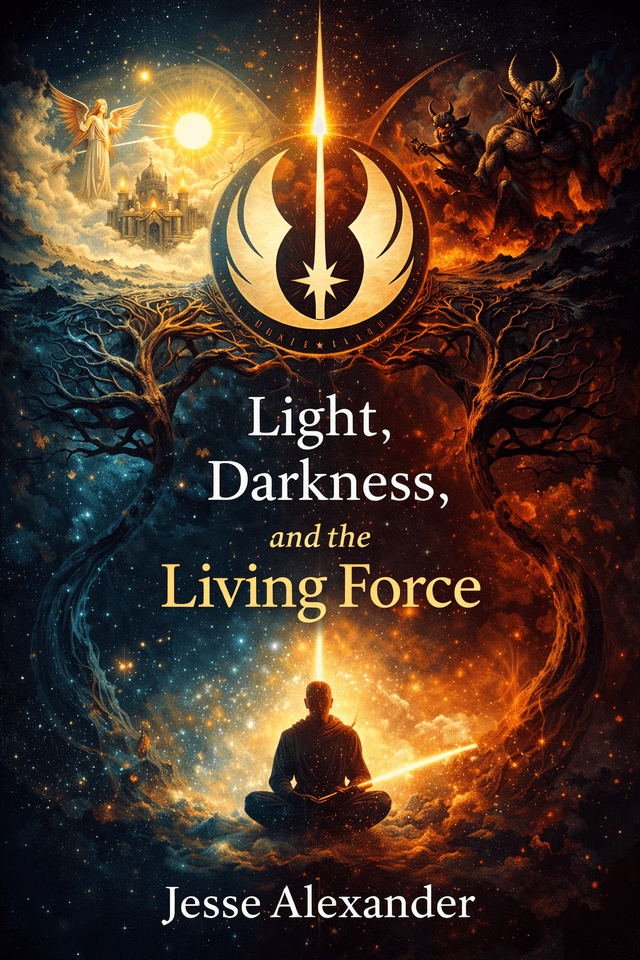
This book offers a sustained work of comparative metaphysics that unfolds the latent spiritual architecture at the intersection of ancient Manichaean cosmology and the mythic universe of the Jedi. It treats the Star Wars conception of the Force not as a closed fictional system, but as a contemporary symbolic grammar through which perennial questions about spirit and matter, good and evil, embodiment and redemption can be rigorously reconsidered.
Rather than rehearsing familiar popular narratives, the book reconstructs a layered philosophical framework. It begins from the Manichaean affirmation of two coeternal principles, Light and Darkness, understood as ontological modes of being rather than merely moral categories. Light signifies intelligibility, relational harmony, and the very possibility of meaning, while Darkness designates fragmentation, opacity, and alienation. The Force is reinterpreted through this lens as the manifest field in which these principles encounter one another, and in which consciousness must choose between complicity with distortion and cooperation with liberation.
Chapter 1 situates the project within the wider study of myth and metaphysics. It introduces the guiding claim that modern mythic worlds can function as laboratories of religious ideas. Drawing on the Manichaean vision of a cosmos structured by radical dualism, the chapter argues that one can map the Realm of Light onto a reimagined understanding of the Living Force as the luminous ground of being, while the Realm of Darkness illuminates the conditions that give rise to the Dark Side. This mapping is not an arbitrary analogy but a disciplined comparative move that exposes how both systems wrestle with the same foundational problems, such as the status of evil, the unity of reality, and the place of finite agents within a fractured world.
Chapter 2 reconstructs Manichaean cosmology on its own terms, before bringing it into dialogue with Jedi mythology. It examines three core doctrines: the dualism of Light and Darkness, the cosmological drama of the Mixture in which particles of Light are scattered through matter, and the eschatological process of separation in which Light is gradually released. In parallel, the chapter revisits pivotal moments in the Star Wars narrative as symbolic enactments of these themes. The post–Order 66 galaxy, for instance, is analyzed as an image of the Mixture where meaning is fragmented, institutions are co opted by domination, and spirit is subordinated to systems of control. In this framework, the Jedi emerge not primarily as military actors but as agents of metaphysical clarification whose true vocation is to free Light wherever it is trapped.
Chapter 3 develops the metaphysics of Light and Darkness in more precise philosophical terms. Light is articulated as the condition of possibility for truth, relation, and ethical responsibility. It corresponds to a mode of being in which each entity is transparent to meaning and open to participation in a wider order. Darkness is not treated as a rival substance, but as a deficient mode of appearing characterized by privation, distortion, and opacity, in which consciousness identifies with fear, domination, and separateness. In this respect, the analysis draws on and critically reworks classical accounts of evil as privation and existential accounts of alienation, while insisting that these are to be read through, rather than imposed upon, the comparative material. The Dark Side represents a style of existence in which beings misrecognize dependence on the Living Force as an opportunity for control, thereby deepening the Mixture instead of cooperating with its healing.
Chapter 4 introduces the symbol of the Manichaean Cosmic Tree and reinterprets it in Jedi terms. Traditionally understood as the mechanism through which Light ascends back to its origin, the Tree is recast here as an image of the living web of relations that constitute the cosmos. The chapter argues that Light moves “upward” not along a literal spatial axis, but along gradients of awareness, ethical responsibility, and contemplative clarity. Human and non human agents participate in this ascent whenever they minimize harm, reduce attachment, and cultivate compassion. Translated into the language of the Force, the Cosmic Tree becomes a figure for the interconnectedness of the Living Force, within which every choice either thickens the opacity of Darkness or facilitates the transparent flow of Light. This reconceptualization provides a bridge between metaphysical speculation and concrete ethical life.
Chapter 5 unfolds a temporal dimension through the Manichaean schema of the First Time, Middle Time, and Final Time, and then aligns this with the narrative arc of the Star Wars universe. The First Time names a primordial metaphysical balance in which Light and Darkness remain distinct, prior to conflict and mixture. It is not history but a conceptual origin that grounds the very possibility of order. The Middle Time corresponds to the fractured present, marked by embodiment, finitude, and struggle. In Jedi imagery, it resonates with the imperial era in which the Order is scattered, and practice becomes discreet, contemplative, and strategically indirect. The Final Time is then reimagined not as a catastrophic end, but as an eschatological fulfillment in which relations are purified and Darkness loses its capacity to ensnare. The restoration of balance to the Force is read as the gradual dissolution of illusion through understanding, compassion, and reconciliation.
Across its five chapters, the book maintains a formal academic tone while aiming to construct a spiritually resonant system. It treats Jedi figures as paradigms rather than heroes, emphasizing their contemplative, relational vocation instead of their combat proficiency. Violence is acknowledged as sometimes unavoidable in a world of Mixture, yet it is presented as a tragic concession rather than a spiritual ideal. To live as a “Jedi–Manichaean” in this conceptual framework is to commit oneself to the slow work of clarification: perceiving the presence of Light within every situation, resisting structures that amplify fear and domination, and cultivating practices of attention that attune perception to the subtle movements of the Living Force.
The book concludes by arguing that this comparative synthesis illuminates a shared anxiety within both Manichaeism and the Star Wars mythos, namely, concern for the fate of consciousness in a cosmos seemingly prone to fragmentation. By juxtaposing an ancient religious system with a modern mythic narrative, it becomes possible to see how each can correct the other’s distortions and extend the other’s insights. Manichaean cosmology supplies a rigorous metaphysical architecture, while Jedi mythology provides a vivid dramaturgy through which that architecture becomes existentially immediate. Together they offer a vision of spiritual life as participation in an ongoing work of liberation, in which every act of clarity and compassion contributes to the slow restoration of balance within a fractured universe.