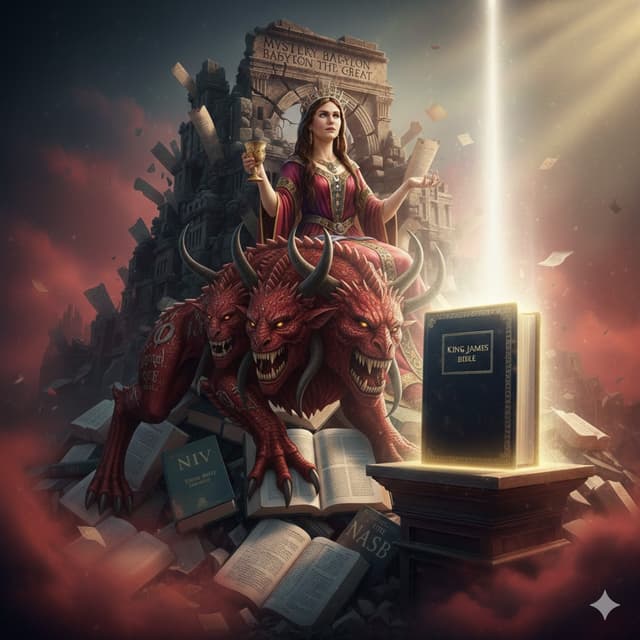
The Last Bible: Mystery Babylon, Modern Versions, and the Final War for the Word of God
Introduction
The Bible is not simply a book among books. It is the written voice of God to His people—the standard for faith, the rule for practice, and the instrument by which sinners are confronted and saved. For Bible believers who hold to the trustworthiness of Scripture, any attack on the words of the Bible is an attack on the power of God to save. This book is written out of that conviction and out of a deep concern: we are living in a generation in which the very words of Scripture are being nudged, edited, and in some cases removed—and the effects are dangerously spiritual.
The central claim of this book is direct and urgent: the modern movement to rework the biblical text and produce ever‑changing English versions is not a neutral academic exercise. It flows from a lineage of skepticism that began with German rationalism and the Enlightenment and has been passed down into modern textual criticism. That spirit of doubt treats the Bible as a problem to be solved rather than the Word of God to be believed. The result is an “unsettled text” mentality that justifies continuous revision. And where the text is fluid, doctrine will be weakened, the gospel will be blurred, and the church will be easier prey for the spiritual counterfeits of the last days.
Mystery Babylon is a prophetic motif for a religious power that will deceive the nations by offering a palatable, syncretistic form of worship—one that will unify many at the cost of truth. A Bible crafted to be acceptable across religions and philosophies is precisely the tool such a system would welcome. Softened language about Christ’s person, His blood, and His atoning work—whether by omission, doubtful footnote, or altered rendering—prepares hearts to accept a counterfeit Christ who promises peace without true repentance and unity without holiness.
Why this matters now
For generations, English‑speaking Bible believers have relied on a settled text in public worship, preaching, and family devotions. The King James Bible served as that public, steady text: pastors could preach with confidence, parents could teach their children the language of repentance and faith, and the church could hold fast to clear doctrine. That confidence depended on the conviction that God had providentially kept His Word by means of the believing community. When that steady stream is treated as merely provisional—when scholarship presents an ever‑shifting reconstruction of “original” words—the church’s footing becomes uncertain.
Modern textual criticism did not arise in a vacuum. Its assumptions track back to men who first questioned the supernatural claims of Scripture and then reconstructed the Bible to fit naturalistic presuppositions. The methods that flow from those presuppositions—prioritizing fragmentary manuscripts, speculative conjectures, and committee consensus—produce a text that changes with scholarly fashions. That process has real pastoral consequences: it obscures who Jesus is, what His blood accomplished, and what the believer may confidently expect from God’s promises.
What this book argues
The Bible must remain the settled foundation for the church’s doctrine, worship, and mission. When the words are shifted, trust and clarity give way to confusion and compromise.
Two paths now compete for the church’s allegiance: the received, preserved textual stream that has formed evangelical faith historically (embodied for English speakers by the Authorized King James Bible), and a critical, reconstructive stream that treats the text as unstable and continually improvable. These are not merely scholarly alternatives but spiritual choices.
Modern critical methods have roots in unbelief and a philosophy that mistrusts God’s preservation of His Word. Those roots explain why critical tendencies often lead to doctrinal softening on the person and work of Christ.
The drift toward a neutral, ecumenical Bible suits Mystery Babylon and the rise of Antichrist. When the Bible’s sharp edges are blunted, false teaching finds a foothold and unbelieving hearts are more easily seduced.
The church must resist cultural pressures for an “all‑welcome” Bible and instead hold fast to a text that names sin plainly, proclaims Christ fully, and calls for repentance.
How this book is arranged
Part I lays out the prophetic stakes and explains why Scripture sits at the center of last‑day conflict. It introduces Mystery Babylon as the religious power that seeks unity at the price of truth and shows how a compromised Bible serves that agenda.
Part II traces the rise of modern textual criticism, its philosophical roots in rationalism and skepticism, and how those presuppositions reshaped the work of scholars and translators, producing an unstable critical text and a stream of modern versions.
Part III examines doctrinal consequences: how small textual decisions affect the doctrine of Christ, the meaning of His blood, the reality of judgment, and the believer’s assurance. It shows how ambiguity in words becomes ambiguity in doctrine.
Part IV calls the faithful to stand. It surveys the spiritual fruit of a settled Bible in preaching, missions, and family life; it honors the pastors, scholars, and laymen who hold to a sure text; and it offers sober pastoral counsel for churches navigating these perilous times.
A pastoral challenge
This is not a book for cynics or for those who delight in controversy. It is a call to vigilance. The age of the end‑time apostasy demands that God’s people know their Bible and love it—not as a human artifact to be endlessly improved but as the revealed, preserved Word that brings sinners to Christ and equips the church to stand. We must be able to say with conviction, “Thus saith the Lord,” because those words still mean something.
If the Last Days bring a final assault on the Word of God, then faithful Bible believers must refuse compromise. We must teach our children the language of repentance and substitutionary atonement; we must preach Christ in plain terms; and we must not hand the world a Bible neutered to please its gods. The measure of our faithfulness will be whether we love God’s words enough to guard them.
Read this book with prayer. Test its arguments against Scripture itself. Let conviction lead to careful, humble action rather than merely angry reaction. The stakes are high; the hour is serious. If the enemy seeks a Bible fit for Mystery Babylon, then the church must stand as a people who will not exchange the truth for a lie.
Let us begin.