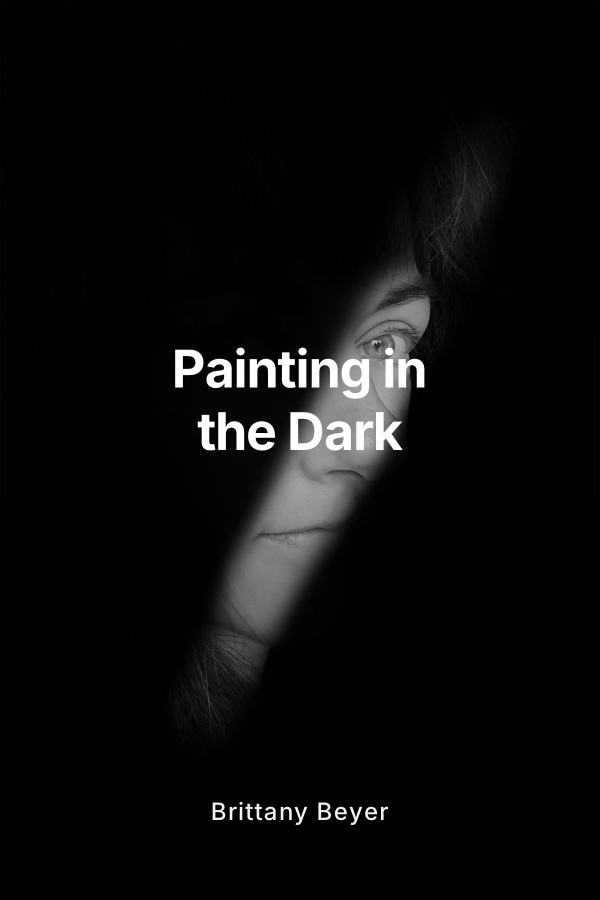
This is the story of a woman who learned to see beauty in what was never meant to survive the fall.
"Painting in the Dark" is an unflinchingly honest autobiography told in reverse. It begins in the dim, quiet room where the author now paints with the lights off, hands moving over broken objects she has rescued from the trash. From this present moment in recovery, she walks us backward through the wreckage and the rebuilding, revealing how each shattered thing she upcycles into art mirrors a part of her own life that was cracked, discarded, or violently taken.
Part personal testimony, part intimate studio diary, this book traces the way she transforms splintered wood, crushed metal, ripped fabric, and forgotten household scraps into raw, arresting pieces of art. Every work begins as something someone else decided had no value left. Every work becomes a small act of refusal, a way of saying, "You were wrong about what is worthless. You were wrong about me."
Content warnings come plainly at the start, not as an apology but as a form of care: this story holds sexual violence, rape, self abandonment, family rejection, and the hard, messy truth of recovery. The author does not write around these realities. She writes through them, returning again and again to the same question: what do you do with what you cannot undo?
Across four chapters, each split into two deeply personal subchapters, she revisits the major phases of her life through the lens of her art:
Chapter One opens in the present, with her hands in the dark over a work in progress that captures who she is now. She shows us what it feels like to create with almost no light, on purpose, so she cannot pick herself apart in the way she has always done. The first subchapter stays in that scene, in the breath by breath work of not overthinking and simply letting color and texture move. The second subchapter pulls back the curtain on her current stage of recovery, naming the quiet daily wars with shame, numbness, and the urge to disappear. The broken objects she uses today become symbols of the parts of her she has finally decided to keep.
Chapter Two steps back into the years when her sense of self really began to fracture. One subchapter centers on the violence that changed everything: being raped and learning, painfully, how the body remembers what the mind would rather forget. Here, the broken objects are sharp, dangerous, and hard to touch. Twisted metal and cracked glass hold stories she never wanted to tell, yet cannot heal from by staying silent. The second subchapter moves into the aftermath, the long echo of that harm, where she tried to outrun her pain instead of tend to it. She explains how her early pieces from this period were clumsy, jagged, and often destroyed before anyone could see them, because she had not yet learned how to let anything broken remain visible.
Chapter Three goes further back into the landscape that shaped her before she had words for trauma. The first subchapter explores childhood and adolescence, focusing on early creativity, the instinct to make beauty from scraps, and the slow dawning awareness that the people who should protect you can also be the first to teach you you are disposable. The second subchapter dives into one of the deepest wounds: a mother who threw away her artwork. That single act becomes a recurring image, a kind of private myth she has to unlearn. It is here that readers see how easily a child begins to believe that their voice, their vision, their very self is trash to be taken to the curb. The broken objects in this phase are small, almost fragile: plastic toys, torn pages, things that never got to finish becoming what they were.
Chapter Four turns toward the complicated, non-linear path of healing. In the first subchapter, she maps the early days of recovery, where reaching for help felt like admitting defeat, and where making art was less a choice and more a lifeline. She writes about nights where she nearly stopped, and the single cracked plate or mangled hinge that kept her at the table. The last subchapter brings the reader back to the present room in the dark, but with newly earned context. We see how far she has come not because she is "fixed" but because she no longer demands that of herself. Here, she lays out the quiet manifesto she has pieced together: that brokenness is not proof of failure, that repair can be creative instead of invisible, and that beauty is often most honest where the seams still show.
Throughout the book, each life phase is paired with a series of artworks, each born from a broken object and a particular moment in time. She explains the meaning behind these pieces, not as a critic would, but as someone talking to a trusted friend late at night. She lets readers into the private logic of her studio: why she chose that rusted screw, why that ripped T shirt had to be cut into strips, why she buried specific memories under layers of paint and let others remain exposed. She does not romanticize suffering, but she refuses to let it be the final word.
"Painting in the Dark" is not a how to guide in any formal sense, yet it quietly offers a path: take what has been broken, hold it long enough to hear what it asks to become, and give it a second life that you control. The author never pretends this is easy. She admits the days she cannot bear to touch certain materials, the nights she paints in the dark not because it is poetic but because the sight of her own hands makes her flinch. She admits the temptation to throw her own work away, mirroring what was done to her.
What makes this memoir different is not just its rawness, but its refusal to separate the inner story from the physical objects that carry it. The broken chair leg, the shattered mirror, the abandoned frame are not metaphors tacked on after the fact. They are co authors in her recovery, stubborn evidence that something can be cracked wide open and still hold weight.
Readers who have felt discarded, violated, or told they take up too much space will find here a language for their own fracture. Those who have never lived through these specific harms will be invited to witness without prying, guided by clear content warnings and the author's own pacing. She makes space for people to put the book down, to come back later, to skip a scene if their own nervous system needs gentleness.
In the end, "Painting in the Dark" is a testament to what happens when a person chooses not to hide the broken parts, but to arrange them into something that tells the truth. It is about learning to trust your hands more than your self criticism, your body more than the stories forced onto it, your art more than the people who taught you to doubt it.
This is a book for anyone who has ever stood over the trash can, holding something that hurt them and wondering whether to throw it out or try one more time to turn it into something else. The author does not promise that making art will save you. What she offers instead is her own lived evidence that paying attention to what you usually discard can change the way you see everything, including yourself.
By the final page, the dark room where the story began feels different. It is still quiet. The lights are still off. But the person inside it no longer believes that being broken makes her unworthy of being seen.